RSS Feed

Category Archives: Laneway House

The Grandma who lives down the lane

Hot on the heels of my previous post about ownership of our laneway comes this article on the Senior Living website.

The “canny senior” , Ann Eynon has built a laneway on her daughter’s property (such a clever idea!). She says

“It’s lovely to free up the cash rather than sitting on it,” she says while pouring over travel brochures. Where to go next?

Exactly!  Plus there’s some info on how different families are handling the ownership “situation”.

 Some families enter into joint ownership; others agree to forgivable loans. Put everything in writing, especially when adult children are involved……… amortizing …payback over 25 years and clarifying a payout schedule if, or when, the unit changes hands.

Or, if no payback is expected, as in Ann Eynon’s case,

she made sure everybody understood her situation before she broke ground. Ann will have her laneway house appraised and then assign percentages of its value to each of her two children.

Read the article for the full story.

Living on borrowed land

I was showing a friend the plans for the souped-up kitchen in the laneway house (more on that in a future post) and even dragged out the little square of wood veneer to show how the cupboards will be finished. She oohed and aahed, I kvelled, it was a pleasant time.  Then she said “It just makes sense to spend money on the kitchen, because of the resale value.”

And just like a needle being dragged across a record, the conversation veered off from cozy decor to cold hard facts.

We are paying for the laneway home to be built.  And we’ll be spending a little more than absolutely necessary to get exactly what we want in the way of finishes, appliances and building materials. And we will live in it.  But we won’t own it. The owners of the main home on the property own the laneway house as well. That’s the rule.

All our money is buying us is the right to live in the house until…..we don’t want to live there anymore.

Oh, we’ll get our money out of it.  Eventually the property owners (DD and DSIL) will eventually start making payments to us for the amount we paid to build the home — but no more, no matter how much the property may have appreciated in value.

It works out very well for us all.  They get a free babysitting at hand, we can share shopping trips, it’s a nice convivial living situation for everyone involved.

But we are stepping off the real estate merry-go-round forever.  And that’s the way we want it.

We cannot have our cake and eat it, too.  We can stay in this condo and watch it go up in value every year, but we can’t take that money and use it.  Yes we are sitting on the proverbial gold mine, but that’s just it, we’re sitting on it, not mining it.

Building the laneway home gives us a chance to live mortgage-free in a lovely neighbourhood in our favourite city in the world.  Next to the nicest neighbours we could imagine.

What more could we want?

It’s good news and bad news……

The folks at LaneCraft homes blogged today on the evolving rules surrounding Laneway Home construction.

While it’s good that there is continuing discussion about laneways, and methods of making them more popular not just with the home-owners but also with their neighbours……there are current talks with the city about the problem with parking.

It’s true that most people who build enclosed parking spaces for their laneway homes are using them for living space.  And that means that they have to use street parking (or pay for parking elsewhere).  But for us, if they change the rules in mid-stream, it is going to mean problems.

Right now we have an enclosed parking area in our laneway.  There is a proposal that laneway homes should also include another space.  To quote LaneCraft:

To address the issue, the City is proposing to require an unenclosed surface parking spot when building a laneway house. This would address the issue by ensuring at least one on site parking spot, but, by reducing the buildable footprint (keeping current setbacks and height limits in place), would create more challenges in designing liveable spaces.

Creating more challenges right now would send our designer back to the drawing board and delay start on our project.  I hope nothing happens in the next few weeks to jeopardize our current design receiving a building permit.

I feel for the city and their wish to reduce street parking.  But no one wanders up alleyways with a flashlight to make sure that every garage contains its quota of automobiles, and has not been converted to a workshop, a studio, or even a storage area.

Where will you put everything?

When I show people the plans for our place (which I am apt to do at the drop of the proverbial hat) one of the first things they ask is “Where will your stuff go?” And I say “Mostly the Salvation Army.”  Because, of course, we have to get rid of SO MUCH.

We have already begin this winnowing process, and it’s like getting rid of a huge weight ounce by ounce as things disappear from our cupboards and our closets.   I think I’ve mentioned it before, but this is more than a change of address, it’s a change of lifestyle for us.  Buy fewer, better things.  Throw stuff out.  Keep just what you need, not what you think you might need next year, or what you needed two or three years ago.  Come on, I know I’m not the only person who hangs onto winter coats long after they should have been passed on to some deserving soul at the IODE shop.

How many of us have closets for the clothes we wear now, and closets stuffed with clothes we used to wear and might again if we can lose 15 pounds or if shoulder pads come back?

But we will still need to put things away– or more accurately we need to HIDE things away.  Dishes, books, cat food.  And that means built-ins.

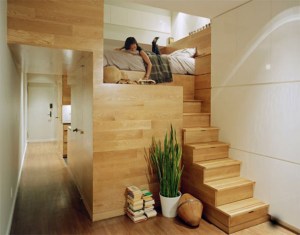
Built-ins are the go-to choice for small-home decorating.
20130201-1


Super built-in apartment, with storage under the bed loft and in the stairs.  That other room you can glimpse down the hall is the kitchen — completely built in, of course.
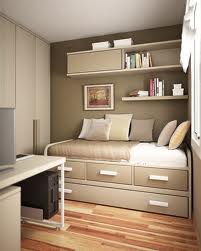
20130201-2

Storage under a built-in bed. Good idea for a very small bedroom.  We’ll have storage under our bed, who could ignore that great storage area?  But we won’t have room to pull out drawers on the side (bed fits snugly with just a foot of space on either side), so we’ll have a lift-up hydrolic arrangement that will give us access to the space beneath.

20130201-3Here’s a nice wall of built-ins from Apartment Therapy.  See that blank space between the windows with just the small green cut-out?  That entire panel flips down and rests on the little green cabinet you see on the right to make a large dining table.

Have you seen any great built-ins?  What do you think?  Keep them the same colour as the walls, or make them stand out?
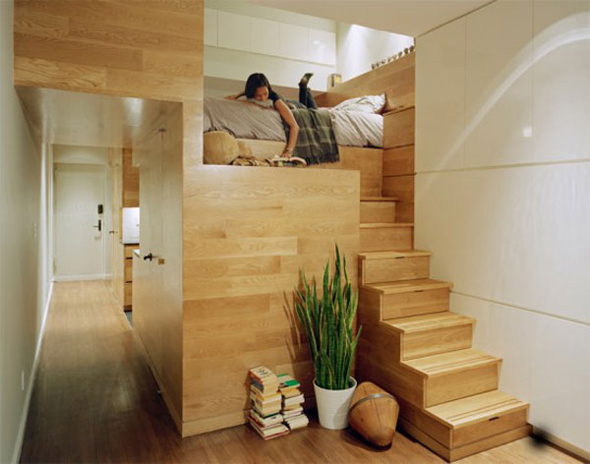
 

Good bye to all that…..

One of the reasons we are looking forward to the laneway living experience, is because we have to rid ourselves of extraneous “stuff”.  That is a good thing.  As Wordsworth says

THE world is too much with us; late and soon,
Getting and spending, we lay waste our powers:

Others have gone before us, and show us the way.

Sherry Willis of the Half-Pint Homestead blog writes about it on the Tiny House Blog.  Like her, we must begin

the complicated process of extricating ourselves from our possessions.

And that’s what it’s all about, isn’t it? When we hold on to “things”, no matter how precious they seem to us at the time, we are owned BY them.

But most advice I get on how to de-clutter seems to be geared to clearing the mess that we can see — hiding away the untidyness and detritus of our lives.  But we want to get rid of it.  Forever.  Banish it from our lives, so we can live so much more simply.

That’s why I like what Laura Norcross has to say about winnowing her wardrobe at Tiny House Talk.  It’s a process.  Do it once, twice, how many times you need to say good-bye to things that you don’t need any more.

Good advice for our new lives, not just our new living space.

More small homes planned for Vancouver

According to this story on Vancouver radio station CKWX, there are a record number of permits  for laneway houses approved for this year.

The City issued a record 350 laneway housing permits in 2012, a big increase from the yearly average of 146 recorded between 2009 and 2011.

It’s not a fad — it’s a movement!

Notice anything different?

About the blog? *

It’s now at ladywholivesdownthelane.com, no “wordpress” in the address — I bought the domain.

When I first started the blog it was just supposed to be for fun, so my family and friends could check up on the progress of our laneway house project.

That was before I became obsessed interested with the whole “living small” movement.

Then I had the radio interview and I thought it would be nice to hear from more people — much easier to find me when I’m just the ladywholivesdownthelane.

Plus I wanted a way for others who are interested in laneway housing —  or actually living in a laneway house — could contact me.  I think it would be very nice if we could form a virtual neighbourhood of laneway occupants. And that would mean reaching out to people who left me comments.

I found out that, with the wordpress domain blog you have to register to leave a comment, and I know some people are reluctant to do that.  I know I am.  So, in order to be more inclusive, it would be better to have my own domain.

So here it is!  Expect a few more changes — some links to other sites I think you’ll find interesting, etc. I’m just starting to explore the capacity of the new arrangement.

*By the way, the correct answer to “Notice anything different?” is always “Have you lost weight?”.  Always.

Custom or off-the-shelf?

One of the reasons we are looking forward SO MUCH to our new laneway home is because every bit of it will be designed and built specially for us by Novell.  Do we want drawers in the stairs for shoe storage? It shall be done.  Sitting room and kitchen upstairs? Our wish is master to their deed.

But some people don’t want to spend the bucks on a custom home — or don’t need to.  They just want a rental unit or a studio that can house friends or visiting relations.

You can still buy a standard plan from one of the laneway builders in town.  OR, if you really want to save money, go with a pre-fab.

PacificOutbuildingsWestcoast Outbuildings will sell you a pre-fab home like the one above for less than $35 grand.  (That doesn’t include permits, electrical, plumbing, or appliances, natch, and I don’t think it includes installing the concrete pad it rests on).

It’s not for everyone, but don’t think you are priced out of the laneway home market just because you can’t — or won’t — pay for a custom build.

Just a caveat — I ran across the Westcoast Outbuildings website and thought I would tell you about it.  I haven’t had any contact with them and of course, I’m not taking any money from them.  Also, I can’t confirm their claims that you can get a permit to build or live in one of their projects.

An affordable apartment in New York — can it be true?

From Houzz (see, I told you to subscribe) comes the story of what New York City is doing to create affordable living.

New York’s problem was not the same as Vancouver’s.  On the surface it’s just too few places to live.  But New York needs more spaces for singles and couples, not necessarily families.

In July 2012 New York City’s Department of Housing Preservation and Developmentlaunched an adAPT NYC competition to develop a building with microunits on a city-owned lot in Manhattan’s Kips Bay neighborhood. The competition was spurred by the changing demographics of the city, which now has 1.8 million one- and two-person households (comprising more than 20 percent of its 8.4 million residents) but only 1 million one-bedroom and studio apartments. Furthermore, the current zoning code restricts the size of apartments and their density (number of units per lot), making it impossible to build small units for singles and couples.

Today, Mayor Michael R. Bloomberg announced the winner of the competition at the launch of the Museum of the City of New York’s Making Room exhibition, which also explores small apartments in the city through design. A team made up of Monadnock Development, the Actors Fund Housing Development Corporation and nArchitects won with their My Micro NY entry. Here are details of the winning design.

Sizes start at 250 square feet, with an innovative design that makes it seem like much more.

Going smaller is not always the answer

I have been singing the praises of living small for years — and on this blog for months.  But the problems that Vancouver has with housing its citizens cannot be solved by building a few (or a few hundred) laneway houses.

For us, it’s the perfect solution — there are two adults in our immediate family (and two indoor cats) and we are certainly not planning to add to that number of people or cats in the future.  We are building our new laneway house in the garden of a comfortable home for a small family.  There is potential in that home for building more bedrooms and baths in the walk-out basement — or even pushing up the roof to create space above the existing top floor — and thus accommodating more children.  But the owners of that home have two  good incomes.  What chance do people with less than they earn have of finding a nice, roomy home to buy?

Very little chance indeed. Even in the areas that used to be a viable alternative for working class families — the suburbs.

And as Frances Bula says in this article, the “solution” to the housing problem everywhere seems to be to build more and more smaller and smaller homes.  Not suitable for families with several children.  And that trend can have long-reaching consequences for communities.

“We’re hearing this all the time now, that developers want to build more single-bedroom units, more small two-bedrooms,” Coquitlam Councillor Terry O’Neill said.

Last month, the Beedie Group, which is developing the Fraser Mills megaproject on Coquitlam’s Fraser River shore, asked to increase the number of units in its proposed development to 4,700 from 3,700 without changing the overall four million square feet of allowed building space.

That would mean shrinking the average size of the project’s units to 865 square feet from 1,100. It worried many Coquitlam councillors.

“The concern we heard was not about parking, not about extra population. It was about ‘What’s this going to do to the nature of the city?’” Mr. O’Neill said. “If it’s all small units, you’re just going to end up getting couples. We want to make sure there are a substantial number of units that will attract families.

Let’s see if any cities come up with good ideas for attracting and keeping families inside their borders.

My Pain, My Life, My Struggles, My Fight

Come walk with me, Down My Dark & Stormy Journey BUSINESS INQUIRIES & CONTACT EMAIL : GODSCHILD4048@GMAIL.COM

ANNOTATED AUDREY BLOG

Artist and Desert Dweller with Big City Style.

Im ashamed to die until i have won some victory for humanity.

Domenic Garisto / LIFE IS NOT A REHERSAL,SO LIVE IT..if you can't be the poet, be the poem..havau22.com

The Lady Who Lives Down the Lane

Lane Way Housing for the Nervous Novice

Apartment Therapy| Saving the world, one room at a time

Lane Way Housing for the Nervous Novice

Slightly Snug House

building a home that's not too big and not too small

Vancouverandy

Funny thoughts from a nut like me.

Small House Bliss

Small house designs with big impact

WeeHavyn

Lane Way Housing for the Nervous Novice