RSS Feed

Author Archives: ladywholivesdownthelane

Keeping it cool old school

Being part of the design process for your home means making decisions — and compromises.

DH and I had a bit of a struggle over air conditioning.  Neither of us can handle the heat in the summer — we tend to wilt around 25° C. And as for sleeping in a hot, humid room – well, it ain’t gonna happen.

Fan

DH wanted air conditioning for the laneway.  I did not.  I think we can keep the space cool through the summer using what we have, and not use more energy cooling off the place.

On his side of the discussion — summer.

On my side — windows on all four sides of the house, so we’re sure of getting a cross breeze, upstairs and down (our ex-condo had windows on one side of the building — north — so no chance of a cross breeze). Plus the house is built facing full south, but the sun does not hit the windows after 5 pm (this far in the year) so we don’t get the hot rays of the setting sun streaming in. We can close the blinds on the south and east sides of the upstairs to keep the hottest sun of the day out.  Plus we have fans to blow cooling breezes (when available) throughout the house, and we can move them from room to room as we need them.

So the weight of words won the day and we did not install air conditioning.  We have high hopes that we will survive without it.

Since the bedroom is tucked into the slope of the lot, with a small north-facing window, we can keep it lovely and cool. Last year  we were thrilled to find how cool and dark the bedroom was in the basement suite we rented during the build, and how easy it was to get a good sleep compared to the hot, stuffy master bedroom of our ex-condo.  We expect our open-and-screened bedroom window will provide enough cool air for the bedroom fan to circulate and keep us comfortable.

And we can always step onto our deck if we start to swoon from the heat upstairs.  Delightfully we could even watch TV through the window from the deck, so we’ll always have a cool place to go if it gets too warm in the sitting room.

Right now the sitting room is wonderfully comfortable, with a couple of windows open at the top (tilt and turn windows — great idea)

WindowTilt

windowturn

It tilts!  It turns!  It slices, dices, and juliennes (not exactly as shown) plus it gives our cats the illusion that they can escape if they can just discover how they work.

There’s no shortage of fresh air.  We will put the screens on our windows this weekend, so we can keep the bugs out (and the cats in) when we open the windows nice and wide.

We also expect the extra insulation of the living roof will provide an extra layer of comfort.

We will have to live and learn to see if our plans work as well as we hope they will to keep us really cool in the heat of summer.

In short:

  1. Windows on at least 3 sides of the building to catch all the breezes.
  2. Blinds to keep out the most intense rays of the sun.
  3. Sleeping on the lowest level of the house (a basement if you can).
  4. Getting outside if the heat is too much inside.
  5. Fans.  We are fans of fans.

We are ready for the summer.

Because summer is coming. Keep cool.
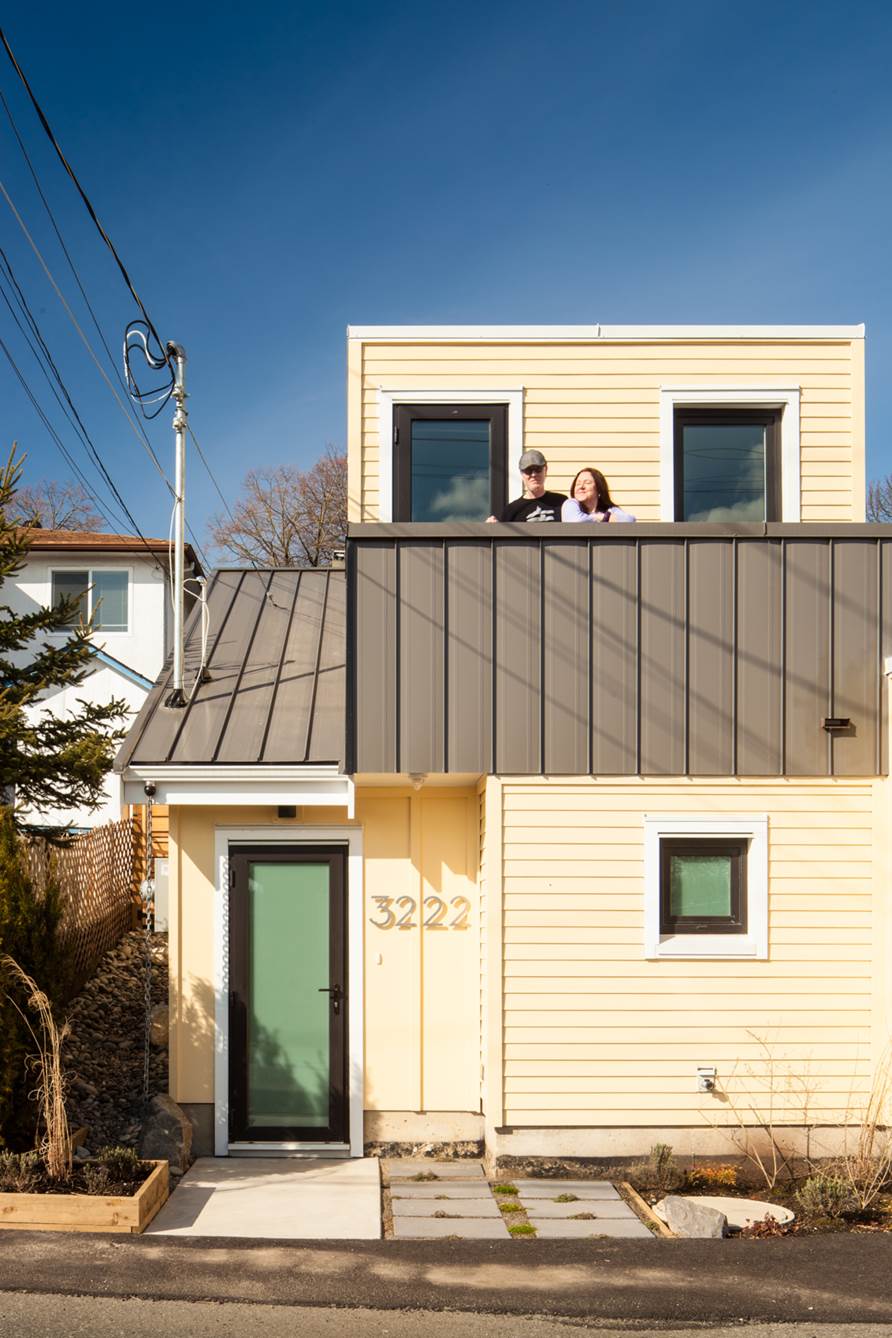
We’re ubiquitous!

Resistance is futile.

It’s official, at this point in time you cannot escape us!

Friday the video featuring our laneway (and us!) appeared on the Vancouver Sun website.

Sunday, Ian Power chatted with me on CKNW’s Home Discovery Program.

Then today Shelly Fralic’s column in the Vancouver Sun came out, featuring our laneway (and us!)

No wonder we’re smiling!

OurHome


We star in our own movie! (at least the laneway does)

Video: Tour of the modern laneway house.

Teensy tinyness — taking it even smaller

I was chatting with an acquaintance the other day, who knowing how fanatical keen I am on small houses, told me that he and his wife are planning on building a tiny house. Not small — tiny.  One of the houses that fit snugly into the Tiny House Movement, at under 120 square feet.

Rustic Exterior by Other Metro Architects & Designers Tumbleweed Tiny House Company

Currently they are renting a nice condo in Vancouver.  The tiny house (on wheels) would sit on his in-law’s property out in the Fraser Valley, and would serve as their quarters as they help her parents renovate their home. If the home is then sold, they would just roll the home onto some recreational property, or onto a corner of the subdivided property. Or they might just decide to move out there and stay.

It’s the perfect solution to their current dilemma, although presently they are not planning to live full-time in the home.

But others do.

Dee Williams has lived for 10 years in just 84 square feet. It’s an accomplishment, to be sure, one worthy of having a book written about her experience.

Like this one.  Which she wrote.
Williams used to live in a much bigger house.  With a big mortgage and big heating bills.  But a life crisis made her realize what was really important — and she turned her life around and put it into a tiny house.
She realized what her true priorities are.
Time has become her most valued and abundant possession. “I have time to notice my natural environment and take a breath through the seasons, to puzzle over the way that nature is throwing itself at me and the community. I live in one of the most beautiful places on the planet. If you’re working all the time, sitting inside, you miss a lot of it. I feel lucky and blessed that I’ve been able to pay attention to it.” 

Dee’s story has been told here in Houzz, and here.  And she’s given a TED Talk on it.

It’s a big story (about a tiny house).

Tiny houses come in a surprising variety of designs.  This couple has a luxuriant 240 square feet in a space no wider than 8 1/2 feet and no taller than 13 1/2 feet.

Contemporary Exterior by Sebastopol Architects & Designers The Tiny Project


What makes tiny houses so liveable?

The blog Tiny House Talk has some suggestions to get the most spaciousness (if not space) in your tiny home.

Some of them are fairly apparent, such as combining your living room and your bedroom to avoid partitioning already small areas even further.  But some I would never think of, like

Keep the space uncluttered above waist height. Anything above waist height that projects into the living space will make the space feel that much smaller. That means kitchen base cabinets are not a problem, but upper cabinets might be. Limit cabinets, shelves, or anything else that intrudes into this space.

This one is a given

Use light colors to create a spacious feeling. Light colors make a space seem bigger, while dark colors make a space seem smaller. Choose white or light-colored finishes for the ceiling and walls. (The floor color is less important for this purpose).

In most of the tiny houses I have seen have seen the ceiling and walls are all the same light colour, so your eye travels from the walls up to the gabled roof without interruption.

And of course

Open up to the outdoors. In addition to windows, think of creative ways that doors or even whole sliding walls could allow you to open your house up. (Check out the Virginia Tech LumenHaus for one elegant example). With a porch, deck, and a whole landscape outside, your tiny space won’t feel at all claustrophobic.

I know that just having our deck outside the upper floor of our laneway makes the entire storey seem larger.

As the author at Tiny House Talk points out

There’s no doubt about it—downsizing and simplifying your life to fit in a tiny home is a very difficult thing to do. And you certainly will want some storage space, partitions, and so on. But beware of the “big house mentality” in which a room can be packed with cabinets, bookshelves, and furniture and still feel spacious. In a tiny house, it can’t. Restraint, and a little bit of good design, will go a long way towards making your small space feel plenty comfortable.

And as DH has pointed out several times, Good Design Trumps Space.

Portland, Oregon says yes to laneway houses

Vancouver is certainly not the only city facing problems of scarce, expensive housing.  Nor is it the only city responding to those problems by building laneway or infill houses.

PortlandADU

In Portland, Oregon, these homes are called ADUs — Accessory Dwelling Units.  Unlike the laneway homes we know and love in Vancouver, they also include basement suites in this category.  And unlike the process here in Vancouver for laneway homes when you build an ADU in Portland they waive the permit fees.

That’s right — the city waives the permit fees for new infill buildings.

According to this story in the Tribune, in Portland that can save you between $8,000 and $11,000. That development permit waiver started as a pilot project in 2010, and was continued in 2013.  In Vancouver a similar program would mean savings of around $20,000 per laneway house.

There seems to be little pushback in Portland from people living in the neighbourhoods — of course you can purchase a perfectly lovely home in that city for about $300K.  And people recognize that the smaller buildings are much greener than large buildings using fewer resources to build and maintain. The state has its own Oregon Department of Environmental Quality, and their spokesperson said,

“Smaller homes have significant environmental benefits compared to other green building strategies. Building small is a very green thing to do,” says Palmeri.

As this story in the Tribune put it

Regardless of their size, ADUs are generally more environmentally friendly than a new home built in a traditional subdivision. They require no new land, less building materials and energy usage. They help Portland and the metro area meet population growth needs without developing farm land. Putting those residents in existing neighborhoods reduces sprawl and vehicle miles traveled, easing road congestion.

A recent survey by the DEQ found

the mean cost for an ADU is nearly $78,000, with about a quarter costing more than $120,000.

“That’s a lot of money for a lot of people,” says Palmeri.

In our neighbourhood numbers like that would have us drooling.  It would take a lot of number-crunching and cost-counting to bring in a laneway house for $120,000.

I would welcome a survey such as the DEQ conducted right here.  It would be interesting to find out how laneways are being used. In Portland, Ashland, and Eugene the survey found

 81 percent of ADUs in all three cities are used as primary residences, only 18 percent of occupants are family members and 53 percent of occupants were strangers when they moved in. And the majority of owners in all three cities — slightly more than 50 percent — built them for the additional rental income.

Lean, green, income generating machines.  It’s great to see how laneway houses can improve cities — and lives.

Getting around with an ELF

I get around most of the time by transit — I don’t like to drive (and DH does not like me to drive his vintage auto) and I don’t like to ride a bicycle. In the rain.  Uphill. And I’m not ready for a motorized wheelchair, although my Dad loved tearing around the streets of Nelson on his Rascal.

I work too far away to ride a bike to my job, and if I want to go shopping there is a strict limit on how much I could carry home.

But what if there were another way of getting around?

Meet the ELF

elf-2

It’s a trike, so it’s more stable than a bike.  It can hold a lot of cargo (up to 350 lbs, according to Life Edited). It’s got an electric motor so you don’t have to pedal all the time.  It’s solar powered.

And it’s so darned cute!

Check out the website for Organic Transit — the people who make this adorable little transport.  It’s a great idea, maybe a game-changer for traffic-congested cities.

I don’t see me driving down the main byways of Vancouver in one of these — and riding a bike or a trike on the sidewalk is not allowed.

But if they can knock down the price from five grand American, if they can get a few communities to adopt them, I think we have a fighting chance to replace cars for zipping around the immediate neighbourhood. After all, if half of all car trips in the US are three miles or less, this could revolutionize how we get around.  With our aging population (and rainy weather), bikes are not always feasible.

The ELF could be the answer.

But isn’t that what I said about the SEGWAY?

Mixin’ in the kitchen

Apartment Therapy is a great source for info on small spaces.  Let’s face it — most apartments are small.  That means getting clever with organization and use of space.

With my mind on kitchens, I was looking through some tiny apartments in Apartment Therapy to see what people have done with these spaces.

Apartment kitchens are usually pretty dull for two reasons — a) they are tiny, and b) they are full of things that are expensive to install and replace — appliances, cupboards, floors.  So most apartment kitchens start off fairly…..pedestrian.

Go nuts.

Go nuts.

Those white/almond cupboards with the wood trim?  Fairly ubiquitous.  This owner has kept the accessories white to add to the feeling of cohesion and spaciousness.  It’s tidy and pleasant, and the upper cupboards go right to the ceiling rather than have that dust-collecting shelf at the top.

But there are obviously strict limitations.  In this suite, they’ve put the kitchen in the space under the sleeping loft, which means it’s basically the foyer as well.

ATKitchen1

The owner has colour-coordinated the accessories, which is nice, but it’s clearly meant to be as unobtrusive as possible.

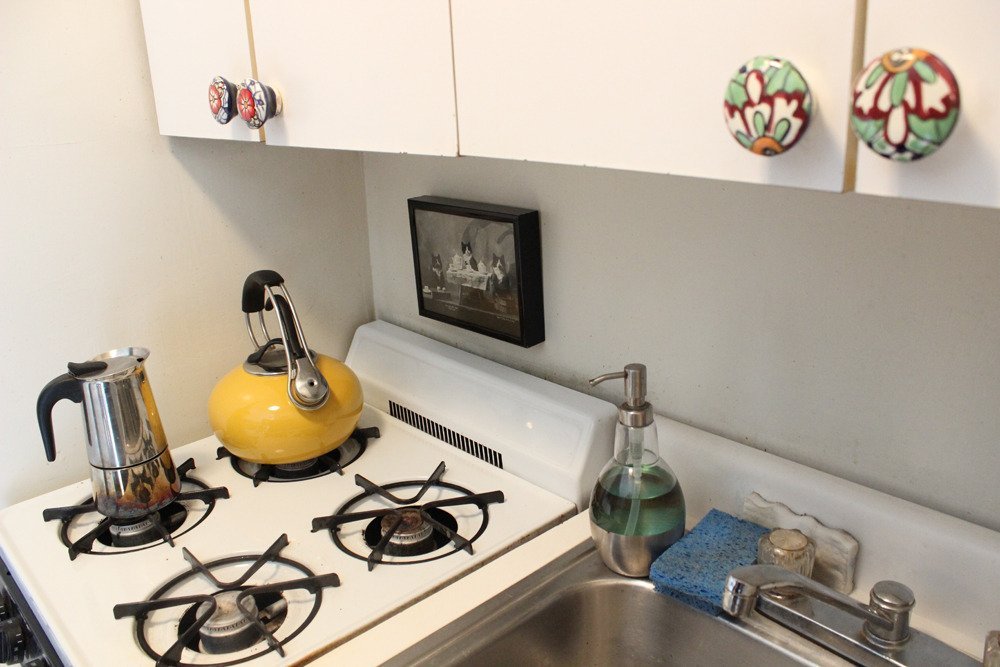
This tenant has managed to infuse some colour and pattern into the basic white of their kitchen with beautiful handles:

ATKitchen3

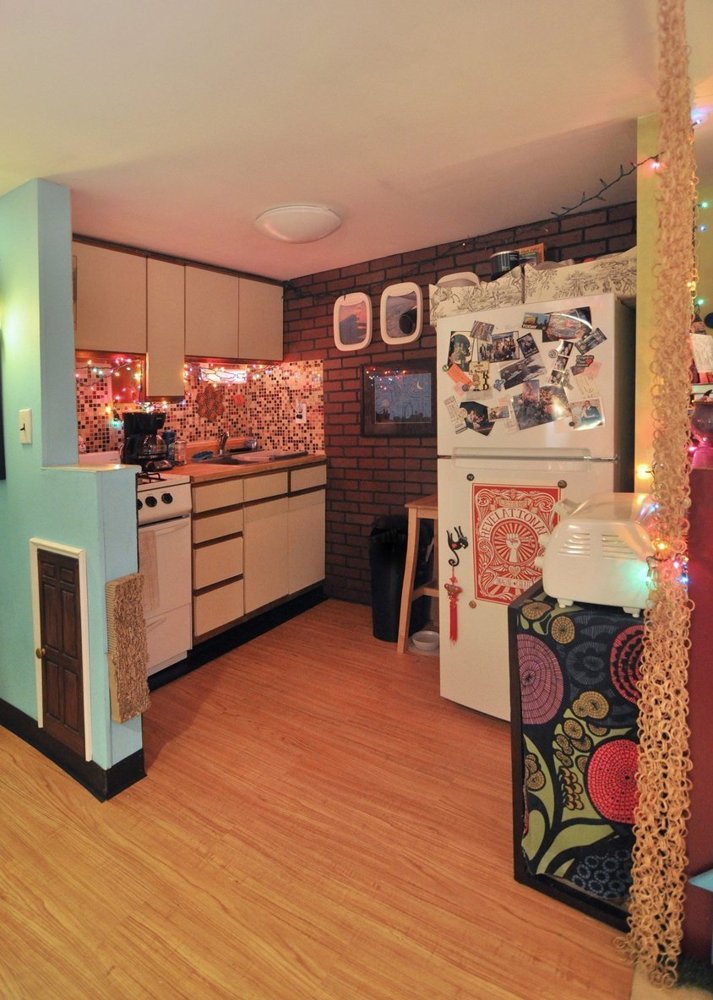
But some people infuse their spaces with their personalities by going all out with eccentric chachkis:


ATKitchen4


I sense a religious theme:

ATKitchen4.2

I think that’s a better use of space than putting your extra casseroles up there.

A studio suite in a basement has a lot to overcome.  Renter Laura Lee has brightened her windowless kitchen with well, stuff:

ATKitchen6

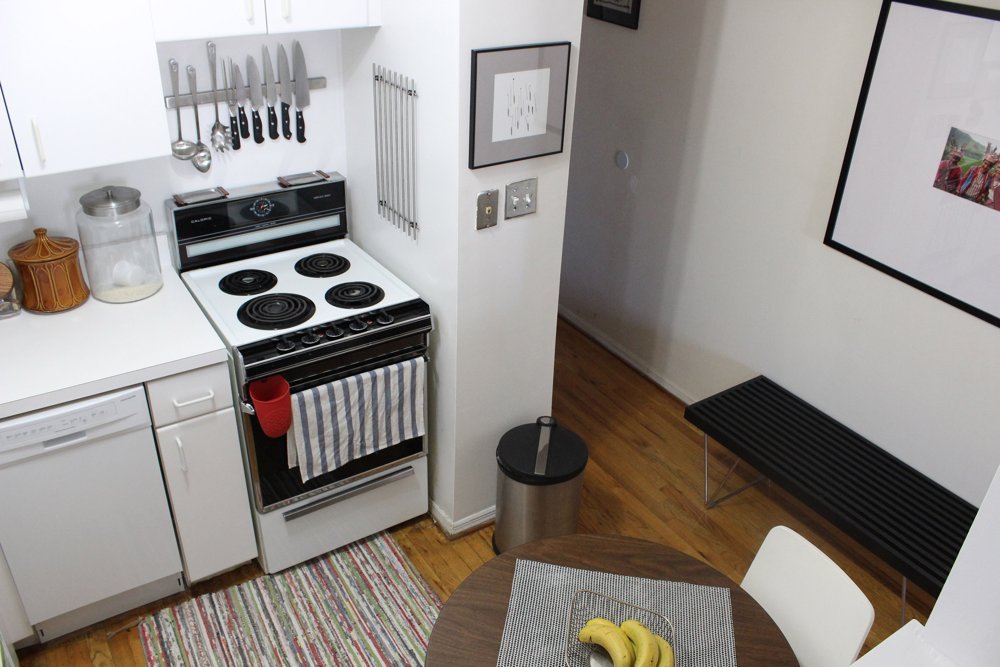
Sometimes plain is a good thing.  These renters have played off the white of their kitchen by keeping to silver and black — continuing the sleek modernism of the rest of their loft.

ATKitchen5.2

Even the rag rug keeps it clean and simple in the kitchen:

ATKitchen5


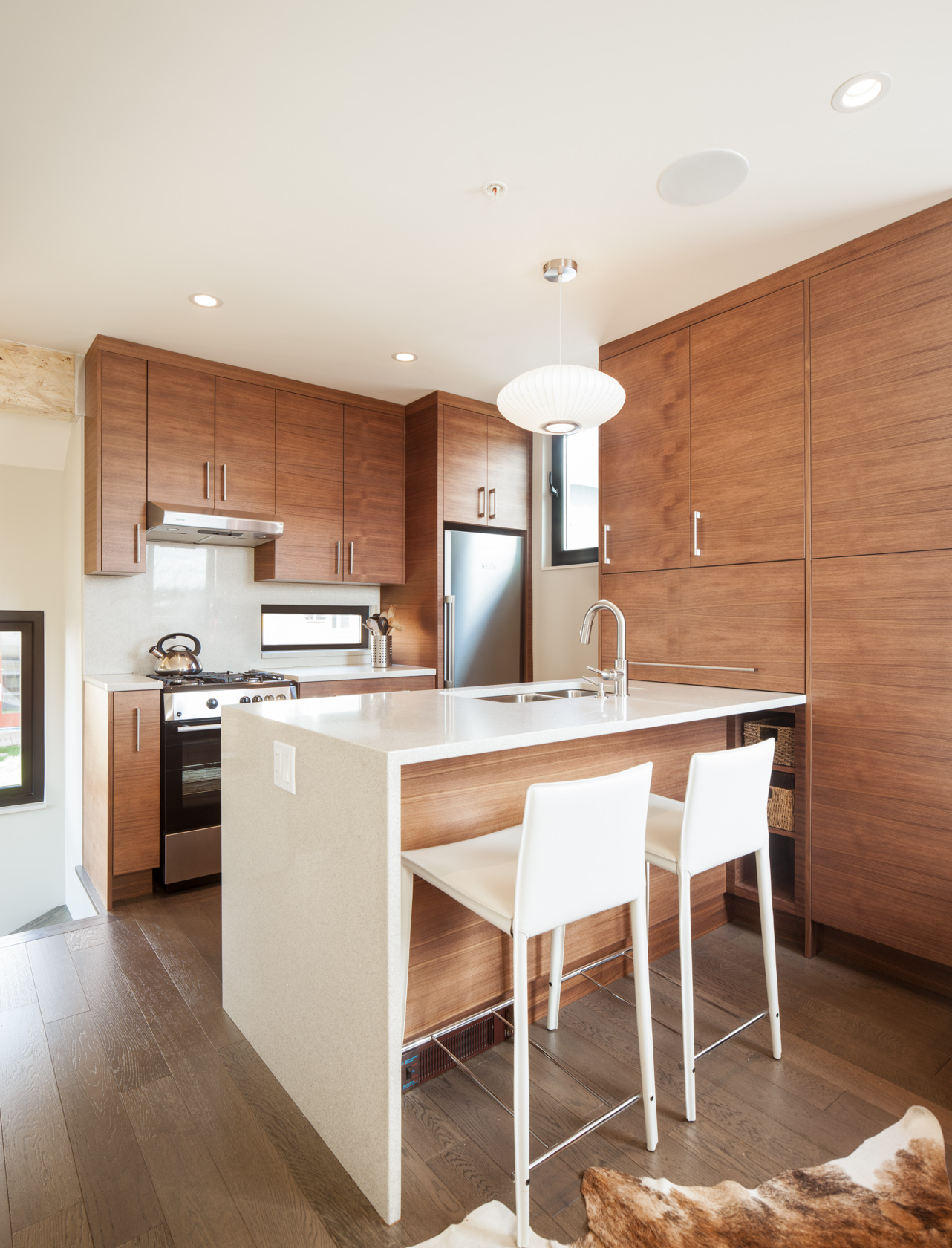
When we were planning our laneway, we wanted a nice kitchen.  You have to compromise, but the kitchen was not the place we wanted to do that.  Instead we sacrificed a “living room” for a more spacious cooking and eating area.

Want to see it?

Kitchen1

Photo courtesy of Novell Design Build.

That huge counter with the waterfalled edge?  We wanted that.  It gives us a comfortable place to sit and eat, plus lots of room for cooking and baking (and sewing and writing blog posts on the laptop.)

You can see how light and bright it is.

Kitchen2

Photo courtesy of Novell Design Build.

And there really is tons of storage.  A pull-out spice shelf, appliance garage, plus deep drawers for our dishes and pots.

This is what it means to have a custom kitchen built just for us.  I’m sure you will look at that kitchen and think “I would have done things differently.”  Well you can!  We wanted this, and we got it, thanks to good work from our designer, our builder, and our custom cabinet maker.

We change up the accessories to add more personality to the space.  And we keep it very, very tidy.

The kitchen is the heart of the home, and we wanted one that would inspire us every day.

It’s Alive! Living beneath a living roof.

One of the most unique features of our home is something we’ve come to take for granted — the living roof.realroof

It was grown for us out at N.A.T.S .Nurseries in Langley, who are representatives of LiveRoof.

It’s very green and ecologically responsible and etc. etc. of us to put in the living roof, but we originally just wanted it because it looks nice.

Because our roof is visible (due to the slope of the property) the folks in the main house and the neighbours are looking at it whenever they look at the laneway house. And because we have flat roof not just on the upper storey but also on the top of the garage and some of the lower storey, we just wanted something nice for them to look at.  The roof of the garage is right outside our kitchen window, and it’s much more pleasant to look at a garden than a heli-pad black slab.

Our roof is an extensive green roof, a carpet of sedums and other low-growing plants.  An extensive green roof would support larger plants, even trees.

But it turns out there are lots of other very good reasons to install a living roof of either kind.  According to the Green Roofs for Healthy Cities site, living roofs offer benefits to more people than the home owners.

For cities:

1. Cleaner water. Living roofs clean storm water.  Here in Vancouver we can have real downpours.  The water runs off hard surfaces like roads, sidewalks, and yes, roofs, and enters the storm sewer system.  All at once.  That can overwhelm the system.  But living roofs absorb and retain the water, delaying its entry into the storm sewer and easing the pressure on the system.  Plus the roofs filter the water, and through evaporation, lessen the of water they deliver to the system.

2. Cooler cities. You may have heard about the “urban heat island effect“.  This is a problem for big cities where the structures absorb heat during the day and retain it far longer into the evenings than soft, natural surfaces.  According to the EPA,

The annual mean air temperature of a city with 1 million people or more can be 1.8–5.4°F (1–3°C) warmer than its surroundings.3 On a clear, calm night, however, the temperature difference can be as much as 22°F (12°C).3

The living roofs keep cooler during the day due to the evaporation that goes on, but they also cool off much faster than hard, black roofs once the sun is down.

3. Cleaner air. Plants clean the air of pollution and particulates.  So living roofs can reduce smog.

For individual home owners:

1. Energy efficiency. The living roof acts as an insulator during the winter, keeping the home warmer.  Plus in the summer, it keeps the home cooler because the plants provide an insulating layer PLUS the evaporation of water through the plants lowers the temperature.  You may have set a sprinkler on your roof during the super hot weather to cool it off — that works by evaporation and our roof does that all the time naturally.

2. Fire retardation.  If a building near by catches fire and the sparks land on our roof, they will just go out.  It would be like trying to light a lawn on fire.

3. Noise reduction. According to Green Roofs,

An extensive green roof can reduce sound from outside by 40 decibels, while an intensive one can reduce sound by 46-50 decibels

4. Increased durability.  The plants protect the membrane below them from the destructive rays of the sun. A living roof can last at least two times longer than a plain membrane roof. And that keeps membrane and sealant out of the landfills.

There’s some maintenance to be done on the roof — weeding!  We’ll also be putting on a little fertilizer.  Thanks to N.A.T.S. Nursery for their help.

Visit N.A.T.S. Nursery at their website for more information.`

Someone’s in the kitchen I know-oh-oh-oh

When I am not strumming on my old banjo (which is totally not something I do) I like to cook.  And I like to eat.  So a well-designed and -equipped kitchen was tops on the list of what DH and I wanted in the laneway home. Some laneways have tiny galley kitchens, but we wanted one with all the bells and whistles.

And we got it!

The appliances are small but they are efficient and the design has made us more efficient.

It was while I was unloading our adorable little drawer dishwasher by Fisher and Paykel that I realized it wasn’t just its size and efficiency I loved — it was also its location.

Isn't it cute?

Isn’t it cute?

When it came to the under-counter storage I knew I wanted drawers for storing my dishes and cooking utensils rather than cupboards.  Drawers give you access to the complete space, pulled out into the light.  No more rooting around in dark corners — everything is right there.  And when I am unloading the dishwasher, having the dish storage just beside it makes putting everything away a dream. Or at least less of a nightmare.

It also helps that the dishwasher is placed just under the counter, so there’s less bending and stooping.

It takes a few minutes to unload the dishwasher and then it’s ready to hold the next meal’s worth of plates, etc. There are never any dishes sitting on the counter waiting to be cleaned or put away.  And it’s changed our lives!

Because here’s the funny part — in our old home we hardly ever used the dishwasher.  DH hates to have dirty dishes sitting all day waiting for the machine to be filled up so it can be run (he can hear the germs multiplying) so he washed them up after every meal (note:  I did not wash them, he did.) But then we had dishes sitting in the rack on our counter all day. The smaller size of our new dishwasher means we do smaller loads more frequently — perfect for the life we lead.

In her blog Nesting Place the Nester talks about her battle with the dishwasher —

For some reason unloading the dishwasher is a dreaded chore in our house.

It’s a pain to dread something that needs to be done daily.

When I dread something that needs to be done daily, it’s a red flag. It’s an opportunity to evaluate if I’m helping or hurting the situation just by something simple that I can change. 

So she reorganized her kitchen so the dish storage was next to the dishwasher and voila!  The chore that everyone was dreading a lot became just another small thing to be done.

Dishwasher unloading takes about 90 seconds and even the 16-year-old thanked me for planning out the kitchen to make unloading the dishwasher super fast and non-dread-inducing.

Do read the whole post at her blog. And when designing a space — whether it’s your kitchen or your bath or your foyer — remember to design around how you want it to work, not just how you want it to look.


Fitting families into smaller spaces

Two people can live as cheaply, and in as little space, as one. One bedroom for two people just makes sense for us.

Families, however,  need private space for their children — and space is at a premium whether you live in a condo or a small house.

When I was a child, lo these many years ago now, my sister and I shared a room for many years with bunk beds.  Eventually we had our own rooms, small spaces but completely our own with our own closets, dressers, desks and beds. But putting two children into one room is possible — and many people are doing it with style.

Apartment Therapy has some great ideas for when two children have to share one room:

Some people like to give the children identical spaces.

KidsBedroomIdentical

This room is for two sisters.  In another space (below) shelves hold the personal belongings of each child, even though the spaces look identical.

KidsBedroomIdentical2

Good use of vertical spaces.

Sometimes the different spaces are indicated by colour or pattern:

KidsBedroomColour

KidsBedroomColour2

And sometimes a single room can be divided by shelves or wardrobes (I did this when my kids were small and sharing a bedroom):

KidsBedroomSplit

KidsBedroomSplit2

And you can even put up a physical barrier in the room to split it.  If the kids get along well, a curtain will be fine.

KidsBedroomSplit3

But sometimes an actual barrier will serve the purpose better (I think my sister and I would have needed something like this):

KidsBedroomSplit4

This is a good idea if one person is a neatnik and the other not so much.

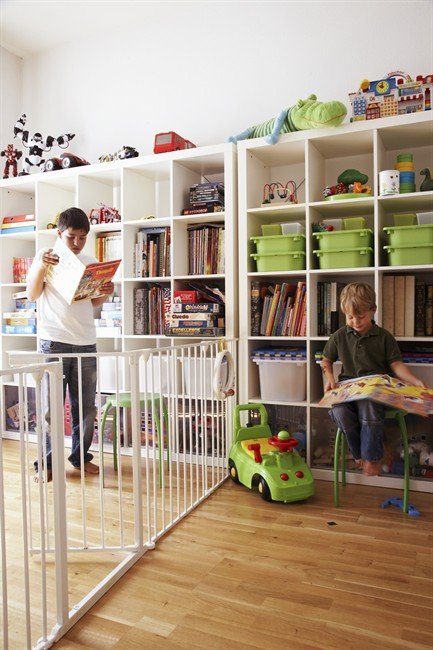
Even if you can have one bedroom per child, a small space means the play area and the sleeping area can overlap.  From this Houzz Tour we see how this family fits four bedrooms into 1500 square feet.  The kids’ rooms are very small, but have beds that fold up into the wall to create more floor space for play:

Contemporary Kids by Inglewood Architects & Designers (fer) studio
The little boy’s bed is hinged at the side, like a Murphy bed; the little girl’s is hinged along the side, like a Pullman bed.
Fitting more people into less space is kind of a mission with me.  I’m glad to see these stylish and comfortable options for families living in small homes.


My Pain, My Life, My Struggles, My Fight

Come walk with me, Down My Dark & Stormy Journey BUSINESS INQUIRIES & CONTACT EMAIL : GODSCHILD4048@GMAIL.COM

ANNOTATED AUDREY BLOG

Artist and Desert Dweller with Big City Style.

Im ashamed to die until i have won some victory for humanity.

Domenic Garisto / LIFE IS NOT A REHERSAL,SO LIVE IT..if you can't be the poet, be the poem..havau22.com

The Lady Who Lives Down the Lane

Lane Way Housing for the Nervous Novice

Apartment Therapy| Saving the world, one room at a time

Lane Way Housing for the Nervous Novice

Slightly Snug House

building a home that's not too big and not too small

Vancouverandy

Funny thoughts from a nut like me.

Small House Bliss

Small house designs with big impact

WeeHavyn

Lane Way Housing for the Nervous Novice