RSS Feed

Author Archives: ladywholivesdownthelane

No place like home (show)

DH and I went down to the Vancouver Home and Design Show to catch up on the trends that are new and exciting in this red-hot renovation and building market.

I remember going to the show twenty years ago or so and it seems to me that it was kiosk after kiosk of handy-dandy  labour-saving devices, pots and pans, with a few decorating and building companies thrown in.  Or maybe that was the PNE.  Anyway, the past few years you’ve been able to talk with a lot of renovation companies, plus get some great ideas about new products that are available.

As usual there were great speakers — including Bryan Baeumler,  Colin McAllister and Justin Ryan, lots of great chefs and designers.

Small was definitely big this year.  There were several retailers showing off various ways to hide beds — not just floor mounted but pieces that looked like regular cabinets but made out into beds.  And Urban Barn tasked the three designers competing for their Next Top Designer with designing a dual-purpose space in just 150 square feet.

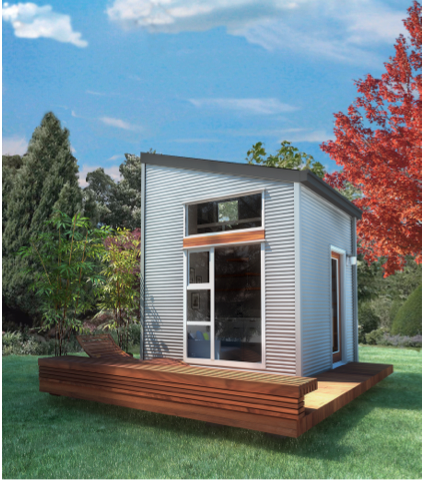
I saw a lot I really liked but for me the outstanding exhibition was the NOMAD MicroHome.  The display unit showed how much living and storage you could fit into a 10 foot by 10 foot footprint.  It would be great for an extra bedroom, tucked into your yard.  Or, with the addition of other modules, you could easily make a nice vacation home.  You can even go completely green with the addition of  a Water Generation Plant, a Solar Power Plant, a Rainwater Collection System and a Grey Water Treatment Plant.

And they are pretty good looking, too.

Nomad

While looking at the home I got a feeling of deja vu — and sure enough I wrote about the Nomad last year.  It’s great to see an innovative local company moving ahead.


Vancouver Heritage Foundation Laneway House Tour is October 25!

Get your tickets now for this year’s Vancouver Heritage Foundation Laneway House Tour!  The theme is Heritage, and one of the featured homes is over 100 years old.

Heritage

The tour is a great way to see what laneway living looks like, and if you are planning a laneway you’ll get lots of good ideas you can incorporate into your plans.

Find out more and get your tickets at the Vancouver Heritage Foundation site.

(Less) Power to the people!

I chatted with Ian and Steve at the Home Discovery Show  on CKNW about the difference in the amount of energy we use here at the laneway house.  It really hit me this week when I signed up for BC Hydro’s Equal Billing.  We are paying $35 a month for our electricity now, back at the condo we paid $64 a month.  That’s a huge difference because even though our new home is about half the size of our old one, our condo was on the second floor of a three-storey building, so we only had two exterior walls.  Now we have four exterior walls over 1.5 floors, plus a roof and deck over the entire footprint.

But we don’t have to depend on lower energy bills to know our laneway is energy-efficient. Our house received an EnerGuide rating of 83 from BC Hydro.

Developed by Natural Resources Canada, an EnerGuide rating is a standard measure of a home’s energy performance. A rating of 0 represents a home with major air leakage, no insulation and extremely high energy consumption. A rating of 100 represents an airtight, well insulated, sufficiently-ventilated home that requires no purchased energy.

Power Smart new homes are required to achieve at least ENERGUIDE 80, higher than what’s required by the B.C. Building Code.

That rating put us in the “highly energy-efficient new house” category in their rating system.

This is “Offtober” at BC Hydro.  Visit their site to see how you can save on special deals from retailers; PowerSmart Programs; and play contests.

EnergyStar

If you want to make some changes to your home you can take advantage of rebates and other incentives from the City of Vancouver, BC Hydro, and Fortis.   Find out more about that here.

If you are a low-income household you can take advantage of BC Hydro’s Energy Conservation Assistance Program.  Find out more about this here.

And if you just want to get started living a more sustainable life, pick up some hints here .

What does all this energy efficiency mean to us?  It means lower Fortis bills for a start.  We pay about $25 a month for natural gas for our heating and cooking (including our barbecue).  But it also means getting out of bed on a winter morning and feeling that radiant heat.  It means no cold corners, no nasty drafts.  It means comfort, as much as sustainability.


Small bathrooms ideas worth thinking about

Hypothetically, you may be interested in putting in a small bathroom.  Maybe you are designing a laneway home for yourself, maybe you have an attic bedroom you’d like to link to a teeny ensuite, maybe you’re trying to fit a powder room or shower into a basement corner.  I’ve told you how we solved the space problem in our laneway bath — now for some other ideas to get the most out of your restricted space.

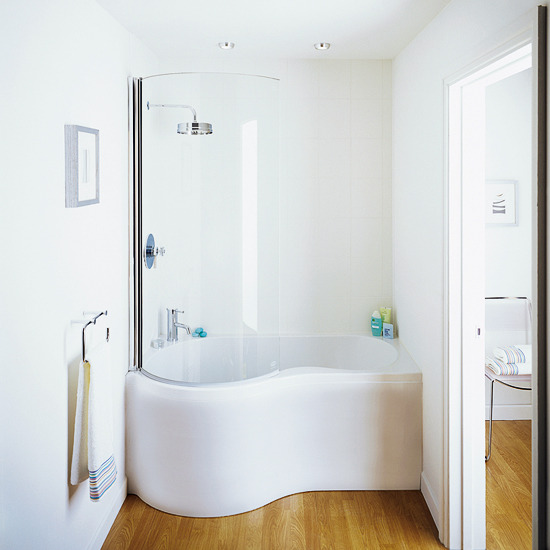
If you just can’t say good-bye to the tub, you could try a tiny one. This one lets you keep the shower and tub combo.

TinyBath1

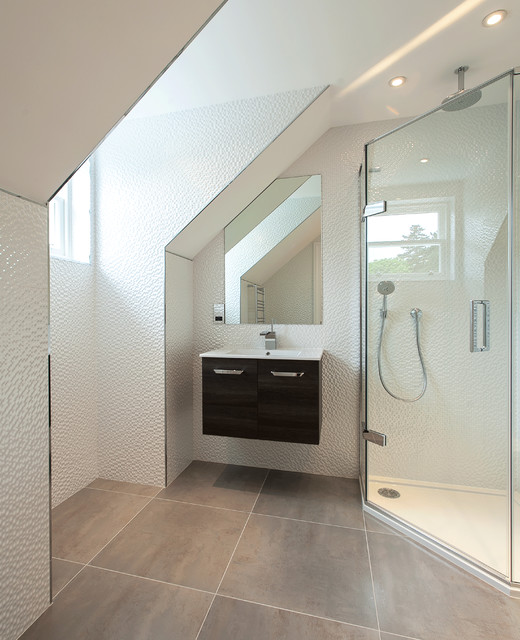
This one is loaded with luxury, and can be snuck underneath a sloping ceiling.

Contemporary Bathroom by London Interior Designers & Decorators Chantel Elshout Design Consultancy


And this one puts the bath and shower into a “wet zone” at one end of the room behind glass doors. Not as compact, but still a good solution when you need both a bath and a shower:

Tinybath2

Another solution is to put the shower into the corner of the room, like this:

TinyShower1

The sliding doors mean it could be snugged up tight to the toilet if you have to — no space needed for your out-swinging glass doors.

Or, in this corner shower, the entire shower is put into a corner, in a nice, triangular shape:

Good use of space putting the sink beneath an eave (or even a staircase) with a sloping roof. And the floating vanity makes the whole room look bigger.

And here’s something I wish we could have put into our bathroom:

Tinytoilet1

A toilet where the tank is placed inside the wall.  It’s so clean and contemporary looking, and of course doesn’t take up as much interior space.  But you have to place the tank space within an interior wall, and we just couldn’t make it work.

Of course a tiny sink can also save you precious inches.

tinysink1

Even IKEA sells a tiny sink.

tinysink2But remember, you won’t be able to build any storage beneath these sinks.

This Tiny-House architect installed a stylish sink in her shower room. the whole home is just 196 square feet, and the IKEA mirror on the retractable arm is their only mirror.

TinySink3And remember that lighter coloured walls will expand the visual look of any small room.  Shiny tiles, mirrors, and glass surfaces also add to the feeling of space.

Tinybath3

Keep it sleek, clean, and simple.  And any bath can look larger.


Why I love my bathroom

I want to write a love letter to my WC.  I’ve been away from home this summer, using different bathrooms and I came to realize all the things I truly love about my bathroom. I realized how perfectly it fit our needs, and how easy it is to keep clean and bright. And if you are planning to remodel or build a new powder room maybe you can use some of the solutions we found for our severe lack of space.

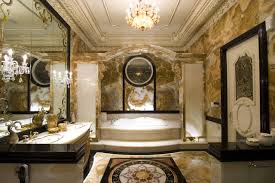
We all want the bathroom of our dreams. Some of us dream big;
BathLuxurySome of us have more modest dreams:

Bathmodest

But as you can imagine, for our laneway home we had to make some sacrifices.  Because our bathroom is eensy, weensy, teensy.  Seriously, check out the plans.

PlansLower

The bathroom is less than 8 feet wide.  So it took some planning to get everything we wanted into the room. But we did!

One of the features that we appreciate so much is the radiant floor heating.  We moved into our place in winter, and we couldn’t believe the difference it makes to your comfort.

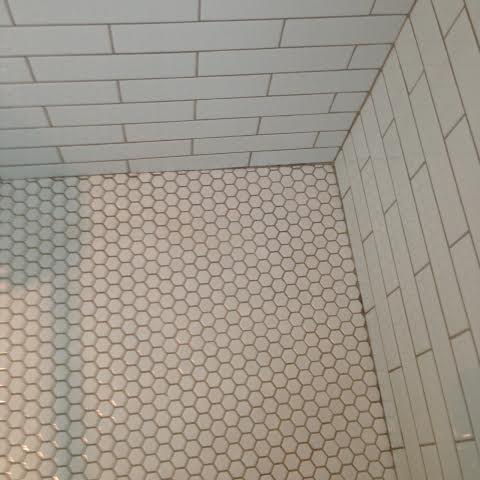
In our planning with the designer we ditched the tub.  We prefer a shower so it would be a waste of precious, precious space to put in a tub.  Then we decided to keep everything square and linear.  We wanted subway tiles to line the shower, nothing fancy that dates so quickly, just the classics.  Honeycomb tiles on the floor of the shower to help make it less slippery.

BathTiil

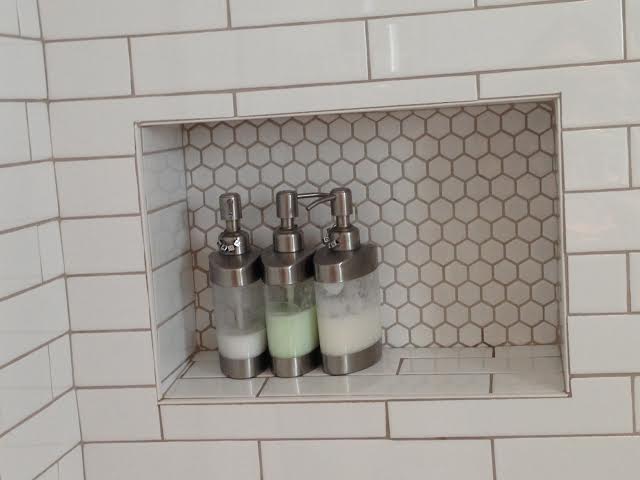
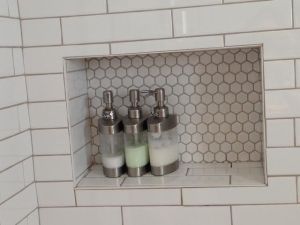
Nice and clean looking.  Plus the clear glass doors make it look as if the shower is part of the whole room, there’s no visual separation.  And we have a handy niche to hold our shower needs.
BathNicheBetter

There are those honeycomb tiles again.  Having that little shelf seems like such a no-brainer, but DH’s shower in our old condo didn’t have one.  It makes a huge difference.  You’ll also note that we empty our shampoo, conditioner, and body wash into little bottles (from the dollar store) which keeps the space looking less cluttered.

The shower itself delivers what we really want — comfort.  We have a rain-shower head — one of the first things to go on our list of features we wanted. We also have a shower wand for when we want to pretend it’s a microphone. C’mon who doesn’t do that when they’re singing in the shower?

BathRain

The controls let us set the most comfortable temperature, and turn it on immediately without fussing and fidgeting.

BathControl

Square shape again — see?  It keeps the look uncluttered.

The toilet also has features we want — clean lines right down to the floor, and the seat closes with a gentle movement (the first days of my holiday were spent apologizing for noisily dropping the toilet seat cover, I was so used to it dropping softly onto the seat at home).   Yes, it’s a little thing, as is the feature that the whole seat lifts off the toilet for super-easy cleaning — but it’s just one of the things I love about our bathroom.

While we were on the Heritage Foundation’s laneway house tour two years ago, we saw the IKEA Godmorgen system.  We loved it at first sight — clean lines, storage space, and it floats above the floor to give the illusion of more space.  We also solved the problem of having no room for sconces beside the bathroom mirror with a great mirror with the lights built right in.

Bathsink

Again, square towel and toilet roll holders.  Square faucet and tap.  There’s also something in our bathroom that I never thought I needed — a clock.  The light/fan switch has a little digital clock to control the fan for ventilation purposes, and it’s so handy!  Up in the middle of the night — check out how long you can sleep before the alarm goes off.  Getting ready for work?  You can schedule your makeup/hair time and NEVER BE LATE AGAIN!

In this shot you can see the little square tiles on the floor — they are quite slip proof when wet, another safety feature as we age in place in this space.

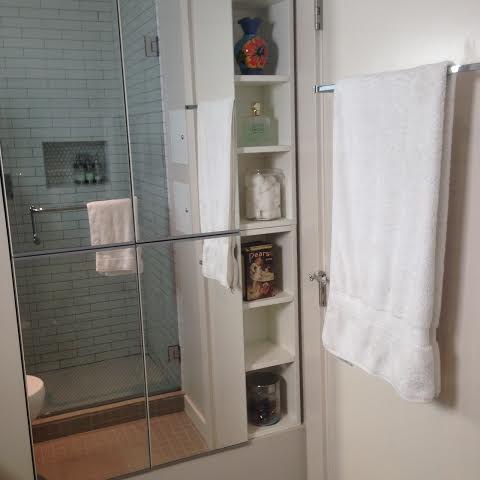
Storage is always at a premium in any bathroom — so our designer, Laurel, found a great way to increase ours.  There’s an inset in the wall the bathroom shares with the washer/dryer closet.  And into it, Laurel placed two IKEA Lillangen cabinets with mirror doors.

BathCabinet

As well as giving us lots of storage space, the cabinets give us a full length mirror.  There’s practically no other space for a big mirror, so this is really appreciated.  Plus it reflects the light and brightens the whole room.

We bought all white towels for the new bath — gave away all our multi-coloured towels to keep things beautifully clean and white.  Plus if one gets stained it’s easily replaced — white always goes with white.

There’s also something Laurel suggested that we had never heard of — lockable valve boxes set into the wall for storage.

Bathboxes

We can lock our prescription drugs away for when the little ones are around.  They’re also handy for holding our jewellery when we’re not wearing it.

It’s so indicative of the comfort and ease we find in our home that our bathroom (is it still a bathroom without a bath) is so perfect for us.  Hope you can find a couple of good ideas to incorporate in yours!
A long, hard slog, another moving experience

The good news is that our parents’ condo in Nelson has been sold.  The subjects have been removed and in mid-October a new owner will be moving in.

The bad news, of course, is that they want to move into an empty condo.  Everything had to be removed, all the furniture, all the boxes, all the pictures, everything.

Happily my sister had gone through the place in the Spring, tossing and re-packing, and had handled most of the heavy lifting.  But there was still a lot to do, so last weekend she and I climbed into a big, honking rented SUV filled with empty boxes and drove up to Nelson from Vancouver and we started sorting.  Everything that we put into our hands had to be either given away, thrown away, or packed to be brought back to our place. All I wanted were the photos, a quilt, an afghan, and the cutlery.  My son and his wife wanted a chair and ottoman.  A local charity was taking the rest of the furniture.

I don’t have to tell you how horrible it is to move.  Tossing away boxes and boxes of opened food, half-full bottles of cleaning supplies.  Added to that there was the mental strain of decision fatigue.  The emotional wrench every time we ran across a piece of paper with our mother’s writing, a card signed by our father.  We fell into our beds, exhausted, every night.  And rose to face it all again, chaos and mess and piles of things.

To save our sanity we took time for walks around town and even had facials.  To prevent the foolish choices that come from decision fatigue we quit at supper time, and spent the evenings relaxing as much as we could before early bed-times (we were pretty pooped after shifting boxes and bags all day, neither of us is in our first bloom of youth).

When we left after a last farewell tour of the now-empty condo we were relieved, but not comforted.  We were so fortunate that we could do it together, my sister lives on the other side of the country and it was just luck that she was on the West Coast to attend a course and could take some holidays, because it would be exponentially more difficult for one person (hauling a huge old TV to the recyclers was definitely a two-person job). And we could help each other winnow through the collections of chotchkes.

One job I will be undertaking right now! is the labelling of the photos and slides I brought home.  I have to identify all the faces I recognise and scan and email the ones I don’t to relatives (while they are still around) so we can catalogue them all.  Note:  pencilling “Dad” on the back of a photo with no date is not going to help someone trying to identify it 70 years later.

So it’s good-bye to Nelson, a beautiful city but one that we have seen frequently over the past 40 years.  Now we will take trips to other equally-lovely corners of this fantastic province.

Home, home on the screen

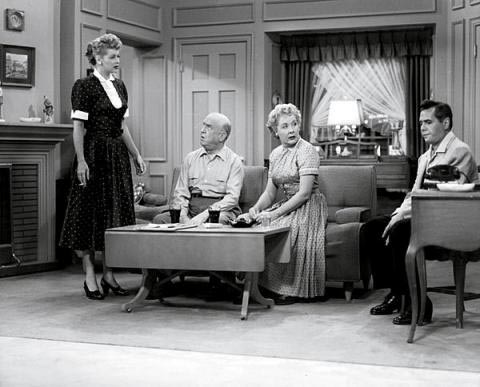
Classic TV shows had great homes.  Roseanne aside, houses were meant to be aspirational, just a little bigger/tidier/nicer than our own, so we could relate without really noticing them.  They were sets, not characters.  Or….were they?  Didn’t they become characters in the shows?

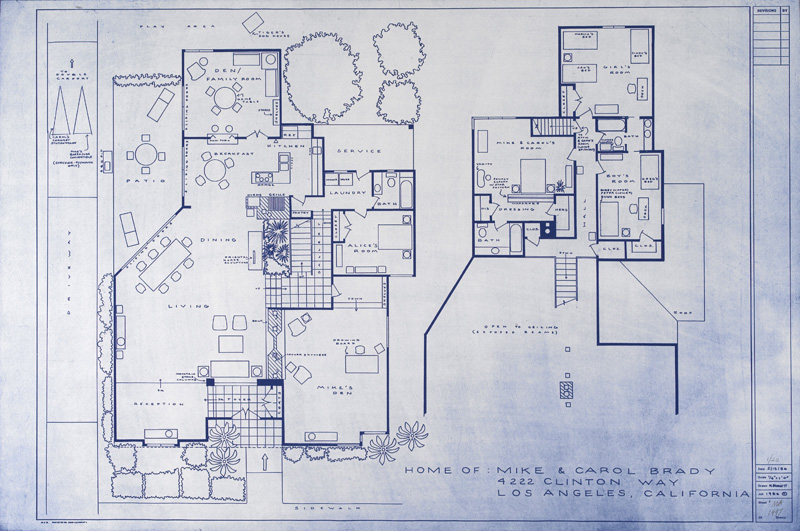
Thanks to artists Mark Bennett  and Inaki Aliste Lizarralde we can revisit those oh-so-familiar homes through their floor plans.

ILoveLucyFloorPlansWe spent many hours in that apartment with these folks

FloorPlansLucyBut that was a New York City flat.  How about this home:

FloorPlansLeaveItToBeaver

Even with four bedrooms (and 2.5 baths) Wally and the Beav shared a room.


The next decade brought us more homes we visited every week

FloorPlansRobPetrie

FloorPlansStephens

FloorPlansBradyBunch

Of course, Mike Brady was an architect, so his place reflected the open-concept, shag-covered tastes of the time.

But all these houses had one thing in common, something that shows itself in the reruns of the shows.

They weren’t very big.

Sure, they were bigger than our homes.  Nicer and newer and just better.  But they weren’t huge.

According to Life Edited, in 1950 the average floor space of a house was 983 square feet.  By 2012 that area had grown to 2,662 square feet, and there were fewer people living in the house. Over the years we got used to the idea that we needed more rooms.  But we really don’t.

That Life Edited article cites the book Life at Home in the Twenty-first Century which has some interesting things to say about what goes on in those big homes:

  • 3 out of 4 of the families garages cannot fit cars because of excessive stockpiling from stores like Costco.

  • 50 of the 64 parents reported not stepping outside in the course of a week.

And what are they doing inside those homes? The book describes a survey that showed how every member of the household moved throughout the home — a measurement taken every ten minutes.  And the pattern looked like this

No one used that formal dining room.  No one sat and chatted in the lovely living room.  Those spaces weren’t needed. And they are expensive in terms of heating, cooling, cleaning, decorating.  The more house the more money you need to support it.  And to build it.

 The outstanding domestic debt of the Household and Home Mortgage Sector in 1950 was $411B (adjusted for inflation). Currently, that same figure is $9.7 trillion. While the population has doubled and home ownership and college attendance have increased, this is still an increase of over 23-times.

Let’s start thinking and planning how we want to house ourselves in this new century.  Let’s leave our fantasy homes on the screen.

A new addition

How have I been occupying myself the last couple of weeks?  Not by writing blog posts.  No, I have been waiting.  We slipped away for a week to our usual holiday spot, but the rest of the time I was waiting.  Brooding.  Sitting in my empty nest and waiting on the arrival of our newest BFF — our grandson. This long weekend I watched a Dr. Who-athon on Netflix and knit a little blue sweater as my daughter patiently waited for her son to be born.

And now he is here!

Andrew

He arrived on September 1, and is a bonny lad. We are all madly in love with him, especially his sister.  How like her he is!

The best thing about this wonderful experience is that we now live right next door to these wonderful people, and can visit them whenever we want!  There are not many grandparents who have that chance, and I realize how lucky we are.

Soon I will be back to the regular content of the blog, but for now I will be gazing into that beautiful face. Darling Douglas.


A tale of two houses

Two houses recently sold in our neighbourhood.  One, the one we lovingly referred to as “the crack house”, is certainly scheduled for demolition.  There hasn’t been any maintenance to that property since mullets were in style (the first time).  It is falling to pieces, the yard filled with trash.  Soon the big machines will come and tear it down and replace it with a three-storey faux craftsman with a laneway.  It was inevitable and to a certain extent, planned-for.

We have seen the future and it is huge.

We have seen the future and it is huge.

The other house that sold is our neighbours’.  The couple who lived there spent much time and love taking care of it.  Yes, it drove us crazy to hear their tools fire up early on a week-end morning, but you could see just from looking at the exterior that these people took care of their home.  Now the big question on our minds is:  “Will the new owners leave as is? Reno? Demolish and rebuild?”

On our block we have seen it all.  Perfectly good small houses demolished for behemoths.  Aging bungalows given new life with loving renovations.  And of course, speculators buying the older, more derelict properties to hold on to for future development (while they rot and attract vermin of all species).

Rumour has it that the house next door has been bought by a family who will be moving into it as is; the tenants in the spacious two-bedroom basement suite are not looking for new accommodations yet.  But we won’t truly exhale until the moving trucks pull away, emptied of a household’s goods now placed in their new home. Then we’ll show up with a plate of cookies to welcome them to the new neighbourhood.

But if they want to make changes but don’t want to tear it down, the new owners will be stepping into a quagmire of regulations and rules that is the permit process for renovation in Vancouver.  This story in the Globe and Mail sums it up quite nicely.

Additions to the building code include a host of requirements designed to enhance accessibility for the disabled and to make houses more energy efficient. …..

Groups opposed to it are arguing that it will make renovations prohibitively expensive, adding to affordability problems and increasing the number of demolitions

Luckily the new owners wouldn’t have to do anything to bring the house up to code — the current residents have done all that.  But what if someone bought the “crack house” to preserve that old-fashioned style of house?  They would be screwed.  It would cost twice as much as the house would be worth to bring it up to current codes.  That’s one of the reasons we are losing these old houses.  It’s just too much bother and expense to try to save them.

It’s not “energy efficient” to put a house’s worth of old materials into a landfill.  And the drive to make our condo buildings air-tight contributed to the leaky condo crisis we are still trying to fix.  Personally I feel people should get some dispensation for trying to save an old house, not just one designated as a heritage home, but a place that was built in the ’60s, the ’50s, and the ’40s.  The architecture of those eras deserves to be respected and cherished as much as that of earlier years.

Meantime we will watch and see what changes our neighbourhood will experience in the next few months.

Decluttering — the journey begins

clutter2

So you know you have to declutter.  Your place may not look as bad as the photo — YMMV — but you want to downsize and declutter.  Where to begin?  With a list!

No, don’t grab yet another piece of paper and start writing — the nice people at Life Edited have made a list for you already.

When do you begin the process of decluttering?  Now.

1. Don’t wait for a good time to start.

We’ve all been done in by those “tomorrow” promises.  Start now.  Throw one piece of paper into the recycling bin.  Clean out the bottom of your purse — or the fridge — or your top drawer.  You’re starting a new way of life.  You can ease into it.  But start now.

2. Get rid of stuff you are very attached to, but don’t worry, it gets easy with practice.

No matter where you begin, sooner or later you will run across something that has value to you — even though you don’t need it.  I remember a lovely old chair we had.  Naturally, it had been given to us by a friend.  I hated getting rid of it, so I persuaded my daughter to take it.  Now when I see it in her basement I cringe.  I should have just given it away to a charity.  I am used to giving those things away now.  It still bothers me, but less and less.  And once it’s gone, believe me, it’s “out of sight, out of mind” — you won’t even think about it any more until you see a picture of it — if it was important to you it will be in the pictures you have of your home.

3. Don’t wait for the right home to start downsizing.

I should have started de-cluttering months, even years, before I did.  But I had the room for all the stuff, in the corner of a closet, in the storage room, in the junk drawer.  It would have improved my life, but only one thing got me to part with all that crap stuff.

4. Moving is the best way of getting rid of stuff.

There is nothing, NOTHING, like moving into a space less than half the size you are currently inhabiting to make you start decluttering.  As you start to pack up your belongings you realize how ridiculous it is to move a box of magazines you never even looked at.  Or an old, cheap, broken camera.  It’s not something you can do all the time, but moving is a great motivator.

5. Don’t wait for the support of friends and family to start making changes.

I remember visiting a little summer house of a friend.  It was absolutely packed with photos, knick knacks, doo-dads, thingamajigs.  It looked charming, she really had a knack of editing and curating.  I do not have a knack.  A room packed with my stuff looks like a room packed with crap — no matter how much it cost.  And I’ve visited houses that looked like that — with too many things crowding the shelves.  The people who live in those houses are not going to be supportive of you giving away your pictures and ornaments.  “You can keep that!”  they’ll say.  “You don’t have too many (insert item).”  So don’t announce to those people that you are downsizing.  Just do it.

Do it one step at a time, one item at a time.  But do it.

My Pain, My Life, My Struggles, My Fight

Come walk with me, Down My Dark & Stormy Journey BUSINESS INQUIRIES & CONTACT EMAIL : GODSCHILD4048@GMAIL.COM

ANNOTATED AUDREY BLOG

Artist and Desert Dweller with Big City Style.

Im ashamed to die until i have won some victory for humanity.

Domenic Garisto / LIFE IS NOT A REHERSAL,SO LIVE IT..if you can't be the poet, be the poem..havau22.com

The Lady Who Lives Down the Lane

Lane Way Housing for the Nervous Novice

Apartment Therapy| Saving the world, one room at a time

Lane Way Housing for the Nervous Novice

Slightly Snug House

building a home that's not too big and not too small

Vancouverandy

Funny thoughts from a nut like me.

Small House Bliss

Small house designs with big impact

WeeHavyn

Lane Way Housing for the Nervous Novice