RSS Feed

Category Archives: Cities

Getting around with an ELF

I get around most of the time by transit — I don’t like to drive (and DH does not like me to drive his vintage auto) and I don’t like to ride a bicycle. In the rain.  Uphill. And I’m not ready for a motorized wheelchair, although my Dad loved tearing around the streets of Nelson on his Rascal.

I work too far away to ride a bike to my job, and if I want to go shopping there is a strict limit on how much I could carry home.

But what if there were another way of getting around?

Meet the ELF

elf-2

It’s a trike, so it’s more stable than a bike.  It can hold a lot of cargo (up to 350 lbs, according to Life Edited). It’s got an electric motor so you don’t have to pedal all the time.  It’s solar powered.

And it’s so darned cute!

Check out the website for Organic Transit — the people who make this adorable little transport.  It’s a great idea, maybe a game-changer for traffic-congested cities.

I don’t see me driving down the main byways of Vancouver in one of these — and riding a bike or a trike on the sidewalk is not allowed.

But if they can knock down the price from five grand American, if they can get a few communities to adopt them, I think we have a fighting chance to replace cars for zipping around the immediate neighbourhood. After all, if half of all car trips in the US are three miles or less, this could revolutionize how we get around.  With our aging population (and rainy weather), bikes are not always feasible.

The ELF could be the answer.

But isn’t that what I said about the SEGWAY?

It’s Alive! Living beneath a living roof.

One of the most unique features of our home is something we’ve come to take for granted — the living roof.realroof

It was grown for us out at N.A.T.S .Nurseries in Langley, who are representatives of LiveRoof.

It’s very green and ecologically responsible and etc. etc. of us to put in the living roof, but we originally just wanted it because it looks nice.

Because our roof is visible (due to the slope of the property) the folks in the main house and the neighbours are looking at it whenever they look at the laneway house. And because we have flat roof not just on the upper storey but also on the top of the garage and some of the lower storey, we just wanted something nice for them to look at.  The roof of the garage is right outside our kitchen window, and it’s much more pleasant to look at a garden than a heli-pad black slab.

Our roof is an extensive green roof, a carpet of sedums and other low-growing plants.  An extensive green roof would support larger plants, even trees.

But it turns out there are lots of other very good reasons to install a living roof of either kind.  According to the Green Roofs for Healthy Cities site, living roofs offer benefits to more people than the home owners.

For cities:

1. Cleaner water. Living roofs clean storm water.  Here in Vancouver we can have real downpours.  The water runs off hard surfaces like roads, sidewalks, and yes, roofs, and enters the storm sewer system.  All at once.  That can overwhelm the system.  But living roofs absorb and retain the water, delaying its entry into the storm sewer and easing the pressure on the system.  Plus the roofs filter the water, and through evaporation, lessen the of water they deliver to the system.

2. Cooler cities. You may have heard about the “urban heat island effect“.  This is a problem for big cities where the structures absorb heat during the day and retain it far longer into the evenings than soft, natural surfaces.  According to the EPA,

The annual mean air temperature of a city with 1 million people or more can be 1.8–5.4°F (1–3°C) warmer than its surroundings.3 On a clear, calm night, however, the temperature difference can be as much as 22°F (12°C).3

The living roofs keep cooler during the day due to the evaporation that goes on, but they also cool off much faster than hard, black roofs once the sun is down.

3. Cleaner air. Plants clean the air of pollution and particulates.  So living roofs can reduce smog.

For individual home owners:

1. Energy efficiency. The living roof acts as an insulator during the winter, keeping the home warmer.  Plus in the summer, it keeps the home cooler because the plants provide an insulating layer PLUS the evaporation of water through the plants lowers the temperature.  You may have set a sprinkler on your roof during the super hot weather to cool it off — that works by evaporation and our roof does that all the time naturally.

2. Fire retardation.  If a building near by catches fire and the sparks land on our roof, they will just go out.  It would be like trying to light a lawn on fire.

3. Noise reduction. According to Green Roofs,

An extensive green roof can reduce sound from outside by 40 decibels, while an intensive one can reduce sound by 46-50 decibels

4. Increased durability.  The plants protect the membrane below them from the destructive rays of the sun. A living roof can last at least two times longer than a plain membrane roof. And that keeps membrane and sealant out of the landfills.

There’s some maintenance to be done on the roof — weeding!  We’ll also be putting on a little fertilizer.  Thanks to N.A.T.S. Nursery for their help.

Visit N.A.T.S. Nursery at their website for more information.`

The Co-operative solution to affordable housing

We have spoken several times about the difficulties finding affordable housing in our fair city.  One idea I haven’t written about is Co-operative Housing.  That’s ironic, because I lived in a housing co-op for 14 years.

witsend

A housing co-op, whether for-profit or non-profit, differs from other multi-unit housing in that everyone who lives in it owns a share in the whole building — not just your unit.  So you own — and have responsibility for — the whole building.  The co-op board (made up of people who live in the building) determines who can or cannot move in and how the building will be managed including how much each share in the building will cost.

Lots of people find it hard to get their mind around the idea that co-ops are affordable.  That may be because they have only heard about exclusive, expensive co-ops such as the famous Dakota in New York City, where suites could cost millions of dollars.  But they are an excellent way to get affordable housing right here in Vancouver.

Let’s say you know several people who all have the same problem you do — they can’t afford to buy or build a home in Vancouver.  You may know several hundred people in that boat.

Well, you can all get together and form a housing co-op.  That’s the way I found myself in Wits End Housing Co-op.  The apartment complex where I lived in Kerrisdale was sold and razed to make a much larger, more expensive tower.  Most of us in the original complex could not afford to live in the new building, but we could afford to pool our resources and our time and talent to form a co-op.

It took a lot of time, and much energy, but many of the families from the original complex called Wits End home for years.  It was a good place to raise your children in a nice neighbourhood convenient to transit.

If you go to the Wit’s End web page you’ll see that the charges for housing are quite reasonable, from $782 for a one-bedroom to $1,215 for a four-bedroom unit.  Plus you must purchase shares in the building, costing from $1,600 to $2,400 depending on the size of the suite you want.  That’s very affordable for Vancouver.  But there’s a way to save even more.  In some co-ops you can receive a housing subsidy through the government that will allow you to live in a suite that you might not ordinarily be able to afford.  The subsidy is given to the co-op, and it is limited.  Extremely limited. Check the Wit’s End page and you’ll see that they do not currently have any subsidy available.  Plus all their suites are full and they are accepting names for a waiting list (you don’t have to come up with the share purchase money until you are accepted into the co-op).

If you want to form your own housing co-op, the first step is to contact the CMHC, the Canada Mortgage and Housing Corporation, and follow their guide to forming and running a co-op. There are also guides specific to the province where you live.

Is it cheap?  No.  There will be lawyers, architects, contractors, inspectors and many more people you will have to hire.  The CMHC can guide you through it. There are guidelines, rules and regulations you have to follow all the way.

Once you live in your co-op you will have responsibilities that condo dwellers do not.  You will have to serve on a committee, you should serve on the board at least once.  And if you choose not to hire cleaning people you will have to do your bit to keep the building clean and safe.

Co-operative housing gives you an instant neighbourhood, a safe neighbourhood for your kids, plus an affordable place to live.

I look back on my co-op years with great fondness.

Knock, knock. Who’s there? And how many?

I ran across another great article on Life Edited, this time on household size.

All along I have touted laneway homes as a good method to increase the densification of neighbourhoods without changing their character.  These houses, by nature of their small size, will only house one or two people each.  What about the housing density of the rest of the neighbourhood?

Not this kind of housing density.

Not this kind of housing density.

We tend to frame the density issue in terms of housing size, because it’s easy to understand that big homes, as a rule, reduce overall density. But there is something else, just as important as housing size, that must be factored in to understand how density works, and that is household size.

The article quotes a paper in the online journal Population and Environment.  Looking at the population/housing ratio in the past 400 years,

the number of households grew faster than population size in every country and every time period. These findings suggest accommodating housing may continue to pose one of the greatest environmental challenges of the twenty-first century because the impacts of increased housing present a threat to sustainability even when population growth slows.

There are fewer people being born per capita, true, but

Progress made in curbing population growth, however, has not translated into reducing human
consumption of natural resources and impact on the environment.

Yikes!  Why?  Of course there are lots of reasons, and it’s not just because people are building larger homes (McMansions) for their smaller families.  People are also moving out of the family home at an earlier age.  The trend during the recent economic downturn for people to move back in with their parents after college is an anomaly, and probably will not be continued after the economy picks up again.  Also elderly people stay in their own homes longer rather than moving in with their families.  Plus they remain in their old family homes longer rather than moving to smaller ones.  There are other factors as well

The rising incidence of divorce also encourages increased household numbers. In the United
States, 15 % of all households had divorced heads in 2000 …. Although remarriage is common, the relatively high percentage of divorced households persists, and divorced households are 27–41 % smaller than married households

And that means?

From a more simplistic perspective, declining household sizes, from over 5 to approximately 2.5, will mean approximately twice as many houses will be needed per capita in any areas of the world yet to undergo the shift in household size.

Assuming that each of the additional households occupies a 210 m2 house (the average US
house size in 2002) (National Association of Home Builders 2004), then an additional
185,800 km2 of housing area would be required. This estimate may be conservative because land
area for household-related infrastructure (e.g., roads, yards, and retail) can require 2–4 times as
much land as the actual land used for the home …. Each of those houses would demand more household products and have lower efficiency of resource use per person because fewer people share goods and services in smaller households.

That’s why urban sprawl — taking more land to build more houses — will not solve all the problem.

One small caveat by Life Edited shows a glimmer of light in the tunnel of doom:

As a small space design blog, we’d be remiss if we didn’t mention that the amount of sprawl (i.e. the 72K sq miles) they calculate is based on a house size of 2509 sq ft–McMansions for all.

So smaller houses will help the problem well into the future.  And they give us a couple of options,

  1. Let things remain the same. Encroach on undeveloped lands and deplete all natural resources until the planet’s homeostatic environmental mechanisms are irrevocably destroyed.

  2. Reverse demographic shifts away from industrialization, the desire for privacy, divorce and so forth.

  3. Rethink housing. Adjust housing style to meet demographic shifts. Have smaller, more efficient houses with shared amenities. Creatively subdivide existing housing. Mitigate sprawl by keeping density high, even outside of major metropolises, permitting walk/bike/public transportation-friendly living.

That last choice seems the best to me.

Affordability? It’s a relative thing.

The news this week is that Vancouver housing prices are the 2nd most unaffordable in the world.  The prices are not necessarily the 2nd most expensive in the world, just when compared to what you could earn if you move here from another large city.  We are hit with the double whammy of pricey real estate and lower wages.  Or, as Tsur Somerville of the Sauder School of Business at UBC says,

“Places that have a lot of amenities and are places that people really want to live, pushes up house prices, but also lowers wages, and employers are paying people less who are willing to take a lower paying job to be there. So you get a higher price-to-income ratio.”

I don’t ski on the local mountains in the winter, I don’t wake board in the local waters in summer.  I live in Vancouver because my family is here.  So I’m paying for those amenities that draw people to the area even if I don’t use them.  But we have found a way to live in a comfortable home — our laneway house.  It’s the smallest place we’ve ever lived in, but for us it’s a perfect solution to the dilemna.

I don’t expect you to wander the streets until you find a nice yard and ask the people if you can build a laneway house in their garden — laneway living is one solution, it’s not the only solution to the housing squeeze in the Metro Vancouver area.

The sad truth is that if you move to Vancouver you are going to be paying more — maybe a lot more — for housing than you would in another city, which means you will probably have to downsize (one bedroom to studio, etc.).  But there are still ways to make an attractive and comfortable home with less space.

Today we have a few ideas for living comfortably in a studio apartment.  They are sometimes called bachelor suites — another term for a separate dwelling with its own bathroom and kitchen facilities, but no separate bedroom.

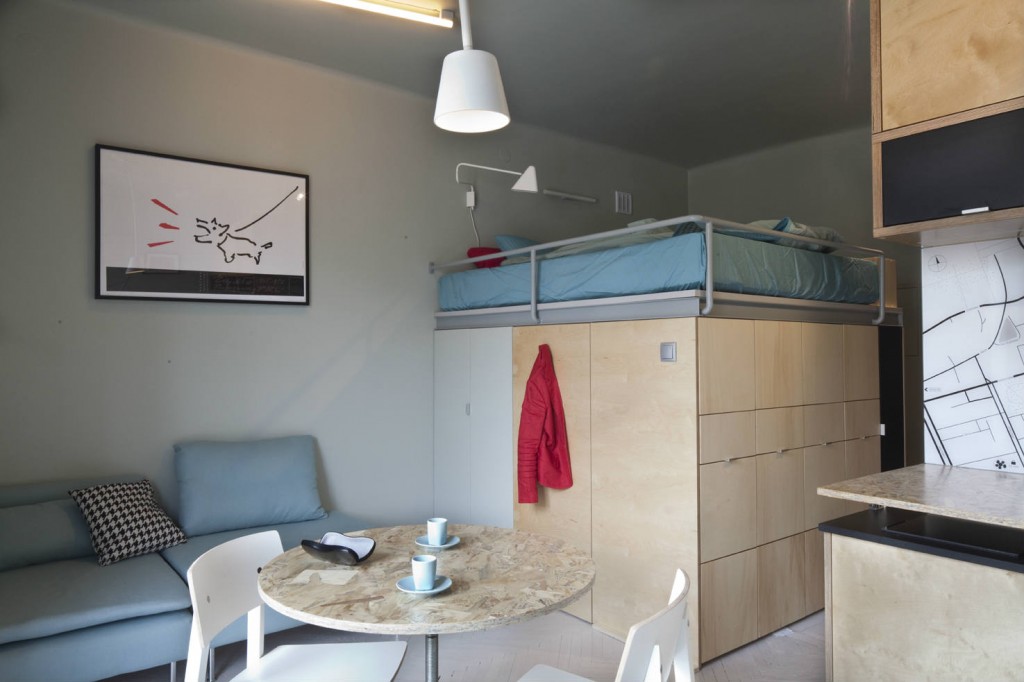
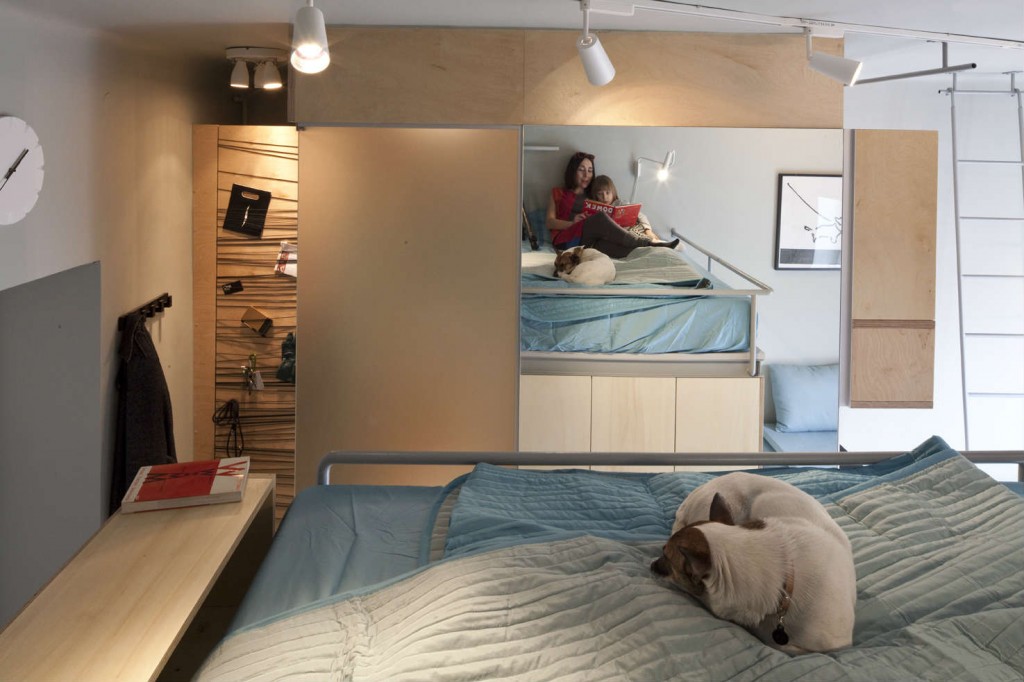
If you’ve some funds, you can get some swell built-ins to add to your space. From Life Edited, here’s a suite in Warsaw, Poland for a mother, her son, and a dog. It’s just 237 square feet.

Small-apartment-Warsaw-living_1

Small-apartment-Warsaw-closet

the suite has “normal” height walls, it’s great to see someone doing something up high in that limited space.

In Barcelona, this bachelor completely built-in his life into this 258 square foot suite:

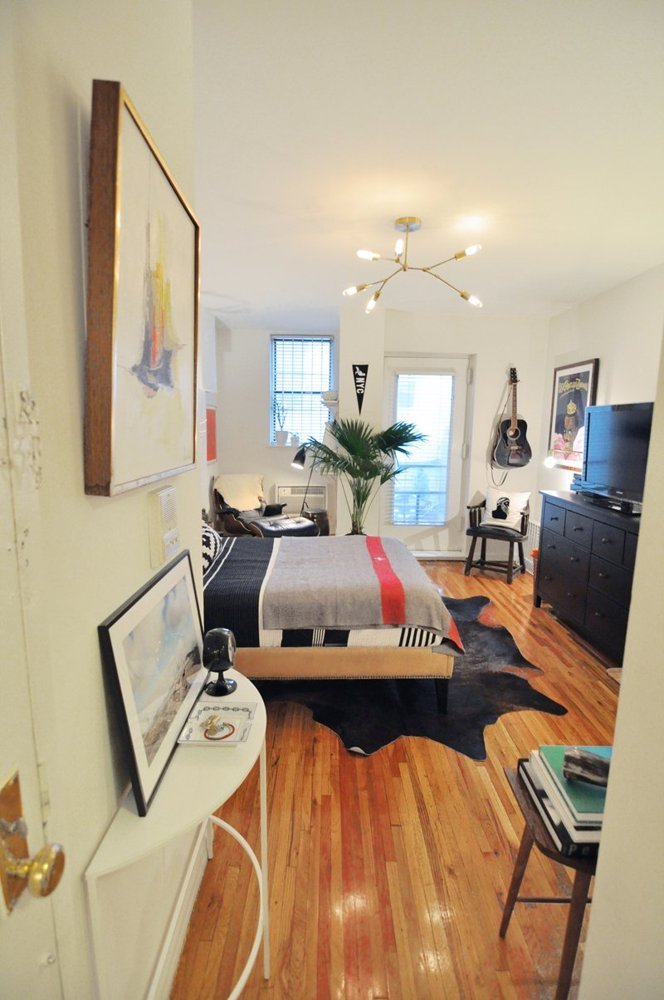
With bachelor suites you may not want to hide your bed away, but rather make it a focal point:

ManhattanBachelor

See the rest of this sweet suite at Apartment Therapy.

But Isabelle LaRue completely transformed her studio space with some clever hacks:

Isabelle is loaded with talent that way — check our her blog at Engineer Your Space.  But you could incorporate a lot of her ideas into your studio even if you are not as handy (maybe you have a few handy friends?).

Here’s another way people divided their space to get a private bedroom:

how-to-divide-living-room-into-bedroom-1

There’s more ideas on fitting a bedroom into a living room here.

The lesson I’m trying to jam down your throat here is that even if living smaller is not by choice (if, for example you have to live in a city with a tight housing market — I’m talking to you Hong Kong!) — you can still find a way to live comfortably in less space.

As I repeat — Small is the new Black.

News from down the alley and around the town

DH and I took advantage of the unseasonably warm weather a couple of weekends ago to walk over to Commercial Drive and shop in some of the little stores that line that avenue.

We started off our stroll by walking down the alley for about five blocks — and we found a laneway home on every block.  All new, of course, all built under the former design rules with one-and-a-half stories and no outside parking pad, all looking very nice….and all looking very much the same.

I can’t blame people for wanting to avoid the extra cost of designing their own laneway homes.  And the Craftsman style that predominates is certainly handsome.  But I am glad that some of the local builders are including new and innovative designs in their catalogues.

Smallworks got lots of press this past week with their brand-new design for a glass-brick house.  The whole house is not built of glass brick, but the all four walls have a cheery glow:

GlassHouseThe design has got lots of attention.  I read about it in The Vancouver Sun, VanCity Buzz, Curbed, and Eater.  There was even a letter to the editor in the Sun that worried about the house contributing to light pollution. That’s more fuss about one laneway house than I’ve seen since the early days (oh, those pioneer days of laneway housing — two years ago).

I like the design, there are two versions of the plans, and I think it would be a welcome addition to any block.  And, as I said, I am happy to see a different and innovative look available without a custom design.

I don’t think I could live there (for one thing there is my proclivity to throw stones, and you know what they say….) it’s a little too bright — on a sunny day the light would pour in.  But it’s a handsome house, a good use of space, and a nice different design.

Congratulations, Smallworks.

On another note:

Laneway housing might be coming to the Queen City.  New Westminster Council is currently discussing

 the interest and feasibility of introducing laneway and coach houses similar to those allowed by the City of Vancouver.

Affordable housing is a problem throughout the entire Lower Mainland, not just in the city of Vancouver, so communities throughout the area are looking into a variety of solutions, and laneway housing is just one of them. New Westminster Council is discussing whether to go ahead with laneway housing or to wait and make it part of a much larger neighbourhood planning process currently planned for two years down the road.

The more the merrier, say I.  I believe fervently that laneway houses has a place in the mix of housing in any community.  It’s true that they don’t dramatically reduce the need for affordable housing but they do relieve the under-supply of homes in the area.

Fingers crossed the plan goes ahead.

Tests, trials, and inspections

Even though we had moved into our (tiny, perfect) home at the beginning of the month, the house having passed its Safety Inspection, we actually hadn’t had our FINAL final inspection.  The inspector arrived a couple of weeks ago, and (spoiler alert) we passed!  So now we are very happy and secure that our house is all legal and everything.  **whew**

But that wasn’t the only test we had to pass.  To be deemed energy efficient, we had to have an Energy Efficiency Evaluation.  A qualified energy advisor has assessed the energy efficiency of our house by using Natural Resources Canada’s EnerGuide Rating System procedures. That involves some test, including a Blower Door Test.

energuide-label

The rating goes like this:

New House build to building code standards 65-72
New house with some energy-efficiency improvements 73-79
Energy-efficient new house 80-90
House requiring little or no purchased energy 91-100

Our house got an Energy Efficiency Evaluation of 83!

The evaluation also included a report on how much we can expect to pay to heat the house — combined electrical and natural gas costs of $942.19 — a year!  Along with telling us how much we can expect to pay each month that also gives us a base amount of what we should be spending, so we can see how much our electrical devises/gas stove and barbecue/do-dads and gee-gaws are costing us to run.

And that great score means we can apply for some PowerSmart Rebates.  DD is working on that.  She and DSIL have to apply, as the home owners.

To help us keep track of power usage we might get a Neurio device next year.  A local invention,

Neurio is a home intelligence™ technology that makes your ordinary appliances smart and your home more efficient. Using a WiFi power sensor and a cloud service with some smart pattern detection algorithms, Neurio monitors your home’s electricity to figure out what your appliances are up to – without the need to install sensors on every device.

It’s pretty space age-y, and a great idea to help conserve. If everyone cuts back on the power they use we can all save in the long run.  Here in BC we expect cheap electricity, just like we expect cheap, clean water.  But with more homes being built, more people moving here, we will need more power.  And that means more dams because we just haven’t caught on to the idea of wind farms (even though there’s a big honking windmill visible from Downtown Vancouver).

windmill

Dams are way out in the mountains, far, far away.  But they are super expensive to build.  And the people who own the land way out in the mountains may not be crazy about the idea of, you know, flooding it.  And they were here first.

Pushback on small apartments in Portlandia

It’s no secret that the rental market in big cities is crazy.  Crazy as in bad.

This article in the New York Times explains how the people who are being badly squeezed by the rental shortage are those on the bottom of the economic pyramid.  New rental buildings are going up — but only for renters who can afford at least $1500 a month.

Many of the worst shortages are in major cities with healthy local economies, like Seattle, San Francisco, New York and Washington. “We’ve seen a huge loss of affordable housing stock,” said Jenny Reed, the policy director at the D.C. Fiscal Policy Institute. “We have lost 50 percent of our low-cost units over the past 10 years, and at the same time, the number of high-cost apartments, the ones going for more than $1,500 a month, more than tripled.”

Everyone is suffering from the rental crunch.  As accommodations get scarce they get more expensive.  It’s bad for everyone, but for the people who don’t make much money it’s far worse. The people who make our lattes, who deliver our papers, who serve us our lunches are all hurting for accommodation they can afford.  So are students, and retirees who don’t own their own home.

And it’s just going to get worse.

Seattle has followed other American cities in allowing (even encouraging) the construction of Micro-suites.  AKA aPodMents.  I’ve spoken of them before.  And other cities in the States are also allowing tiny apartments to go up.

For the adAPT NYC competition, micro-apartments meant an apartment that was between 275-300 sq ft, but these included kitchens and ADA bathrooms. In San Francisco, legislation last year granted an allowance for building dwelling units as small as 220 sq ft, with 70 sq ft for bathroom and kitchen. In Boston, they nervously authorized the construction of 450 sq ft “Innovation Units.” In Providence, RI, they’re making apartments as small as 225 in the Arcade Providence.

But not everyone loves them.  In Portland right now the city government is in the midst of a controversy over a plan to allow these mini-homes to be constructed.

reusable-protest-sign

 The issue, once again, is parking. …The apartments, enjoy a “group living” designation–the same as dormitories, monasteries and convents. As such, they are not required to provide a set amount of parking spaces.

IMHO this opposition is taking is a very, very, very short-sighted view.  Even the most myopic of us can see that having more cars and finding space to put them is not the answer.  Every city planner since Robert Moses has worked to keep cars out of civic cores.  We need them, true, but improved transit and walkable neighbourhoods will serve the entire city (not to mention the planet) much better in the long run.

And let’s look at the market for these micro suites — not every one who rents one will own a car.  Since affordability is the chief attraction of renting one, it’s quite likely that the potential clientèle will use transit or some form of co-op car ownership like Zip Cars or Car2Go rather than tying up money in an automobile.

But even if most of the people in the building have cars, why are the people currently living in the neighbourhood worried about street parking?  Don’t they have garages and parking pads in their yards? And even if they put up “average” sized apartments rather than the micro-suites, isn’t it likely that the tenants will be sharing them, so you end up with the same number of people (and cars).

I’m very much interested in what others feel about micro-suites.  I think there’s definitely a place for them in the housing mix of every large city.

Real life and reel life small apartments in New York

Who hasn’t dreamed of moving to New York, at least for a couple of years?  Pretty much everyone, which is why living space is at such a premium in that city.  And when people pay such a lot for such a little space, they get pretty creative with how they use their limited living area.

A recent discovery of mine, YouTube program SPACEStv brings us this super sleek space-age apartment — completely finished in recycled materials.  Watch this and learn more about it:

Incredible that this space was built by just one guy!  It looks like something from 2001 (the movie, not the year).

And from Inhabitat we see a similar space but a completely different take.  The HBO series Girls features a very home-made looking space-saving studio suite built by and for the character Charlie. As in real life, this apartment uses every square inch for living.

girls-charlies-apartment-leWhereas the first apartment had everything — even the kitchen stove — hidden behind slick plastic and stainless steel, this suite has everything right out in the open. But it feels warm and welcoming.

The space was designed by production designer Laura Ballinger

girls-charlies-apartment-5Surprisingly, I could see myself living in the fictional home before I would feel comfortable in the actual home. There’s something about the “Tron” apartment that looks a little toooooooo white and clean.  But since the builder/occupant is an environmentalist it was important for him to get away from the dirt and the garbage he deals with every day.

Which would you choose?

Living small? Buy into the idea

Yes, we are moving into a tiny home, and yes, we are happy to do it.  It’s not for everyone, but is it for you?  Would you put your money where your future house may be?

Ian Kent thinks his Nomad Micro Homes could be one of the answers for densification in our city — plus the solution for other housing problems.  “Less House More Home” is their motto and they have a 160 square foot house for you…for just $25,000 to $28,000.

Great for a summer house, a guest house, a studio or even your main house (if you live a minimalist life).

“There’s a wide range of uses, from people using them as additional accommodation, to recreational property — you could basically drive this home in and assemble it in a week.”

And if you think it’s a good idea, you can support the idea with a contribution to their Indie Gogo page

Nomad

And find out more about the project here:

My Pain, My Life, My Struggles, My Fight

Come walk with me, Down My Dark & Stormy Journey BUSINESS INQUIRIES & CONTACT EMAIL : GODSCHILD4048@GMAIL.COM

ANNOTATED AUDREY BLOG

Artist and Desert Dweller with Big City Style.

Im ashamed to die until i have won some victory for humanity.

Domenic Garisto / LIFE IS NOT A REHERSAL,SO LIVE IT..if you can't be the poet, be the poem..havau22.com

The Lady Who Lives Down the Lane

Lane Way Housing for the Nervous Novice

Apartment Therapy| Saving the world, one room at a time

Lane Way Housing for the Nervous Novice

Slightly Snug House

building a home that's not too big and not too small

Vancouverandy

Funny thoughts from a nut like me.

Small House Bliss

Small house designs with big impact

WeeHavyn

Lane Way Housing for the Nervous Novice