RSS Feed

Category Archives: Laneway House

Portland, Oregon says yes to laneway houses

Vancouver is certainly not the only city facing problems of scarce, expensive housing.  Nor is it the only city responding to those problems by building laneway or infill houses.

PortlandADU

In Portland, Oregon, these homes are called ADUs — Accessory Dwelling Units.  Unlike the laneway homes we know and love in Vancouver, they also include basement suites in this category.  And unlike the process here in Vancouver for laneway homes when you build an ADU in Portland they waive the permit fees.

That’s right — the city waives the permit fees for new infill buildings.

According to this story in the Tribune, in Portland that can save you between $8,000 and $11,000. That development permit waiver started as a pilot project in 2010, and was continued in 2013.  In Vancouver a similar program would mean savings of around $20,000 per laneway house.

There seems to be little pushback in Portland from people living in the neighbourhoods — of course you can purchase a perfectly lovely home in that city for about $300K.  And people recognize that the smaller buildings are much greener than large buildings using fewer resources to build and maintain. The state has its own Oregon Department of Environmental Quality, and their spokesperson said,

“Smaller homes have significant environmental benefits compared to other green building strategies. Building small is a very green thing to do,” says Palmeri.

As this story in the Tribune put it

Regardless of their size, ADUs are generally more environmentally friendly than a new home built in a traditional subdivision. They require no new land, less building materials and energy usage. They help Portland and the metro area meet population growth needs without developing farm land. Putting those residents in existing neighborhoods reduces sprawl and vehicle miles traveled, easing road congestion.

A recent survey by the DEQ found

the mean cost for an ADU is nearly $78,000, with about a quarter costing more than $120,000.

“That’s a lot of money for a lot of people,” says Palmeri.

In our neighbourhood numbers like that would have us drooling.  It would take a lot of number-crunching and cost-counting to bring in a laneway house for $120,000.

I would welcome a survey such as the DEQ conducted right here.  It would be interesting to find out how laneways are being used. In Portland, Ashland, and Eugene the survey found

 81 percent of ADUs in all three cities are used as primary residences, only 18 percent of occupants are family members and 53 percent of occupants were strangers when they moved in. And the majority of owners in all three cities — slightly more than 50 percent — built them for the additional rental income.

Lean, green, income generating machines.  It’s great to see how laneway houses can improve cities — and lives.

Mixin’ in the kitchen

Apartment Therapy is a great source for info on small spaces.  Let’s face it — most apartments are small.  That means getting clever with organization and use of space.

With my mind on kitchens, I was looking through some tiny apartments in Apartment Therapy to see what people have done with these spaces.

Apartment kitchens are usually pretty dull for two reasons — a) they are tiny, and b) they are full of things that are expensive to install and replace — appliances, cupboards, floors.  So most apartment kitchens start off fairly…..pedestrian.

Go nuts.

Go nuts.

Those white/almond cupboards with the wood trim?  Fairly ubiquitous.  This owner has kept the accessories white to add to the feeling of cohesion and spaciousness.  It’s tidy and pleasant, and the upper cupboards go right to the ceiling rather than have that dust-collecting shelf at the top.

But there are obviously strict limitations.  In this suite, they’ve put the kitchen in the space under the sleeping loft, which means it’s basically the foyer as well.

ATKitchen1

The owner has colour-coordinated the accessories, which is nice, but it’s clearly meant to be as unobtrusive as possible.

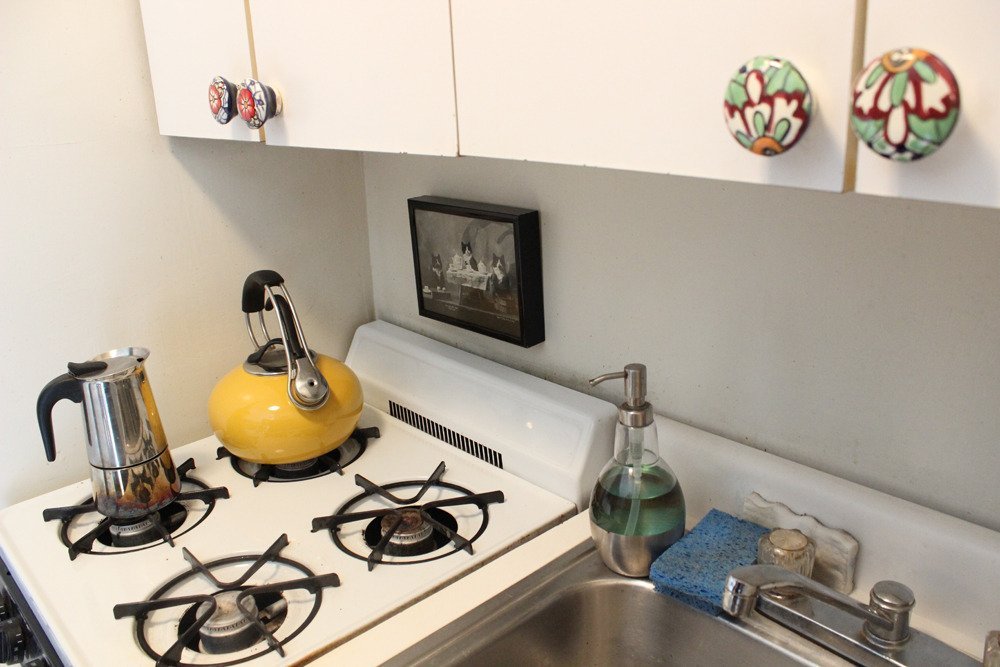
This tenant has managed to infuse some colour and pattern into the basic white of their kitchen with beautiful handles:

ATKitchen3

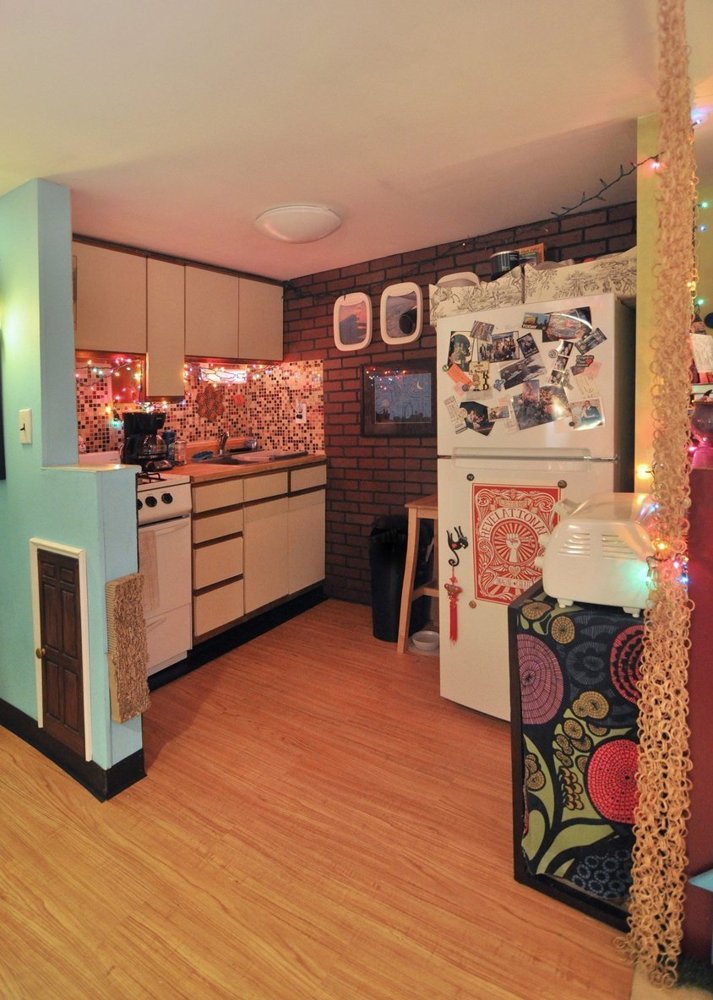
But some people infuse their spaces with their personalities by going all out with eccentric chachkis:


ATKitchen4


I sense a religious theme:

ATKitchen4.2

I think that’s a better use of space than putting your extra casseroles up there.

A studio suite in a basement has a lot to overcome.  Renter Laura Lee has brightened her windowless kitchen with well, stuff:

ATKitchen6

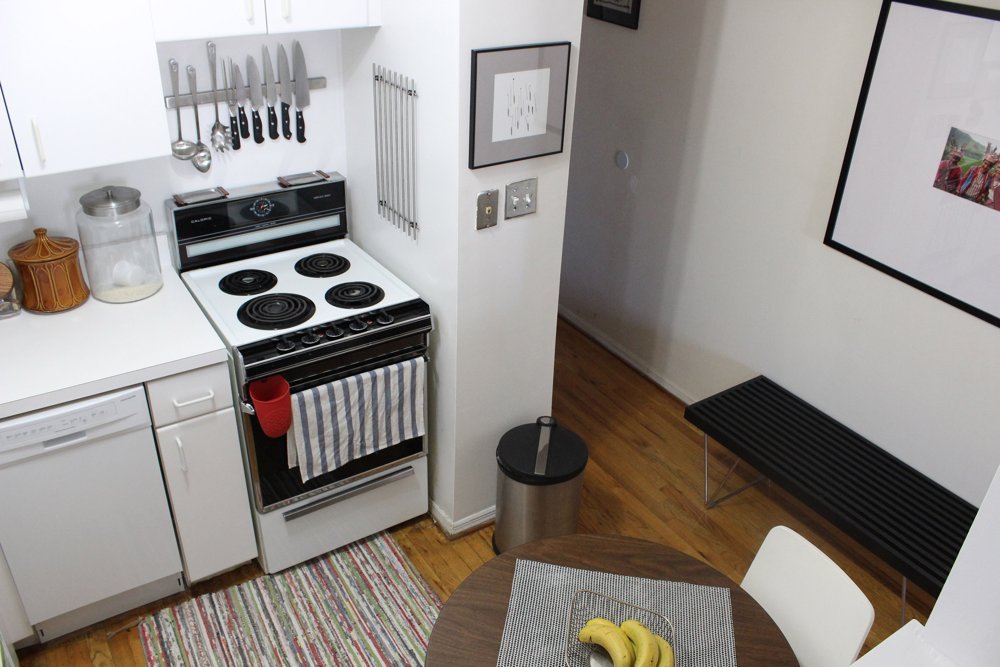
Sometimes plain is a good thing.  These renters have played off the white of their kitchen by keeping to silver and black — continuing the sleek modernism of the rest of their loft.

ATKitchen5.2

Even the rag rug keeps it clean and simple in the kitchen:

ATKitchen5


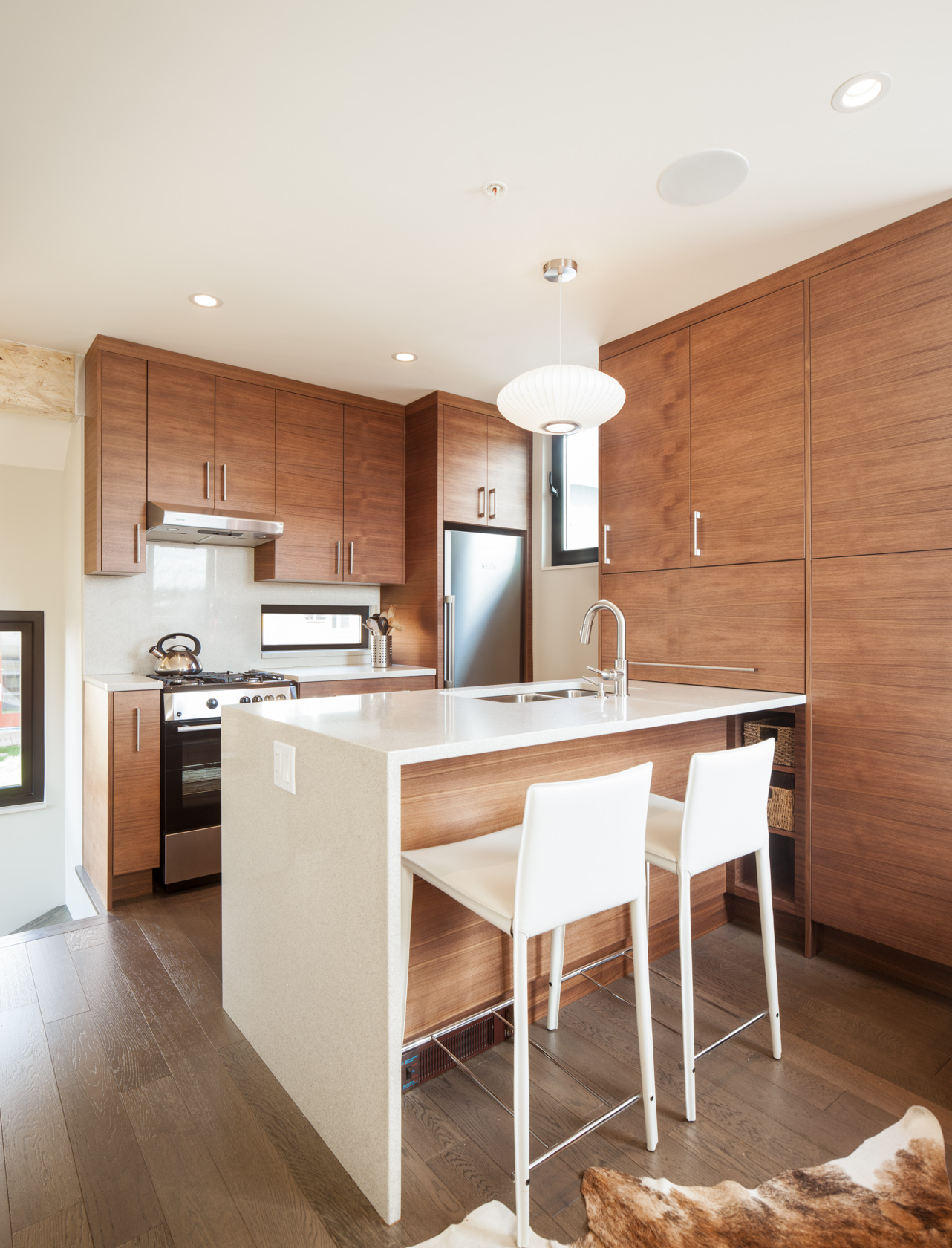
When we were planning our laneway, we wanted a nice kitchen.  You have to compromise, but the kitchen was not the place we wanted to do that.  Instead we sacrificed a “living room” for a more spacious cooking and eating area.

Want to see it?

Kitchen1

Photo courtesy of Novell Design Build.

That huge counter with the waterfalled edge?  We wanted that.  It gives us a comfortable place to sit and eat, plus lots of room for cooking and baking (and sewing and writing blog posts on the laptop.)

You can see how light and bright it is.

Kitchen2

Photo courtesy of Novell Design Build.

And there really is tons of storage.  A pull-out spice shelf, appliance garage, plus deep drawers for our dishes and pots.

This is what it means to have a custom kitchen built just for us.  I’m sure you will look at that kitchen and think “I would have done things differently.”  Well you can!  We wanted this, and we got it, thanks to good work from our designer, our builder, and our custom cabinet maker.

We change up the accessories to add more personality to the space.  And we keep it very, very tidy.

The kitchen is the heart of the home, and we wanted one that would inspire us every day.

It’s Alive! Living beneath a living roof.

One of the most unique features of our home is something we’ve come to take for granted — the living roof.realroof

It was grown for us out at N.A.T.S .Nurseries in Langley, who are representatives of LiveRoof.

It’s very green and ecologically responsible and etc. etc. of us to put in the living roof, but we originally just wanted it because it looks nice.

Because our roof is visible (due to the slope of the property) the folks in the main house and the neighbours are looking at it whenever they look at the laneway house. And because we have flat roof not just on the upper storey but also on the top of the garage and some of the lower storey, we just wanted something nice for them to look at.  The roof of the garage is right outside our kitchen window, and it’s much more pleasant to look at a garden than a heli-pad black slab.

Our roof is an extensive green roof, a carpet of sedums and other low-growing plants.  An extensive green roof would support larger plants, even trees.

But it turns out there are lots of other very good reasons to install a living roof of either kind.  According to the Green Roofs for Healthy Cities site, living roofs offer benefits to more people than the home owners.

For cities:

1. Cleaner water. Living roofs clean storm water.  Here in Vancouver we can have real downpours.  The water runs off hard surfaces like roads, sidewalks, and yes, roofs, and enters the storm sewer system.  All at once.  That can overwhelm the system.  But living roofs absorb and retain the water, delaying its entry into the storm sewer and easing the pressure on the system.  Plus the roofs filter the water, and through evaporation, lessen the of water they deliver to the system.

2. Cooler cities. You may have heard about the “urban heat island effect“.  This is a problem for big cities where the structures absorb heat during the day and retain it far longer into the evenings than soft, natural surfaces.  According to the EPA,

The annual mean air temperature of a city with 1 million people or more can be 1.8–5.4°F (1–3°C) warmer than its surroundings.3 On a clear, calm night, however, the temperature difference can be as much as 22°F (12°C).3

The living roofs keep cooler during the day due to the evaporation that goes on, but they also cool off much faster than hard, black roofs once the sun is down.

3. Cleaner air. Plants clean the air of pollution and particulates.  So living roofs can reduce smog.

For individual home owners:

1. Energy efficiency. The living roof acts as an insulator during the winter, keeping the home warmer.  Plus in the summer, it keeps the home cooler because the plants provide an insulating layer PLUS the evaporation of water through the plants lowers the temperature.  You may have set a sprinkler on your roof during the super hot weather to cool it off — that works by evaporation and our roof does that all the time naturally.

2. Fire retardation.  If a building near by catches fire and the sparks land on our roof, they will just go out.  It would be like trying to light a lawn on fire.

3. Noise reduction. According to Green Roofs,

An extensive green roof can reduce sound from outside by 40 decibels, while an intensive one can reduce sound by 46-50 decibels

4. Increased durability.  The plants protect the membrane below them from the destructive rays of the sun. A living roof can last at least two times longer than a plain membrane roof. And that keeps membrane and sealant out of the landfills.

There’s some maintenance to be done on the roof — weeding!  We’ll also be putting on a little fertilizer.  Thanks to N.A.T.S. Nursery for their help.

Visit N.A.T.S. Nursery at their website for more information.`

Someone’s in the kitchen I know-oh-oh-oh

When I am not strumming on my old banjo (which is totally not something I do) I like to cook.  And I like to eat.  So a well-designed and -equipped kitchen was tops on the list of what DH and I wanted in the laneway home. Some laneways have tiny galley kitchens, but we wanted one with all the bells and whistles.

And we got it!

The appliances are small but they are efficient and the design has made us more efficient.

It was while I was unloading our adorable little drawer dishwasher by Fisher and Paykel that I realized it wasn’t just its size and efficiency I loved — it was also its location.

Isn't it cute?

Isn’t it cute?

When it came to the under-counter storage I knew I wanted drawers for storing my dishes and cooking utensils rather than cupboards.  Drawers give you access to the complete space, pulled out into the light.  No more rooting around in dark corners — everything is right there.  And when I am unloading the dishwasher, having the dish storage just beside it makes putting everything away a dream. Or at least less of a nightmare.

It also helps that the dishwasher is placed just under the counter, so there’s less bending and stooping.

It takes a few minutes to unload the dishwasher and then it’s ready to hold the next meal’s worth of plates, etc. There are never any dishes sitting on the counter waiting to be cleaned or put away.  And it’s changed our lives!

Because here’s the funny part — in our old home we hardly ever used the dishwasher.  DH hates to have dirty dishes sitting all day waiting for the machine to be filled up so it can be run (he can hear the germs multiplying) so he washed them up after every meal (note:  I did not wash them, he did.) But then we had dishes sitting in the rack on our counter all day. The smaller size of our new dishwasher means we do smaller loads more frequently — perfect for the life we lead.

In her blog Nesting Place the Nester talks about her battle with the dishwasher —

For some reason unloading the dishwasher is a dreaded chore in our house.

It’s a pain to dread something that needs to be done daily.

When I dread something that needs to be done daily, it’s a red flag. It’s an opportunity to evaluate if I’m helping or hurting the situation just by something simple that I can change. 

So she reorganized her kitchen so the dish storage was next to the dishwasher and voila!  The chore that everyone was dreading a lot became just another small thing to be done.

Dishwasher unloading takes about 90 seconds and even the 16-year-old thanked me for planning out the kitchen to make unloading the dishwasher super fast and non-dread-inducing.

Do read the whole post at her blog. And when designing a space — whether it’s your kitchen or your bath or your foyer — remember to design around how you want it to work, not just how you want it to look.


Fitting families into smaller spaces

Two people can live as cheaply, and in as little space, as one. One bedroom for two people just makes sense for us.

Families, however,  need private space for their children — and space is at a premium whether you live in a condo or a small house.

When I was a child, lo these many years ago now, my sister and I shared a room for many years with bunk beds.  Eventually we had our own rooms, small spaces but completely our own with our own closets, dressers, desks and beds. But putting two children into one room is possible — and many people are doing it with style.

Apartment Therapy has some great ideas for when two children have to share one room:

Some people like to give the children identical spaces.

KidsBedroomIdentical

This room is for two sisters.  In another space (below) shelves hold the personal belongings of each child, even though the spaces look identical.

KidsBedroomIdentical2

Good use of vertical spaces.

Sometimes the different spaces are indicated by colour or pattern:

KidsBedroomColour

KidsBedroomColour2

And sometimes a single room can be divided by shelves or wardrobes (I did this when my kids were small and sharing a bedroom):

KidsBedroomSplit

KidsBedroomSplit2

And you can even put up a physical barrier in the room to split it.  If the kids get along well, a curtain will be fine.

KidsBedroomSplit3

But sometimes an actual barrier will serve the purpose better (I think my sister and I would have needed something like this):

KidsBedroomSplit4

This is a good idea if one person is a neatnik and the other not so much.

Even if you can have one bedroom per child, a small space means the play area and the sleeping area can overlap.  From this Houzz Tour we see how this family fits four bedrooms into 1500 square feet.  The kids’ rooms are very small, but have beds that fold up into the wall to create more floor space for play:

Contemporary Kids by Inglewood Architects & Designers (fer) studio
The little boy’s bed is hinged at the side, like a Murphy bed; the little girl’s is hinged along the side, like a Pullman bed.
Fitting more people into less space is kind of a mission with me.  I’m glad to see these stylish and comfortable options for families living in small homes.


Springing ahead

Well, despite what good old nurturing Mother Nature is doing to various parts of the country, here in Vancouver it is definitely spring.

Last weekend I did my spring planting.  And I also checked out out shrubs to make sure there were little buds on their bare limbs ready to turn into leaves.

But what about inside?  What’s springing up there to make us think the season has finally changed?

Cushion covers for our sofa — nice green with dots.

Our cozy corner

Our cozy corner

Plus a little round tray for setting your coffee upon (ottoman doubles as a coffee table).

To finish the look, a bowl with the same green for fresh fruit and matching linens.

What other ideas can we provide for freshening your decor?

Well, you can start small with placemats and napkins. Here’s a set from Style at Home’s website.

Spring napkins

Those would brighten your table — and look great with your winter-white china.

To change out a whole room in one go you could paint an accent wall or follow SAH’s advice and apply a wall decal.

Spring decal

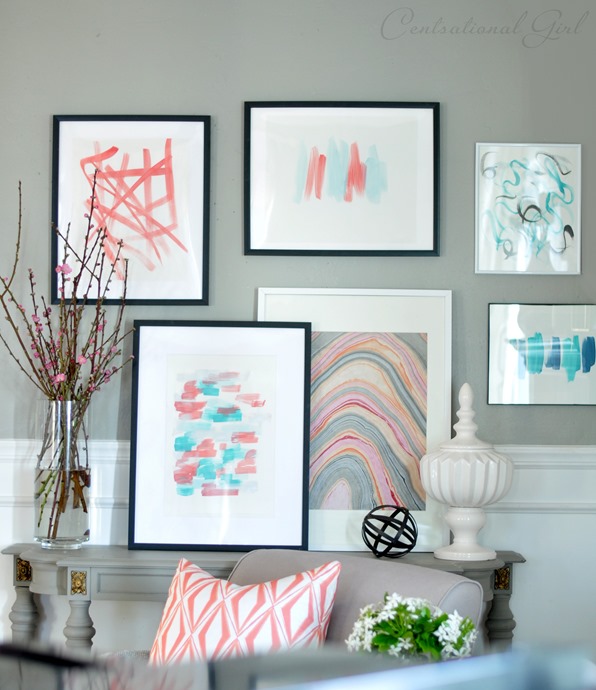
Centsational Girl added some coral cushions to the cool grey of her front room, then created some artwork to match!

Spring sofa

She painted that simple botanical above the seat, and some colour-matched abstracts to pull the colour into other areas of the room.

Spring abstracts

Apartment Therapy reminds us that rain also means rainbows. In accessories.

Spring cushion


And art:

Spring art


If you’ve been living with winter for a while be sure to start your re-newal with a good spring cleaning, open the windows, bring in some greenery and celebrate.

It’s Spring!

How does our garden grow?

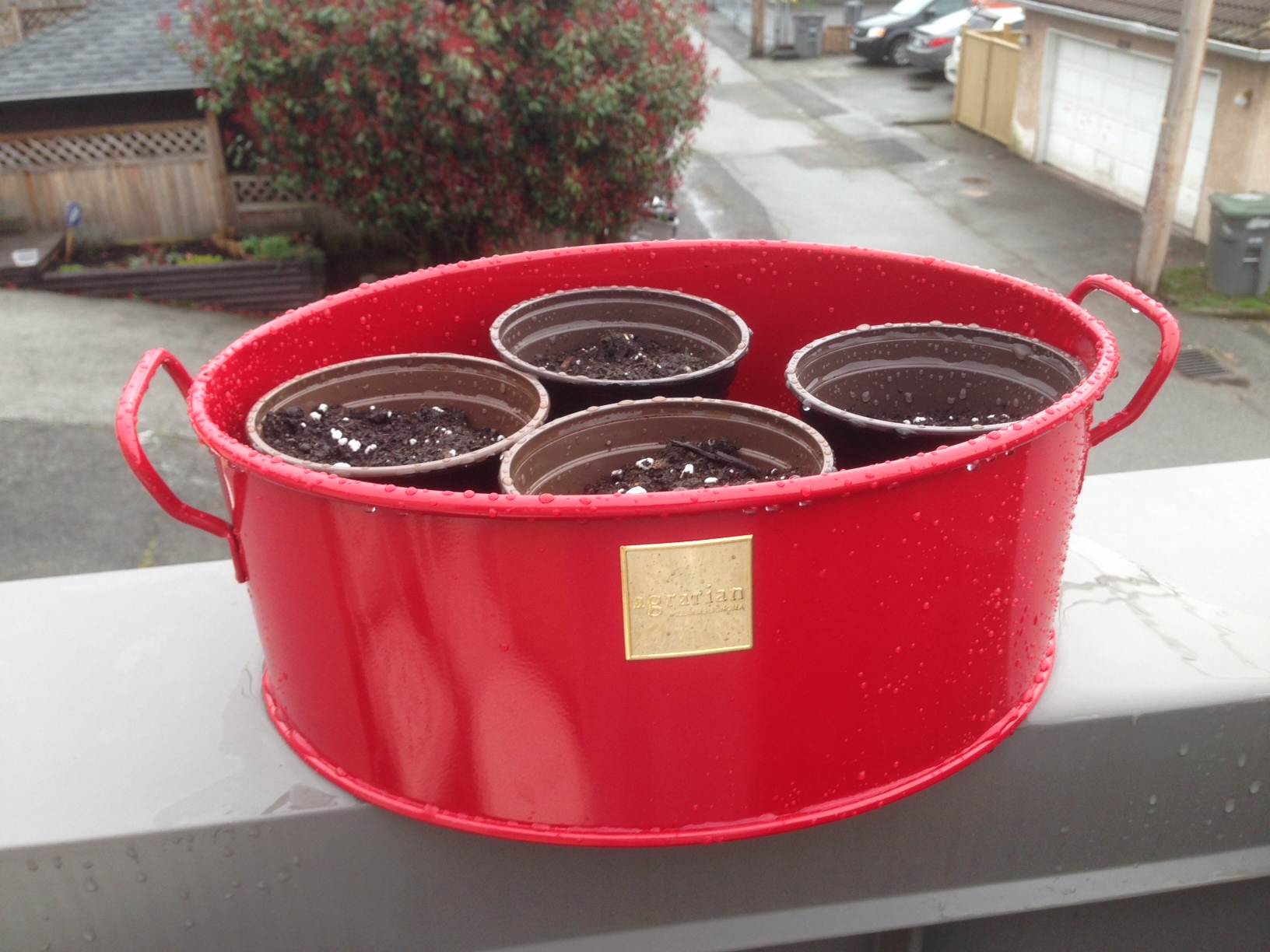
Yesterday I went with DD to the store and bought my first pair of gardening gloves.  Plus a bag of potting soil.  Then, while she carefully delineated and planted her first sowing of vegetables in a narrow strip by the sidewalk, I planted eight little pots with herbs.

The promise of herbs to come

The promise of herbs to come

Yup, I gardened.

One thing that you should definitely know if you are planning to build a laneway house (and I hope you are!) is that landscaping is a very important part of the process. I’ve written about this before but it bears repeating, you have to have a plan.

In the regulations it says quite clearly

11.3.3 Except as provided for elsewhere in this section, the setback area shall be fully graded and
landscaped with trees, shrubs and lawn to the satisfaction of the Director of Planning.

11.3.4 The following may be permitted within the landscaped setback area by the Director of
Planning:
(a) statuary, fountains and other objects of art;
(b) open ornamental fences if necessary for the protection and preservation of landscaping or
permitted objects of art;
(c) walks or driveways which in the opinion of the Director of Planning may be required to
provide direct access to any building or use on the site.

That’s bureaucrat for “you need some plants here, people”.

In the application for your building permit you must include

Landscape plan should include the following:
□ Plant/ Tree list (common & botanical name,
size, quantity)
□ Plant list symbols keyed to the plan
□ Indicate soft and hard landscaping

And not just any plants, either.  They want you to plant with five factors in mind:

1) low-maintenance,
2) drought-tolerance &
hardiness,
3) scale (all plants under 3ft
high not including vines &
climbers),
4) availability, and
5) variety & interest

And in the Guide the City of Vancouver provides they even list some plants that take these factors into consideration.

With the help of our landscaper Amro and his team, we have fulfilled the promise of our original plan.  We have a plum tree

Which will look like this when it's all grown up

Which will look like this when it’s all grown up

And on the laneway, we have our tall grasses, our lavender, creeping thyme and our beauty berry plants

Beauty

Also not at this luxurious stage as yet — but will be!

When you are planning your laneside plantings, you are not allowed to put in anything that will obscure the front.  We originally  wanted to put in some tall bamboo in a little hedge, but it was pointed out that would provide the perfect hiding place for someone who wanted to break into our place or who wanted to give us a little surprise when we came to the front door.

As well, because the occupants of the laneway, us, are family, we do not have to have a specially dedicated area of yard just for us — but if we ever want to rent the place out we will need to have a clearly defined area of yard just for the laneway tenants.

It’s also very important to remember that your landscaping should be substantially in place before final inspection is completed.  So unless there’s a foot of snow on the ground, it’s expected that your plants will all be planted and your land will be scaped.

When planning your walkways, sidewalks have to provide a hard surface from the street in front of the main house right to the lane and the laneway door — no meandering gravel walks — for emergency services to get to the laneway if they are needed.

When you are planning your laneway build keep all this in mind.  Just as with the design of the home itself the landscaping design has strict rules to follow, but you’ll end up with a space you really love.


No new (stuff) is good news

Last week we went through our belongings in our storage locker and renewed our pledge to live with less.  It just makes sense.

But how do you resist the lure of retail?  After all, temptation is all around us — we see new and shiny things (or in my case, old and patinaed things); advertising is everywhere reminding us that we NEED NEW STUFF.

At this point it's mostly toys anyway, isn't it?

At this point it’s mostly toys anyway, isn’t it?

In the nick of time comes two articles from Apartment Therapy to help strengthen our resolve to fill up our lives with useless items.

First of all, avoid the idea that you are missing out on a bargain if you don’t buy that particular shirt or shoes or chatchka.

1. Avoid high pressure sales tactics.

We’ve all done it, gone into a shop for one thing and felt the pressure from the sales staff to get more.  Hey, it’s their job to sell you stuff.  But it’s not a personal rejection if you don’t submit to their wiles.  It’s your job to stick to your original plan.

Don’t have an original plan? Well,

2. Keep a list

You should always be aware of what you need, and what you buy frequently.  If you don’t keep a list in your head you may find yourself prey to the next item.

3. Avoid impulse buys.

You’ve got a shopping cart (in real life or online). Why not just slip in a couple of things that are on sale but are not exactly what you need RIGHT NOW?  Don’t do it.  You will regret that expensive impulse when you get the items home.  You know you will.  And if you bought it on sale you may not be able to return it.

4. Check the measurements and read the product info and reviews.

One of the great advantages of shopping online is being able to read the product reviews.  Those have saved me from many a foolish expenditure.  In a retail store be sure to check out the size on the package or you’ll come home with sheets that won’t fit your extra-thick queen mattress.

5. Eliminate temptation.

When we were stocking the laneway I subscribed to several on-line shopping services.  They were great when I knew I needed one white duvet and two sets of white queen sheets.  I was able to compare and was quite happy with the deals I got by waiting and checking often.

But I don’t need them any more.  There will come a time when I have to replace the sheets/towels, and I’ll subscribe again.  But right now I do not want to see a supermarket of attractive items coming through my inbox and tempting me to purchase them.

Maybe you know you have to buy a new shirt or blouse in an exact colour.  Find a sample of that colour and carry it with you to the stores.  It’s a reminder that you need THAT particular item and nothing else.

Yesterday DH and I took a little walk along Main Street, looking for a particular item.  I had a fabric swatch of the cushion covers I am making and we needed a little tray in a matching tone to sit on our ottoman and serve as a coffee table.  We whisked through second hand stores and thrift shops, zipping through in minutes because we knew exactly what we were looking for.  (We found it, BTW in the Vancouver General Thrift Shop for 50 cents).

So we’ve safely navigated the swamp of retail stores as far as impulse buying goes — what about the danger of (dun dun DUNNNNNN) Stocking up.

We can’t do it here.  We just don’t have the room for a giant case of paper towels or toothpaste.  So this article in Apartment Therapy speaks to us in the dulcet tones of truth. When you have limited room and are not expecting the apocalypse, store it at the store. What could be standing in your way?

Roadblock 1: Buy more, save more

You can save money on large quantities of things like paper and laundry products.  But we know well how much storage costs — we are paying for a storage locker.  How foolish it would be to use our in-home storage for bathroom tissue rather than bringing our good crystal home from that expensive lock-up.

Roadblock 2: Convenience

We have to go to the grocery at least every other day — our little fridge doesn’t hold very much.  And that is fine with us, we are close to 3 major grocery stores, two of which offer clothing, housewares, and yes, small appliances.  So stocking up on the bulky stuff just does not make sense when we’ll be back buying milk tomorrow.

Roadblock 3: You Might Run Out 

Once again, see Roadblock 2 above.  We are close to the store.  Running out means literally running out — the stores are open early and close late.  Plus we keep an on-going list of what we need.  We usually buy replacements for our dishwasher detergent or toothpaste just before we run out — and of course our neighbours can always help us out.

I think it’s a good idea to borrow a concept from our Zen teachers, but instead of mindful meditation we practice mindful spending.

Gettin’ down with the downsizing

Last weekend DH and I fulfilled an epic quest — we moved from a 10 x 5 storage space to a 5 x 5 storage space.  So we started out with 1100 square feet plus a 5 x 8 storage locker and we are now living in our eensy laneway plus holding on to enough extra junk, er belongings to fill just 5 x 5 x 8 feet.  And of course the big plan is that we will eventually get rid of all that extra, er, belongings.

milk

It was good to move it all box by box and take inventory.  We could see where the trims could be made, and we will make them.  We will not make the mistake we did with our old storage locker.  We will not stick stuff in little secret corners and forget about it for 11 years.  We will have to move the stuff at the front to find the stuff at the back so will mix the contents of the locker and gradually take out what we need, and get rid of the rest.

That’s the plan.

Because we are currently living with less, and loving it.  And I can tell you why. I could have thought of my own reasons, but why bother when Life Edited already lists 5 Reasons to Love Less.

1.Less is better for the planet.

It hurts to see how much we throw out.  And it doesn’t take much brain-power to see that the less you bring into your life the less you have to toss.  Less waste.

2. Less gets us into the present moment. Despite our best efforts to prove otherwise, humans cannot do more than one thing at a time; paying attention to one thing will inherently displace our ability to pay attention to another. When we have less in our lives, we can pay attention more fully to the fewer things we do have and enjoy them more.

That’s a little deep, but if we appreciate what we already have we are less inclined to be always seeking more.  And vice versa.

3. Less is easier to manage.

This is really coming across as we downsize our wardrobes.  We do the laundry a little more often and operate on a strictly restricted clothing rotation.  But it saves time and effort — as it does when we deal with fewer pots and pans and dishes, less linen.

4. Less is usually more interesting.

I get a slightly different take on this rule than the author.  S/he feels

Try less. Be unprepared. You might find yourself with a more interesting life.

But to me #4 means that you have fewer things so you have to make sure that they are the best things you can afford/find.  You can’t make do with inferior goods, you have to have exactly what you need.

And finally

5. Less helps us find out what is truly important.

To take it to the extreme, we’ve all seen those shows on hoarders, who collect cardboard and old newspapers with the same manic passion as they collect fine china or crystal.  They honestly cannot make the differentiation between items of real value and ….things. Detritus.

When you have less, you give everything more value, so you make sure it has real, extrinsic value aside from the intrinsic value we give it.

Now the secret will be to keep our promises to live with less.

We have made a good start.

Read the rest of this entry

Who gets to live here?

It’s no secret that I’m a real fan of any housing that lets people live in the city of Vancouver.  Houses, duplexes, condos, rental suites, basement suites, laneway houses.  Bring them on, in greater numbers.  I think that anyone who wants to should live where they want, in the city that has won the Best City in the World award and offers everyone the joys of living in a big, cosmopolitan, multicultural metropolis such as this.

Vancouver hasn’t always been such a “cosmopolitan” place.  We’ve always been a railway terminus and a seaport, a place of sawmills, stevedores and gandydancers, hard-working blue-collar workers.  And for many, many, many years, these people have ended up in the Downtown East Side (DTES) when they couldn’t work any more because of age or injury.  That neighbourhood has been the skid road — a term that started in this town when the corduroy log-paved roads would be greased to allow logs to slide down them to the sawmills — of Vancouver.  It’s a district of Single Room Occupancy hotels, where the sad and the broken live.  There are drugs, drug users, drug sellers (they don’t have to be pushers down there, just vendors). There are people struggling — and losing — with substance abuse of every kind.  There is prostitution.  There are the mentally ill. And there are also the agencies and organizations who help these people through their struggles. It’s a tough neighbourhood — but caring.

So in the middle of this vibrant town, full of life and activity and fun, there’s a place of shadows and sorrow.

Right next to this area is Vancouver’s Chinatown, a cultural treasurehouse. But it is also feeling the pressure of urban development. 

The property these areas sit on is becoming more and more valuable; development is pushing into it, squeezing the “have-nots” into a smaller and smaller area.

 Now maybe the city has found a solution to the squeeze.

From the Vancouver Sun comes this story of a new revitalization of the downtown east side and its centre, Hastings Street.

Today, Hastings is the heart of the Downtown Eastside, Vancouver’s most troubled neighbourhood. Hastings has become synonymous with drugs and poverty, an internationally-known eyesore.

But change may be around the corner. The city of Vancouver has spent the last couple of years going through a new Downtown Eastside local area planning process (LAPP), in tandem with many of the neighbourhood’s most vocal anti-poverty activists.

And therein lies the secret to this plan’s success.  Lots of times experts and pundits and caring folk from all around the city will try their best to solve the problems of civic blight.  But it’s only because they have pulled in people who live and work and advocate here that I think that they might have a chance to make this work.

If the Downtown Eastside plan succeeds — and that’s a big if — much of Hastings between Clark Drive in Strathcona and Abbott Street in Gastown is likely to be replaced with new developments. Taller buildings filled with single room occupancy hotel rooms, known as SROs, around Hastings and Main will probably survive, but most everything else is up for grabs, unless it is a designated heritage building or existing social housing.

There will be condos allowed in the five blocks between Clark and Heatley, as well as in the two blocks from Carrall to Cambie. Any new development will have to include 20-per-cent social housing.

The condo-free zone between Heatley and Carrall is called “Hastings Central.” Maximum heights range up to 12 storeys, although pure social housing projects can apply to go higher. All new projects in this zone have to be at least 60-per-cent social housing.

Overall, the plan calls for 4,400 social housing units to be built in the Downtown Eastside. Most people think this is the rough patch around Hastings and Main, but the city plan defines it as a much larger area that includes surrounding neighbourhoods like Victory Square, Gastown, Chinatown, Strathcona and Thornton Park.

Is it going to work?  Who knows?  It’s a noble effort, there are lots of people who are fighting it — well-meaning people with good arguments against it.

I’ve had some spirited discussions with them.   Why should developers buy into this plan?  Why should we, the lucky ones, bother with these people, drug addicts and the like?

Because, that could be us.  One or two mis-steps.  Age.  Illness.  Injury.  We could be there. According to counsellor Andrea Reimer:

She figures fewer than a hundred of the Downtown Eastside’s 18,000 residents are involved in the street disorder that goes on. Most of them just “fell through one crack, and then another.”

“How many times did I meet guys who lost their job, got divorced, had gambling addictions, were injured at work and were on pain medications they couldn’t get off of. People with brutal childhoods. It’s amazing that some of them are still walking around, right? And some of them aren’t.”

I want it to work.  I want the people who live in the DTES to have clean, safe, pleasant homes to live in.  And I think it could work if those homes were a mixture of those who have and those who have not.

I want it to work because I think the true measure of a society is how they care for those who cannot take care of themselves.

My Pain, My Life, My Struggles, My Fight

Come walk with me, Down My Dark & Stormy Journey BUSINESS INQUIRIES & CONTACT EMAIL : GODSCHILD4048@GMAIL.COM

ANNOTATED AUDREY BLOG

Artist and Desert Dweller with Big City Style.

Im ashamed to die until i have won some victory for humanity.

Domenic Garisto / LIFE IS NOT A REHERSAL,SO LIVE IT..if you can't be the poet, be the poem..havau22.com

The Lady Who Lives Down the Lane

Lane Way Housing for the Nervous Novice

Apartment Therapy| Saving the world, one room at a time

Lane Way Housing for the Nervous Novice

Slightly Snug House

building a home that's not too big and not too small

Vancouverandy

Funny thoughts from a nut like me.

Small House Bliss

Small house designs with big impact

WeeHavyn

Lane Way Housing for the Nervous Novice