RSS Feed

Category Archives: Minimalism

Nostalgia is not what it used to be.

As one gets older (and that’s the plan, remember?) one finds oneself with what you might call “obsolete skills”.  For instance, while I am in charge of de-jamming and refilling the multi-use colour photocopier at work, I also carry in my brain knowledge on how to run a Gestetner machine.
Gestetner

If you are about my age you will recall the sound of the drum whooshing around, the smell of the duplicating fluid and the sight of purple-printed pages heralding a class hand-out or exam.

I don’t need the ability to run one of these machines, just as I don’t need to know how to send a Telex, or operate an old-fashioned switchboard.  But the knowledge remains, crammed into a little corner of my brain.

Technology has made a huge difference in the way we disseminate information–we have to constantly learn new skills to keep up with it.

But in the home these changes are not as apparent.  The vacuum of my childhood might have been an ancient Kirby bought from a door-to-door salesman, but it worked the same way my new built-in does.  The fridge defrosts itself, but it still cools stuff like our old round-shouldered Kelvinator.

The only domestic chore that has completely changed is the way we wash our clothes.  I was pondering this fact the other day, as I loaded sheets into a machine that will weigh the load, adjust the water level, and deliver clean items painlessly and surprisingly noiselessly.

I want to pay homage to the home makers of the past, and to this very important talent that was once such a difficult and time consuming task: to keep the family’s clothes clean.

How to use a wringer washer:

Because everyone changed their sheets on their beds on the weekends, Monday was wash day in our home.  Yes, all day Monday. Set aside at least 6 hours, because you are doing a whole week’s worth of laundry.

Separate the laundry into whites (sheets and towels), brights, darks, and dirty (Dad was a blue-collar guy, his clothes got dirty).

First the washing machine would be rolled to the sink.

VintageWashingMachine

We had a basement, and big double concrete sinks, so that’s where the washer would be placed.  A hose attached to the faucet fills the machine with straight hot water.

Put in the detergent and let the agitator mix it into the water, then start the wash.

First load:  sheets.  Set the timer for 20 minutes or more (depending on how dirty the clothes are) and go and do some baking or cleaning or God forbid write a letter or have a cup of tea.  When the timer goes off, go back downstairs, swing the wringer over one of the concrete sinks that you have filled with rinse water, and then feed the sheets into the wringer so that the soapy water runs back into the washer.  While the sheets sit in the first rinse, put in the second load.

After swishing the first load around in the first rinse water, swing the wringer so that it sits between the two concrete sinks.  Feed the sheets through the wringer into the second rinse so that the soapy water runs back into the first sink.  Empty that sink.  Rinse it and refill with fresh water while you wring out the items for a second time and load them into the basket to hang up outside (if it’s sunny, even if it’s freezing out there) or in the basement on the clothes lines especially installed for the purpose.

When it’s time to wring out the second load, put them through the wringer into the second sink — thus the second rinse from the first load becomes the first rinse of the second load.  That way you conserve water because this method uses a lot of water.  And you rinse in cold water because hot water costs money, kiddo!

As the saying goes, lather, rinse, repeat.  All day.  Put in more water if it gets low in the washer, but it will get progressively more grotty — that’s the way it is.  Put in more detergent if you add more water. Do the dirtiest clothes last.

As each load is finished and wrung out, carry the heavy basket of wet things to the back yard and reach into the basket and lift and pin the item onto the clothesline so that it will catch the slightest breeze and dry.  It sounds like hard work because it is. It’s a lot of stooping and standing and carrying heavy loads.  In the winter your hands will get very, very cold.

Eventually the last load is finished and it’s time to empty the washer (we used a kind of siphon that Dad had hooked up to the washer so it could empty into the sink).  That lady in the picture above?  She had to open a spigot in the bottom of the tub to drain the water into a bucket which she would then empty into her sink.

And that button on the top of the wringer?  That’s to release the rollers when your child tries to help and the rollers grab her hand and pull it through the wringer up to her elbow.  Ask me how I know about that.  The pressure on the rollers was adjustable, too, so you could fix it according to the weight of the fabrics being wrung.

Now remember — the laundry must be whisked inside off the line at the first drop of rain.  And you must bring everything in before the dews of the evening make it all damp again.

Fold and put away the items that don’t need ironing, underwear, towels, dish cloths.  Put the items that need ironing into the clothes basket.  That’s for tomorrow.

More space for less stuff

The shelf guys were back this week to give us more space.  They put in shelves in places we had hardly thought of — great horizontal spaces for us to put our stuff.  And just moving boxes out of their way to install the shelves showed us once again — we have too much crap.  Er, things.

F’instance they installed a shelf under the kitchen sink so we can finally put our composting, recycling and garbage out of the way….and discovered we had stored bottles of carpet cleaner under the sink for the past 6 weeks.  We don’t have any carpets.  Ergo, we don’t need carpet cleaner.  Into the recycling they went.

Removing what we don’t need is part of our de-cluttering quest for this year.  And it’s a long, hard, constant job. Or, as LifeEdited puts it,

editing, i.e. getting to that essential, irreducible quality…is something that takes time and great effort.

They have a point, this life style demands a shift in thinking, a paradigm shift if you will.  One of the most important questions we have to ask ourselves is

What would my life look like in its most essential form?

So we’re changing our way of thinking in five essential ways, as suggested in this article:

1. Attention. Practice doing one thing at a time–whether it’s work, driving, reading or talking with a friend.

No more watching TV while writing, reading, doing the crossword.  Let’s concentrate on what we are doing.

2. Space. ask ourselves how we can make the most of the existing space and how we can remove any elements that don’t support how we live.

Like carpet cleaner.

3. Clothing.Create a wardrobe where every item is our favorite.

And that means no more shopping for shopping’s sake — even during the sales.

4. Food. eat less, but better–healthy, fresh food that supports longterm health, not immediate gratification.

Now the holidays are over and all the candy/snacks/desserts are gone, let’s keep it that way until next December.  The only food to grab and eat will be fruit.

5. Stuff. we might continually ask whether we need the stuff we have. Do we use it? Does our frequency and quality of use justify its residency in our lives?

As we move things from our rental storage space to our laneway home we have to keep getting rid of things we don’t use and don’t need.  Yes!  Everything we get rid of makes our lives simpler, more elegant, easier.  And cleaner.

Living a conscious, serene life.  Isn’t that what we all want?

Keeping it cool – decluttering the fridge.

While showing off our ootsy-cutesy home over the holidays, someone mentioned that their small fridge was driving them a bit crazy, as it was just too small to adequately hold their needed victuals between trips to the market.

I didn’t see how it was an issue for us as we have three markets within easy walking distance, and we can replenish our little Blomberg quite easily and frequently — every day if we want.

Fridge

But guess what — now it’s an issue.

Mostly because none of the local markets supplies small amounts of foodstuffs for couples with small fridges — they are used to stocking huge freezers with family-sized boxes and bags of food.  Plus I just go a little nuts when I see some produce I like, so our eensy crisper gets filled up and spills over into the limited number of shelves.

It’s a habit I must break myself of — right now I am wondering how I am going to get rid of a large bunch of kale and 3/4 of a head of cabbage since I’ve discovered that my cabbage/kale soup has a deleterious effect on DH’s  digestive tract. I bought a lot because a) I like cabbage/kale soup, and b) it’s cheap (like borscht!  only cheaper!), and c) no one in the neighbourhood sells half a head of cabbage. Plus I find myself with a leek (they only came in bunches of 3) and half a sweet potato.

I have learned my lesson, and will only get what we need from now on, and I am sure I will be able to clear out the fridge if I plan a few meals of leek/kale/sweet potato soup (it is a real thing) with cole slaw on the side.

I’m usually quite good at planning meals — I customarily make a month’s plan of meals so we’re not repeating the old stand-bys and we’re trying new recipes.  I just went off the rails with the move.

But it turns out that wasting food is not just a fault of mine…

  • It’s estimated that 40% of America’s food supply ends up in the trash.

  • 10% of greenhouse emissions from developed countries is generated by the production of food that is never eaten.

Yikes!  This article from Life Edited came along just at the right time.  It offers six tips for editing down your supplies, and preventing waste. As it suggests in the article, I buy food from the perimeter of the grocery store, the produce, meat, dairy, and bakery, and try to stay away from the processed food in the middle.  And we save our scraps for the city’s compost scheme. Leftovers get taken to work for lunch.

But I am guilty of saving cans and jars of food “for special”

Avoid “precious” food. How many times have you bought special cheese, meat, heirloom tomatoes–whatever–and waited to use it for a special occasion, only for that food to end up rotting? Have a plan for your food–either eat it at an appointed time or immediately. Food spoils. Make every day a special occasion.

And henceforth, I swear I will live by this rule:

Buy only what you need. This is a pretty obvious one, but try to buy the food and the quantities you know you’ll consume from one shopping trip to another. It’s okay to have an empty fridge before you go shopping. If feasible in your area, make more frequent, smaller shopping trips.

I’ll take that challenge!

You may know that I am a decorating junkie (and if you didn’t know before…..that statement was a dead giveaway).  Every Christmas my husband “surprises” me with a year’s subscription to Style At Home.  I follow decorating blogs and get updates from Houzz and Apartment Therapy.  It was a bit silly when I was living in an 1100 square-foot-condo that I couldn’t afford to renovate, but it’s ludicrous when we’re living in a teensy laneway house with all-new furnishings and finishes.

Or is it?

Although we are going to concentrate on de-cluttering and minimalising our lives this year, we will also have to finish off the little things that will make our house our home.  And Apartment Therapy has a great way to do it, with lots of help and tips.  It’s called The January Cure — a month-long step-by-step way to give yourself a

 “new” cleaner and more organized home.

What’s the sense of moving into a perfect home if I keep up all the bad habits that got me into clutter-strewn life I lived when I had more space?  I’m sure it will take me many iterations of the cure to rid me of all my bad habits but I will start small.

Step One (I should have started this on Thursday, but won’t have to spend a lot of time on it):  Make a List of Projects.

ApartmentTherapyCure

Hmmmm. Starting in the front foyer area, we need to put a picture over our electrical panel.  It’s well-recessed into the wall, so a picture on a good solid hinge can also hide lots of “front door clutter” behind it.  We also want to hang some more art.

We have to wait until all the deficiencies are addressed to get some of these projects finished BUT making a list will give us a good start. I’ll go through the place room by room to make the list.

Step Two:  Weekend Chores, Flowers and Floors.  Hah!  That’s a snap.  Our built-in vacuum will de-fuzz the floors followed by a swipe with the damp mop. Quick work.  Plus a visit to the market for some flowers.

Step Two also includes finding Earth-friendly cleaners.  We have been relying on tried-and-true cleaners, but this is a good time to check out some of the more ecological choices we have. Luckily Apartment Therapy has some suggestions.

We’ll also see if we can’t complete one task from our project list: hanging the bedroom blind.

Well, I feel I’ve accomplished something already.

Fresh starts!

I don’t really make resolutions.  I find that they just add more pressure to my life, and I like making goals and working towards them rather than just saying “I will eat more healthily”.

So instead of just saying “I will live more minimally in 2014” I have set ourselves the task of getting rid of our rented storage space.  I am giving myself the wiggle room that we may move the rest of our stuff into a smaller storage space, and then continue our process and our progress into 2015.  But we will definitely be ridding ourself of stuff.

So far so good with keeping to the more minimal lifestyle on the retail front.  We ventured out on Boxing Day and managed to come back with just what we needed — a tray for the sitting area to make an ottoman into a coffee table, plus an HTMI cord so we could connect my laptop with the TV and watch videos (went through the whole Harry Potter canon during the holidays). I even bought some new bras, and came home and tossed my old ones.  There just isn’t space to save old AnyThing, if we get acquire  new, we have to shed something.

Today I got another little kick in the pants reminder to keep downsizing.  My twice-weekly email from Houzz included some handy tips for editing belongings.

The author mentioned one of my bugbears.  I am not looking forward to editing family pictures.  We used to have so many walls we could just toss pictures of grandparents and ancestors, so many surfaces to hold stiffly-posed portraits and spontaneous snap shots.

She wisely suggests editing:

 I took all of my family pictures out of albums and off the walls, and then organized them by year, starting in 1972 when Mike and I were married, and moving through our 40th wedding anniversary. Then I picked my absolute favorites and built a new single album, simply entitled “The First 40 Years.” I placed the rest of the pictures in clearly marked envelopes that went into a single large plastic bin. (Plastic bins are a downsizer’s best friend.)

This is a big project.  I am not looking forward to taking it on, but will make a start by sorting through our pictures for family shots and putting them aside.  Hopefully someone will find a quick and inexpensive way to digitize the photo library by the time I get around to it.

Unfortunately, the pictures don’t take up a great deal of room.  Fortunately the stuff that does take up a lot of room is easier to get rid of.  And we have a goal to work towards — no more expensive rental storage.  As this other excellent guide to de-cluttering says,

Begin with the end in mind. Think about how you want your home to be. Browse through the ideabooks you’ve already created and look for themes. Only after you’re clear what you’re shooting for should you begin to purge

How much can we stuff into our laneway house?

Stuff is a noun.  And stuff is a verb.  It’s either the things you own, or it’s how you fit them into a small space.

So how much do we need to make us happy? Comfortable? Content?

It’s a long trail of discovery.  With many things discarded along the way.

Last night I watched a movie called “Happy“.  It was a fascinating study of people around the world and what makes them happy.  And guess what doesn’t make them happy?  Stuff. Scientist types explained that wanting stuff makes us happy.  And the anticipation of owning something makes us happy.  We’re even happy when we’re acquiring the stuff. But owning it does not make us happy.  Because once it’s ours, after a very short time it just becomes part of “the stuff we own”.  And apart from it losing that new-car smell and getting a little worn, it also needs to be taken care of.  Polished. Ironed. Painted. Dusted.  More work for you.

Oh, sure, I know you love that guitar/vintage Chanel purse/motorcycle.  But how much of our stuff do we really love, and how much of our stuff is just…..stuff?

We’re lucky in that our two moves this year have brought us face to face with everything we own.  And we own too much.  During the first move I was astonished by the stuff I found in the back of cupboards or the top of closets.  Things I had not even looked at in the 13 years we had lived in that condo.  I said good-bye to it quite happily. Now, as we sift through our Christmas decorations for the ones we can use, the ones that will go to family or to decorate my workplace office, and the ones that will be used to decorate our laneway home, we will be freeing ourselves a little bit more from the tyranny of owning too much stuff.

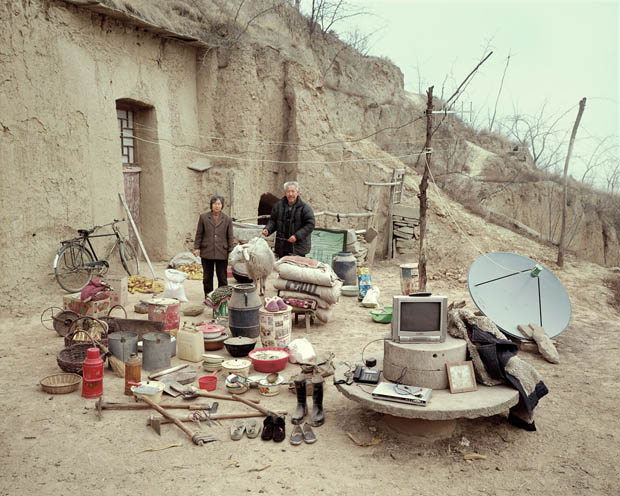
Huang Qingjun is a Chinese photographer who photographed families with all their belongings posing in front of their homes.  These people own very little.  What they have is precious to them.  You can read more about the story here, here, and here, and read an interview with the photographer here.

My favourite shots are these:

200-7

200-6

Even in a yurt or a mud house built into the side of the hill, these people have their TVs and their satellite dishes.  They are connected with the world outside their small homes.

And I suspect they are happy.

Boxed in and loving it!

Currently I am surrounded by boxes, with more coming and every time I tape one shut I give a little happy dance.  Although it looks chaotic, we are actually being quite systematic, and looking forward to unpacking in the new place — tomorrow!

So there’s not much to report here.  We have met with our builders for our final walk-through and expect most things to be done by the time we are unpacking.  I’ll update once we are in the new place and have internet connections once more.

In the meantime, let’s take a look at some other small houses worth noting:

At Tiny House Talk we learned about the Kanga Room Systems — prefabricated structures that can be used for outbuildings, or for homes.

Take a tour of this 280 square foot city house from Kanga:

Looking for something a little more compact?  This 200 square foot home is available in Portland, Oregon, and is built on a flatbed so you can move it to your lot:

And for a truly heart-warming story, learn about a Colorado couple who built their tiny home by hand — learning how to do it every step of the way. They even made a movie of the whole process. Their take on the situation is this:

What is home? And how do we find it?
One couple’s attempt to build a Tiny House with no building experience raises questions about sustainability, good design, and the changing American Dream.

TINY: A Story About Living Small (Teaser Trailer) from TINY on Vimeo.

I’ll catch up with you when we are moved into the laneway.  I am excited beyond description about this step of our journey.

Making the bed — the hard way

One thing must be said right from the beginning:  DH and I are not handy.  We do not make things.  We do not know anything about carpentry, or wiring, or plumbing, or tiling, or any of those DIY things that the TV shows tell us we all can do (but we know we can’t).

LiftBed

But I felt sure we could put together a Lift And Stor bed by ourselves.  There’s a video at the website that shows how it’s done.  You don’t need special equipment — just a mallet, a screw driver, some allen wrenches, a nut driver.  What could be easier?

We weren’t attempting to actually BUILD the bed, although you can order the hardware by itself and get your own boards and save lots of money.  We’re optimistic, not delusional.  We had purchased the kit, where all we had to do was get the pre-cut pre-finished pieces connected with the supplied hardware.

Seriously, what could be easier?

We have a system that we employ when we assembled pre-made furniture (cough**IKEA**).  We get all the tools together. We unpack the components. We read over the instructions together.  We set aside all the nuts, screws, bolts and nuts in an easy-to-reach place.  Then we spend the next few minutes-to-hours grousing, smashing fingers, grunting, swearing and throwing invective at each other.  At least one thing will be attached incorrectly and will be nearly impossible to fix. There will be a running argument.  Tempers will stretch, fray, and break.  

In the video on the website it shows the experts putting together the bed in less than an hour.  It took us closer to 3 hours to do it. We pulled up the video on our phones to help us, as we were completely unable to decipher the instructions.  The boxes had been stored in the garage space and were covered with fine dust, which we got all over ourselves.  Our knuckles were skinned.

But it was done!  Finished!  Assembled!  It looks very nice and operates beautifully, easily lifting up to reveal storage below.

We high-fived each other and went off to collect a Zip Car for a trip to IKEA.

More than enough?

We are currently packing up the few belongings we have here at the rental preparing to move in less than a week.  A co-worker is coming to take our shelves, table and chairs (she is grateful for the free stuff, we are grateful it will be GONE!).  My son and DIL came by yesterday for my grandmother’s nesting tables — promised to me by my mother but in my possession for only a few months.  Ah well, at least they will stay in the family. My niece is taking the microwave, but I’m not so sentimental about that.

I am very pleased to see how much storage there is in the new place — in the kitchen cupboards, the bathroom cabinets, under the stairs, even in some of the furniture.

But as I pack I am confronted by items for which there will be no space.  Baskets on the shelves, with no correspondent shelf to place them on in the laneway.  A set of plastic drawers that were perfect in our old condo for storing small things under the bathroom sink. Our new bathroom sink already has drawers,

godmorgen

And the two bathroom cabinets, stacked along a wall, are not deep enough to hold the unit

Lillangen


There’s plenty of room to hold the things that are in that cheap, dollar-store set of plastic shelves, but no room for the shelves themselves.

Shall I find a new use for those shelves?  Or just toss them?

Now imagine making decisions about dozens of items — not precious or expensive in any way — just THERE.

NOW imagine the process of going through all the boxes in our storage space, repeating this over and over again.

That’s what downsizing means — and that’s why it is going to take us so long.

We will be doing this for months…maybe longer.  It’s tiring, it can be exhausting.

But it’s liberating, too.

A moving story

We are SO CLOSE to our very last moving date. But it’s like that old science class problem, where you have to move a distance, but first you have to move half the distance, then a quarter of the distance, then an eighth of the distance, and so on, until it looks like you will never get to your destination because you will still be 1/128th away from it. The details still have to be attended to, and there never seems to be an end of them.
But that is for our builders to fret about. We are preparing for the move here at the rental. Putting stuff in boxes so a coworker can take away the shelves to furnish her first apartment. So a charity can come and take the last stick of furniture. So we can bundle ourselves onto a moving truck and get to set up a home in our laneway.
Life was a lot easier when all we had to do was throw our books and records (pre-CD days) into a few milk crates, which would then serve as the foundation for shelves at the new abode.
milk


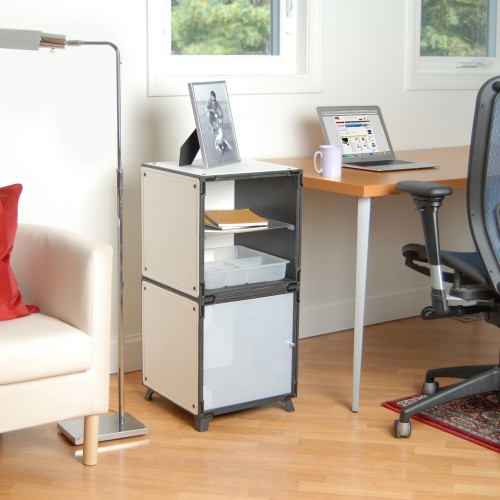
Wouldn’t life be simpler if we could still use something like that for our shelving?  You can see where I’m going — someone has come up with a modern version of the milk crate — the Yube! It’s a modular cube that you can use to make larger pieces of furniture.

Like a coffee table

YubeTable


Or office shelves

YubeOffice


A media centre

YubeMedia


Or a modern wall of bookcases

YubeWall


A sleek look you can take with you anywhere — and configure how you wish in your new home. The Yube locks together for a safe and secure structure–with optional doors and shelves.  And as this article in Life Edited says

The YubeCubes also feature a very solid eco-cred, with panels made entirely made of sugarcane fiber, bamboo and recycled plastic.

Storage is at a premium in a small home, but you can’t afford to sacrifice style.

The Yube Cube looks like the smart, ecologically friendly alternative to our old friend, the milk crate. Plus it’s great for a rental.

My Pain, My Life, My Struggles, My Fight

Come walk with me, Down My Dark & Stormy Journey BUSINESS INQUIRIES & CONTACT EMAIL : GODSCHILD4048@GMAIL.COM

ANNOTATED AUDREY BLOG

Artist and Desert Dweller with Big City Style.

Im ashamed to die until i have won some victory for humanity.

Domenic Garisto / LIFE IS NOT A REHERSAL,SO LIVE IT..if you can't be the poet, be the poem..havau22.com

The Lady Who Lives Down the Lane

Lane Way Housing for the Nervous Novice

Apartment Therapy| Saving the world, one room at a time

Lane Way Housing for the Nervous Novice

Slightly Snug House

building a home that's not too big and not too small

Vancouverandy

Funny thoughts from a nut like me.

Small House Bliss

Small house designs with big impact

WeeHavyn

Lane Way Housing for the Nervous Novice