RSS Feed

Category Archives: Cities

It’s a laneway house world!

It’s that magical time of year again!  It’s time to get your tickets for the Vancouver Heritage Foundation’s Laneway House Tour!! We always support this effort to expose everyone to the best of laneway living.  But this year (and for the only time!) we are part of it!!!  No wonder I’m going crazy with the exclamation marks!!!!

The city is bragging about how many laneway houses are being built. It’s a movement that is taking hold.

The Huff Po is asking people to rent laneway houses.

And Global TV pointed out where laneway houses work for the increase of affordable housing in Vancouver — and where they don’t work.

And the Vancouver Sun mentioned our project (and my name!!!!!)

Maybe it’s the time of year (or as Joni says, maybe it’s the time of man) but the focus right now is on laneway homes.

We are SO PROUD to be part of this movement.

Shelley Fralic pointed out the one problem with laneway homes

Laneways are a good idea, especially as a means of increasing urban density and affordable housing while discouraging demolition. They provide rental income, and accommodation for university students or family members who don’t want to leave a cherished neighbourhood and their local support systems.

But here’s the problem with laneway houses.

They are built on lanes. Right on lanes. Which means, not to put too gritty a point on it, that when you live in a laneway house, you become a resident of a back alley, which is not always the most savoury of locales in which to spend your golden years.

True dat, Shelley, we will definitely be looking at the alley.  But, unlike our alley-facing condo where we lived (happily) for 13 years, we will have a south-facing laneway view — sunnier than where we lived before.  And as the TV story said, having eyes on the laneway will increase the security for the whole neighbourhood.

Are laneway houses the answer for affordable housing in Vancouver?  Of course not.  But they are part of the answer.  Co-op housing. low-rise condos, high-rise apartments, rentals, basement suites, are all part of the solution.

We are part of the solution.  And it just feels right.

Laneway Life

We swung by the laneway the other evening to have a look at the developments.  We found Angelito, our builder, patiently revamping the top of the stairs.  The inspector had asked that he change the staircase where it makes a 180 degree turn — from the landing just inside the garden-side door at the top of the first run to where it enters the kitchen part of the upper storey.  Apparently the way it was originally built it would not pass code.  I asked Angelito if these were the same stairs that the same inspector had been climbing every visit for the past six weeks.  He paused and said yes.

We then chatted about the next steps and how soon everything will be coming together.  Of course, to us, things are moving maddeningly slow.  We can’t always see the subtle but important steps that lead to the final product.  Angelito assured us that by the time of the Vancouver Heritage Foundation tour the place will be substantially finished.  That means exterior Hardie siding, insulation, drywall, painting, floors, cabinets, and lighting will all be done within the next couple of weeks.  We should see the home bloom before our eyes, as we did in the first weeks when the footings and foundation appeared to spring from the earth.  We are very excited, but I find I am a little anxious.  There is still so much to be done to get us ready for the move!

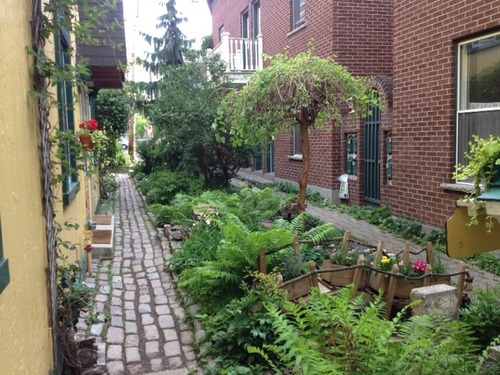
Every time we leave the laneway we walk down the lane, noticing yards where another laneway home could be built, adding to the lane community and to the ambience and livability of the lane.

We are very happy to be part of the laneway renaissance movement.  You don’t think that’s a real thing?  Thanks to This City Life, we know that cities around the world are taking back their alleyways, embracing them, repairing and renovating them.

Like in Seattle:

alleywayseattle

Montreal:

alleywaymontrealSydney:

alleywaysydney

Here in Vancouver Livable Laneways is an organization

dedicated to transforming the overlooked laneways and alleys of Vancouver into pedestrian-friendly civic spaces.

They recentlyheld an event in association with The Mount Pleasant Business Improvement Association.  There was music, vendors, food, and even a lovely art piece made out of a fire escape:

LeeBuildingArtpieceMore events are being planned for the future.  On the North Shore, an organization called More Fun Alleys had a contest to re-name an alley in North Vancouver.  The winner:  LoLo Lane.

Alleys can be wonderful places.  And they have great acoustics:

Acoustic of a saxophone player in Vancouver’s back alley from Alexandrine Boudreault-Fournier on Vimeo.

What should we name our lane?  I think Penny Lane is taken.

Densification. How is your city doing it?

Let’s face it, cities are running out of affordable housing.  To spread out into more and more far-flung suburbs is very expensive.  You need more amenities, schools, parks, hydro, sewers, transit lines and on and on.  It makes more sense that people fill in the existing neighbourhoods so more people can live there.  One of the answers is laneway homes but it would be too simplistic to suppose that it’s the only answer.  Other means of densification must be found.

the future of Vancouver?

the future of Vancouver?

Let’s look at the facts.  As we know, there are lies, damn lies, and statistics.  As this article in the Tyee shows, the current “trend” toward stabilization in the housing market in Vancouver is actually a continuing crisis.

In Vancouver, nearly half of us (46 per cent) are paying more for lodging than we can afford, at least according to the official definition. But some analysts warn that even these numbers could be understating the problem.

The statistics that lie to us are questionable because

the elimination of the mandatory long-form survey dealt an insurmountable blow to accurate data collection.

So when some people refer to Vancouver housing prices, they actually mean

everything from West Vancouver to Langley and all the way down to White Rock.

But here in the City of Vancouver we are running out of affordable housing.  Fast.  And densification seems the logical answer.

But while many people complain about Vancouver’s expensive housing, to just as many “density is a bad word,” notes Anne Mullin, president & CEO of the Urban Development Institute (UDI), which represents Canadian developers. “But it’s an important discussion to have.”

She’s alluding to neighbourhood uprisings that have blossomed across Vancouver against city hall’s efforts to boost density. Marpole residents, for instance, blocked a “thin streets” proposal to allow more houses per lot. Grandview-Woodland neighbours became incensed at the idea of high-rise towers being added to the bustling transit hub at Commercial and Broadway.

The answers are out there, let’s take a look at what’s happening in other cities.  Both are sea ports.  Both are first world communities.  And both are facing the same kind of problem as Vancouver is — a lack of affordable housing.

In Sydney, Australia, families are turning away from condos and

 $2,000 a quarter in strata fees, with remodelling, pet ownership and even visible decor frequently regulated.

In Australia properties are sold in auctions, and you can bet the prices get pushed up on attractive houses, even tiny ones.

Over 70 people turned out for the auction of a one-bedroom house on a 114 square metre block in Darlington, which fetched $951,000 — well over the suburb’s median house price of $757,000.

That’s about 1225 square feet in size.

The listing for a 139 square metre space in Balmain, which sold for $825,000, suggested that buyers could maximise the floor plan by building a second level.

A 300 square metre fibro cottage in Annandale, marketed as needing “a major overhaul”, sold for a cool $900,000.

Those are Vancouver prices!  And it doesn’t really add to affordability in neighbourhoods, rather is makes it worse by driving up the prices of the homes that are available.

In Seattle some developers are building “APodMents” — rooming houses with tiny apartments and shared amenities

One aPodment development, the Solana, has units that average 170 sq ft according to Seattle Mayor Mike McGinn, who has expressed his support of the developments (some units in other building are as small as 100 sq ft). The units come furnished (with no murphy beds so far as we know) and have their own bathroom and shower. Instead of a proper kitchen, they feature a fridge and microwave, with available communal kitchens. All utilities including wifi are included.

To say these buildings are experiencing push back is a gross understatement.  People owning houses worth millions are suddenly findings these developments sprouting up along their blocks.  And they are not happy.

Anyone who can scrape up enough money for month-to-month rent can live there…I don’t think most people want to live next to a boarding house with itinerant people living in it.

But in reality, tenants are not the usual SRO crowd

 The various articles we scanned reported of young Microsoft employees, recent college grads and divorcees on a fixed income occupying these apartments–not thugs looking for launchpads for heists.

Once again we see that if we are going to offer affordable housing for the people who pour our lattes, sell us our groceries and our clothes, teach our children and attend our universities, we are going to have to accept higher densification in all neighbourhoods.  Can we really say “Not In My Back Yard”?

A showhouse laneway!

I’m sure you’ve seen lots of model houses — all tricked out and decorated to the last cornice.  But I hadn’t seen any laneway houses like that — until today!

DH and I skipped off to the IDSWest show at the new(er) convention centre.  It’s always nice to wander around and see the beautiful finishings and furnishings, but the real reason I wanted to go was to tour the Homes & Living Laneway Feature Home.  The home has been auctioned off in support of Alzheimers research — and it was chock full of great style and features.

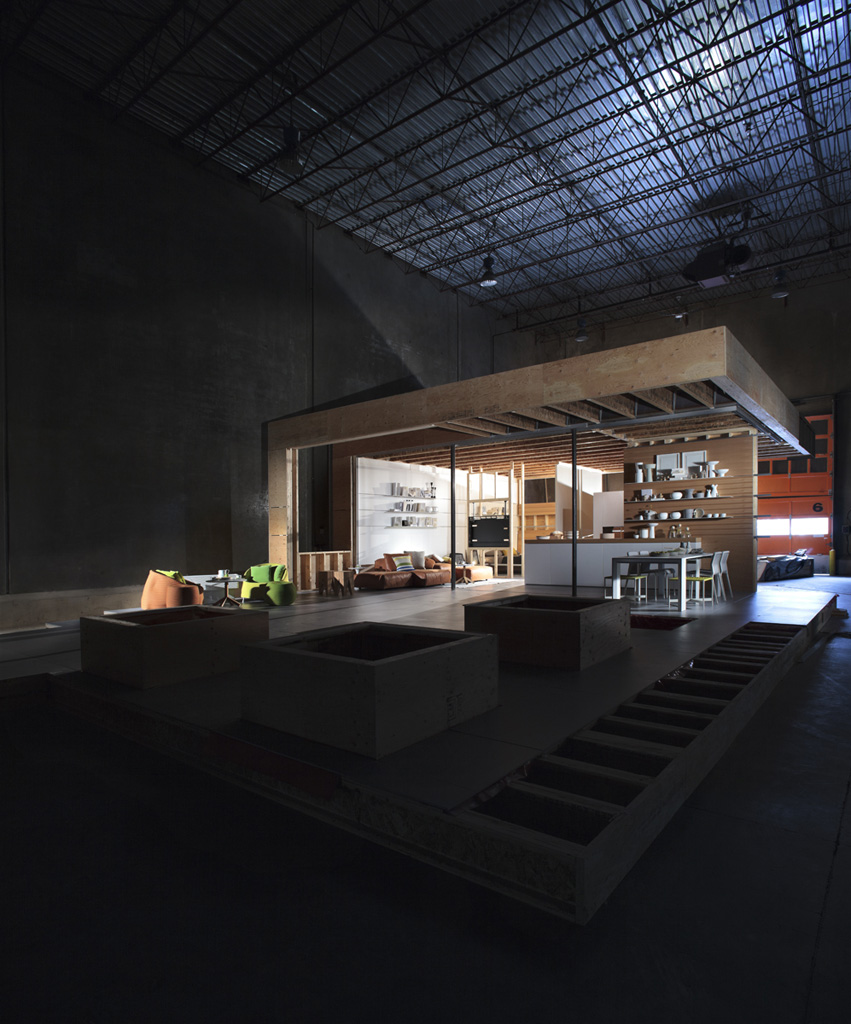
It was set up in the convention center, here’s a shot of the place while it was being assembled:

ISDWestLaneway1you get the idea of the home, even though you can’t see the finished exterior (dark wood) or some of the walls (sleek white).  The auction winner will have to provide a pad and heating system, plus a bunch of other stuff (permits, engineers report, lot to put the home on, etc.) but should get quite a lovely place out of it.  Unsurprisingly, I could not take any pictures, but the home had some pretty sweet features:

  • ten-foot ceilings
  • an overhang and sliding glass walls that open up for outdoor entertaining
  • completely built in kitchen so the dishwasher, fridge and freezer are behind cupboard doors
  • a hefty wooden counter top that slides over the stove and sink to completely hide them away
  • state of the art sound system that can be run from an iPad
  • beautiful furniture (natch)
  • floor-to-ceiling doors so it looks like the wall slides away or opens up
  • the Nest thermostat, pretty impressive and affordable, too

The roof is flat and the new owner must put on the torchon to finish it.  I asked twice, and no, there won’t be a living roof on the house.  You could put one on, I guess, but that’s something for an engineer and the designer to confirm.

There’s a big takeaway —  this is a real design experiment. That’s great, love to see so much talent and time going into the design of a laneway home, but just one caveat. If you are a decorating junky like I am, you know how “theoretical” designers can always come up with something really spectacular.  Of course!  They are not restricted by civic building codes, lot sizes, lot shapes, lot slopes, budgets.  Put that place anywhere you want — Narnia, Wonderland, just outside Hogwarts.  When you start with a completely clean slate you can do anything you want.  All they had to worry about was the size. A big deal, sure, but it’s just the start of a lot of big deals.

I love looking at other laneway designs, and (IMHO) the best way to do that is with the Vancouver Heritage Foundation’s Laneway Tour.  We took the tour last year and loved it!  Lots of great ideas!  But this year we won’t be able to go around — because our house is part of it!  There will be more on that to come.

What else did I like about IDSWest?  It’s a very nice to see all those lovely examples of finishes and accessories.  And we actually saw Tommy Smythe in person!

My heart be still.

PS:  The winning big was $230,000.  The winner will still have to pay at least $73,000 to have the home installed on their lot.  Good news for the Alzheimer’s Society!

We’re hooked up!

We have connections!  The water is hooked up to our laneway and the main house has a new and improved water connection which should solve their low-pressure problems.

On the way to getting it done the city made a big hole full of ugly in the lane:

20130912WaterBut at least we have water and can move forward.  The back yard will need to have the trench filled in and then be levelled before it can be planted with grass soon if we are to capture the rain that will be coming.

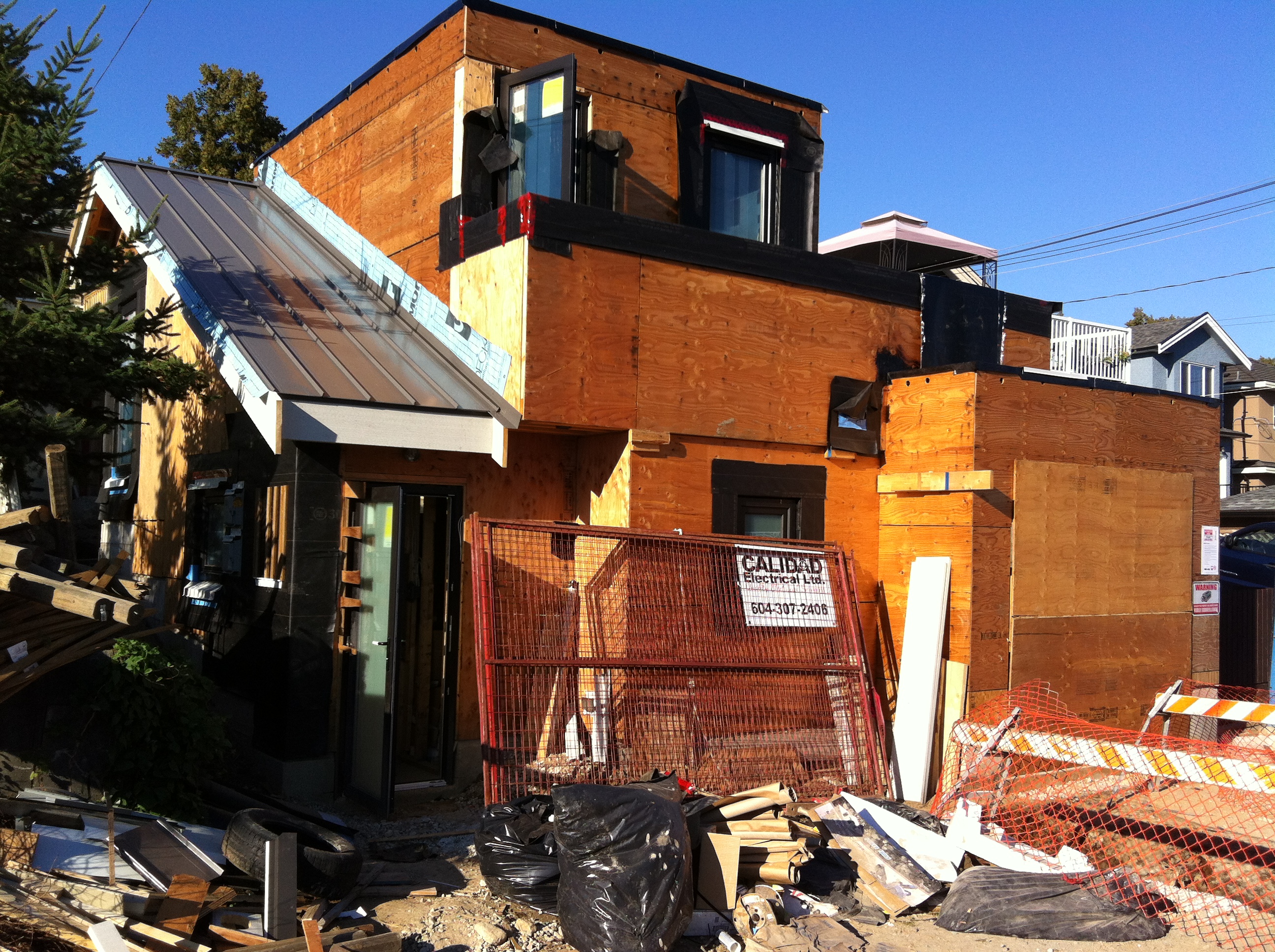
DH took another “time lapse” shot of the place:

LWHTime9Looks different than 18 weeks ago:

LWHTime2Just 12 weeks to go!

Rue Britannia?

I embrace the idea of living in a small home — I’d be an idiot not to, when I’m going to be moving into less than 50 square metres of living space in a few months.

I don’t pretend it’s for everyone, but it’s perfect for me and mine and for many others.

So I was quite surprised when I read several articles from British newspapers disparaging the trend for smaller houses, calling them “rabbit hutches”; and decrying the decreasing size of houses and apartments in the UK.

According to this Guardian article by Penny Anderson,

The UK has the smallest new-build houses in Europe

a situation she called a “crisis”.  I could almost see her point.  Although her OpEd piece is rich in hyperbole and short of actual statistics, according to her anecdotal info many homes are too small to live in.

miles of single-fronted new-builds with awkward open-plan kitchen/diners/spare rooms/lounges, almost entirely free of storage. Then there are converted homes in older buildings situated in desirable areas where the market is febrile, which are often the worst low-space offenders, with bathrooms or even kitchens, squeezed into what used to be cupboards, and the original bedrooms sliced in half.

Apart from giving me a new word (febrile = feverous), she paints an ugly picture indeed.  Rapacious builders squeezing every square inch of living space out of small plots of land “to maximise profit”. “Bedrooms … as cramped as prison cells”.

Even the hard facts in this Telegraph article seem to bear her out.

Of the 2,500 owners of private new homes who were questioned, 57 per cent said there was not enough storage space, 47 per cent said there was not enough space for furniture and 35 per cent said there was not enough kitchen space for appliances such as toasters and microwave

Newer houses are definitely smaller than the traditional detached home, as Simon Bowers says in The Guardian:

In 1920, the average semi-detached new-build had four bedrooms and measured 1,647 sq ft, according to the Royal Institute of British Architects (RIBA). Today’s equivalent has three bedrooms and is 925 sq ft. Typical new terrace houses have shrunk from 1,020 sq ft and three bedrooms, to 645 sq ft and two bedrooms.

But is the problem size?  or design?  I know that our North American ways are not theirs.  As Anderson says

add in the need to dry laundry inside when it’s raining, with one or more adults working from home and you have a problem.

because in Britain very few homes have clothes dryers, an appliance we take for granted.  Take into consideration other specifically British realty idiosyncracies

unlike other countries, houses in the UK are sold on the number of bedrooms rather than square footage…. The result is a lot of small rooms. And UK consumers like gardens, which leads to smaller houses.

The rise of solo living is another factor. People wanting to live alone trade space for having their own flat.

OK, I’m beginning to see the problem here.  I’ve been to Great Britain, and I know that I was surprised at the housing there.  People seem to either live in detached or semi-detached homes, or in massive blocks of flats (these are often in the less-desirable sections of large cities).  To me, a Canadian used to very wide very open spaces, I was amazed that they could fit so many people into such a tiny area without resorting to a) Hong Kong style apartment houses reaching to the sky, and b) vast housing tracts despoiling the English countryside.

But I think those days of “and Englishman’s home is his three-bed and two-bath castle” are through.  It’s time they faced up to some hard facts.  Brits can no longer expect

enough room for a two-, or even a three-seater sofa, a dining table with chairs, and a little space for those things you can’t bear to part with.

Instead, they will have to accept some compromise.

The UK has a housing crisis. A shortage of homes has pushed prices out of the reach of many hoping to get onto the ladder. But once they get there, they may be disappointed – the UK has some of the smallest properties in Europe.

Many of the problems cited (lack of storage, fitting furniture into open plan spaces) can be overcome with good design.

Happily living in a small home is first of all about psychology, says Hannah Booth, homes editor at Guardian Weekend. “You can live without much more than you think.”

Apartment dwellers in New York and Japan know the secrets of this lifestyle, she says. “They’re the masters, they eat out a lot, spend a lot of time in the park. In the winter your home can be a nice little cocoon.”

I get the impressions that these new, small homes are still following traditional building styles, separate living and dining rooms,

All of us who live in areas where building space is at a premium are having to change the way we live — not just our domiciles.  Some people are sharing gardens.  Many are using dual-purpose furniture to get the most use out of the least amount of space.  Everyone is carving storage out of spaces they never thought of before.

And we are living with less, certainly fewer of “those things you can’t bear to part with”.

But what is the alternative for British homes? How are you going to fit more people into that extremely finite space?  They can either accept living in smaller places…..or ????

Just one more quote, from Quentin Crisp:

The British do not expect happiness. I had the impression, all the time that I lived there, that they do not want to be happy; they want to be right.


Day 102 — the calm before the storm

We dashed back after our week amid the beaches and peaches of Penticton to see what changes had occurred in the laneway and were significantly underwhelmed.

From the outside, it looked as if nothing had happened.  But when we got inside we could see that the electrician had been very busy.  All the pot lights are installed in where the ceiling will be — that is going to be one bright home — and we could also see where the receptacles and switches will be.

We are still trying to figure out one key part of the plan — the bedside lamps.  We thought we had found the perfect lamp, but then heard from Laurel our designer that the electrician had said, yes, they could be installed, but they could not be hard wired in, and that meant a visible cord running down the wall.  Why bother? We want built-ins!  So we just slipped into the Penticton branch of a local lighting store and hope that we’ve found the perfect one.  We’ll go over to their local branch to see if they can help us out.

We got a little too clever for ourselves and looked in furniture and accessory stores for the bedside lamps before we went to a lighting store.  We have learned our lesson.

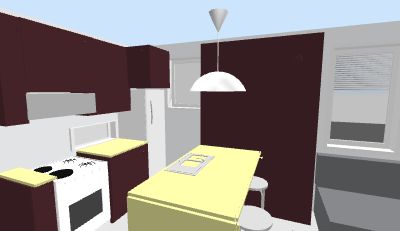
I also discovered a free computer assisted design program, Sweet Home 3D.  I’m still learning the program, but it allowed me to use our plans to draw a 3D rendition of our kitchen and sitting area:

upstairsMetro.jpgIt’s still crude (like I said, I’m still learning) but we are able to visualize so much better — I cannot look at two dimensional drawings and “see” in my mind where things will go.  For instance, we were hoping to use our current coffee table, actually a carved wooden chest with a slab of glass on it.  But when I tried to fit it into the 3D rendition, it was clear that it would block the flow to the deck door.  It looked possible in the floor plan, but in 3D it was unworkable.

What is ahead for us is:  electrical and outdoor sheathing inspection, building paper and rain screening, then the metal roofing and siding installation.  Then more inspections and then…..DRYWALL!  So we are going to see some major changes soon.

Also we are waiting for the city to connect the water to the main house and the laneway — that will mean the main house can fill in the trench that currently leads from their front yard to the laneway — ugly and dangerous with a toddler around.

Put it in a box and put a ribbon on it — container homes

As soon as I heard about people using a shipping container for the shell of a small house I had to say owchamagowcha — what a great idea.  No surprise that seaport cities have led the way — in Vancouver and Seattle people are finding new uses for these sturdy structures that can be used singly or in combinations–the containers are literally thick on the ground around here.

In Seattle,

The first two cargo homes are being built at the ShelterKraft location in Ballard and set up on Whidbey Island. And, like a boat, they can easily be picked up by a boom crane and transported using a flatbed truck to a different location if needed.

“It’s the ultimate in reuse,” says Amy Gulick, an author and photographer, who purchased a Cargo Cottage with her husband, Chris Gulick. “I love the idea of taking a perfectly good steel structure and making it into something great instead of discarding it into a waste yard.”

Who can argue with recycling, it’s just the size of the tin cans that has changed.

In Vancouver in the heart of Gastown,

The 12 shipping containers on Alexander Street near Jackson Avenue have been converted into apartments by the Atira Women’s Resource Society, which bought a lot on the block in 2009. The first shipping container was dropped on the lot at the end of November, and each unit cost $82,500 to build.

Some of the homes will eventually be occupied by women over the age of 55, who will pay $375 a month in rent, while other units are intended for younger women, who will pay about 30 per cent of market rent.

containers

Wow, said I, I would like to know more about how container living 24-7 — it’s so interesting.  And I found the source to find out more about living in containers, the blog My Home In A Box is a great way to follow the movement.

Small is beautiful!  Pass it on.

What’s the skinny?

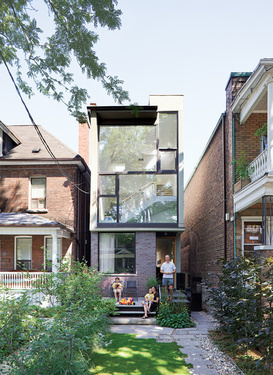
The small house movement is creating solutions to one problem of large cities — odd, skinny lots, sometimes between two existing buildings.

skinny homesThis article from Dwell features five such buildings, from all around the world.  Check it out, with the built-ins and niches that make skinny houses feel more like homes.


Tetris housing? China says yes!

I bet the first house you designed was built of blocks.  And although it may have had tons of style, I bet it didn’t have a lot of structural integrity, nor did it have a lot of interior room.

But Studio Liu Lubin has designed a modular home plan that lets you fit pre-made blocks into each other to make a small, or a large home.

Studio-Liu-Lubin-Tetris-House-537x405According to this story at Inhabitat, the home can function as a single room, or

can also be stacked up to create a mini housing complex that meets China’s land use policies

Read more: Tetris-Like Micro House Can be Stacked to Form Expanded Housing Suites | Inhabitat – Sustainable Design Innovation, Eco Architecture, Green Building

I’d love to see the housing complex go up!  Especially when they start flipping the modules around to get them to fit perfectly.

My Pain, My Life, My Struggles, My Fight

Come walk with me, Down My Dark & Stormy Journey BUSINESS INQUIRIES & CONTACT EMAIL : GODSCHILD4048@GMAIL.COM

ANNOTATED AUDREY BLOG

Artist and Desert Dweller with Big City Style.

Im ashamed to die until i have won some victory for humanity.

Domenic Garisto / LIFE IS NOT A REHERSAL,SO LIVE IT..if you can't be the poet, be the poem..havau22.com

The Lady Who Lives Down the Lane

Lane Way Housing for the Nervous Novice

Apartment Therapy| Saving the world, one room at a time

Lane Way Housing for the Nervous Novice

Slightly Snug House

building a home that's not too big and not too small

Vancouverandy

Funny thoughts from a nut like me.

Small House Bliss

Small house designs with big impact

WeeHavyn

Lane Way Housing for the Nervous Novice