RSS Feed

Category Archives: Housing

Heritage homes — lovely and livable

We were very, very lucky on our trip to the United Kingdom, not just in the fabulous weather, but because we could stay with our lovely relatives — and they live in lovely homes.

It’s rare to be able to step foot inside one actual home when visiting a foreign country, and we were able to see lots of them.  We also toured some “stately homes” with the rest of the tourists, but it was the privilege of sitting and taking tea in a real Georgian sitting room, or sleeping in a true Edwardian bedroom, or enjoying the garden of an old English cottage that made the trip even more special.

The first home we stayed in was that of our first-cousin-once-removed in Edinburgh.  Naomi’s was the oldest home we stayed in, built before 1800.  The building had once been a brewery with the bottom two floors for commerce and the third floor, where Naomi’s flat is located, made into a comfortable home for the proprietors.  At one point the one apartment was made into 3, sometime in the 19th century, but it’s been re-converted to one unit.  So some of the features were changed plus a modern kitchen and bathroom were added.  But a lot of the original Georgian decor remains.

NOutside2

Here’s me standing outside the front door to the building.  The stairs are located just behind this wall, stone stairs to the third floor, then concrete ones up to the more-recently modernized fourth floor.  Naomi’s is on the third floor.

NOTE:  We were staying in a private home.  The place wasn’t staged for photographs, it was set up for living (and Naomi lives a very active life).  So I won’t be showing whole rooms, just snippets of the features that made the rooms truly Georgian.

Here’s a Googled photo that illustrates what you can expect to see in a Georgian Room.

GeorgianRoom

The Georgian builders and decorators revered symmetry, so the fireplace is centred on one wall.  The windows are very wide and high, coming within inches of the ceiling and set deep into the thick walls.  The panels at each side of the windows are actually shutters which can be closed over the windows at night (although most homes don’t use the shutters any more and have draperies instead).

All the rooms are beautifully proportioned, with high ceilings and a feeling of spaciousness.

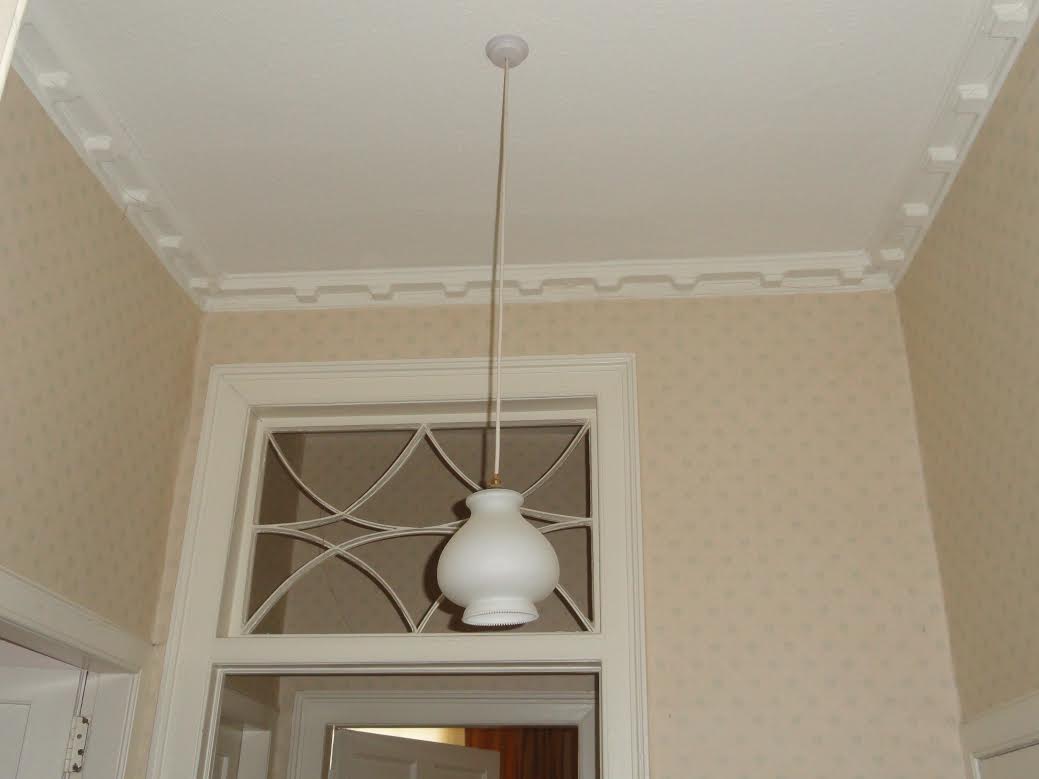
Naomi’s apartment is split very nicely by a wide corridor, with transoms above the doors allowing some light in from the rooms on either side. Since the flat takes up the whole of the third floor, she has windows on three sides and a lot of light flooding in.

NTransom

Here’s one of the transoms — a work of art by itself.  And the beautiful plaster crown moulding along the top of the walls.  The Georgians also tried to bring sculpture into their homes, and that is reflected in the ornate plasterwork you see here on this arch in the apartment.

Arch2


Imagine living in all this beauty all the time!  We were so lucky to spend just a few days in this wonderful Georgian home.

How can we save more of our heritage homes?

Vancouver already has the screwiest housing market in the world.  Hyperbole?  Empty derelict houses are sitting on million-dollar lots in ordinary working-class neighbourhoods.  Huge houses and luxury apartments sit empty most of the year because of absentee investor owners.  Rental vacancy rate of less than 1%.  Housing costs beyond many salaries.

In this story on the city’s effort to save pre-1940 homes, the people who bought a Shaughnessy home for $4.6 million and who have it on the market for $7 million find it too small for their needs.

“They just think the building is not livable,” Liang said. “They are now looking for a larger property.”

Meanwhile city dwellers wring their hands and mourn the loss of heritage houses that originally made the neighbourhood so attractive; demolished so that enormous monster houses can take their place.

heritage2013

The problem affects neighbourhoods, almost exclusively on the west side, where old discretionary zoning and density rules are encouraging developers to raze smaller homes to build massive buildings.

In the first six months of 2014 there have been nearly 1,000 applications for demolition permits, an increase of 20 per cent over previous years…. Many of those involve pre-1940s buildings that don’t use all of their allowed yard setbacks or building heights.

And there are no easy fixes.

I would have to argue with the statement that the problem is almost exclusive to the west side of the city.  There are plenty of charming old homes in the Grandview and Sunrise areas that are being replaced by much larger structures.

The Vancouver Sun story lists some ways that Vancouver City government is hoping to save more heritage homes.  A planned moratorium on demolition permits for houses in Shaughnessy; a requirement that 90% of the demolished home’s materials be salvaged or recycled.

The moratorium on demolition permits may work in an area like Shaughnessy, but couldn’t be used city-wide.  Who would like to see their property value plummet because any buyer could not replace the over-70 year old structure with a new one (while your neighbour’s more recently built home could be smashed and trucked away to reveal that tender, juicy city lot just ready for redevelopment)?

But if someone were to ask me (and what is a blog for if not to answer questions no one has asked?) I would suggest a more-carrot-and-less-stick approach by the city to encourage the retention of heritage homes.

  • Right now it can take months or longer to designate a house a heritage building. That process should be sped up.
  • There are only four designated heritage areas:  Chinatown, Gastown, Shaughnessy and Yaletown. Any area where most of the buildings are over 70 years old should be designated a heritage area, including Sunrise, Strathcona, Kerrisdale and Kitsilano.
  • Tax breaks from the city would encourage developers to maintain older houses.
  • A relaxation of certain housing regulations would allow some heritage homes to be maintained.

Does anyone else have any ideas?


The Vancouver Heritage Foundation Heritage Homes Tour

Last Sunday found us up nice and early in preparation to hitting the road for the Vancouver Heritage Foundation Heritage Homes Tour.

It’s something I’ve been promising myself I’d do, but always put it off.  This year, though, we were able to get it together and June 1 found us up, fed, dressed (with easily removable shoes) and water bottles at hand we headed off to the first house on the tour: Casa Mia.

HeritageCasa

Casa Mia is the fabled house built by the Reifel family.  It sits on Mansion Row on South West Marine Drive and yes, everything you’ve heard about it is true.  There is a ballroom on the basement level with gold-leaf walls and ceiling and a sprung dance floor.  The walls of the playroom were hand painted with Snow White decorations by Disney artists brought in for the job.  The rooms are beautiful, opulent, luxurious.  The bathrooms are incredible. The men’s powder room by the ballroom has black fixtures! The lady’s has gold plated faucets!  As a piece of OTT decorating (and the life that demanded it) it’s a prime example.  One that will probably be changing in the future, as it’s currently being considered for a care home.  This was our only chance to see this building, and thanks to the Vancouver Heritage Foundation, we did.

By the way, kudos squared to the Foundation for the organization of the tour.  The route was good — from Casa Mia though houses 1 to 10, the guide told us what to look for and expect at each home (and where we could find public restrooms along the way), the volunteers were helpful and friendly, the homes were all lovely, and there was even a food truck mid-way through to make sure you didn’t collapse from hunger.

Still, intrepid explorers though we were, we found it almost too overwhelming and skipped one of the three storybook homes on the tour.

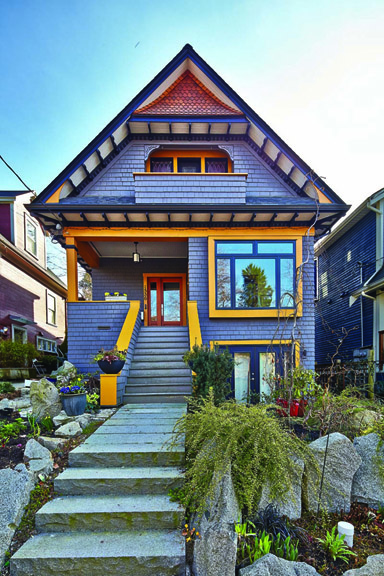
We saw this one -- it was terrific.

We saw this one — it was terrific.

I won’t take you on a room by room recap, there’s lots of info at the Vancouver Heritage Foundation site.  Here’s the highlights I took away:

  • It’s easy to think of the lovely west-side homes in Kerrisdale, Shaughnessy and Kitsilano as heritage homes, but there are many gorgeous heritage properties on the east side in transitional neighbourhoods like Strathcona, Grandview, Mount Pleasant and Sunrise that have not always been well maintained but should definitely be preserved and respected.
  • It’s still possible to maintain the charming design of an older home while updating it with energy efficient heating and modern bathrooms and kitchens.
  • People love built-in sound systems.  We have one in the laneway because we didn’t have room for speakers on the walls — but lots of people put them in so they won’t have to have ugly speakers out in the open.
  • Take shoes you can easily remove at each home — they didn’t mind bare feet inside so you could wear sandals — but make sure they are comfortable because you may have to walk a couple of blocks from where you can park
  • Mature gardens are so lovely — everyone had beautiful exterior spaces
  • Everyone was respectful of the age of their home — even when the furnishings were modern the interior design reflected the original finishings

How can we maintain these fine old homes?  How can we keep our city neighbourhoods from becoming homogeneous slabs of suburban architecture?  I’ll be thinking — and writing about this.

We’re getting some Apartment Therapy! We’re Small and Cool!

Do you read Apartment Therapy?  Well, then, stop reading this, go to the site, and subscribe.  We’ll wait.

Well, when I saw that they were accepting nominations for their annual “Small, Cool 2014” feature — I knew I had to enter.

And we’re in!


Visit us!  Click on the Favourite Button (please).

We could win….bragging rights! and fame ‘n’ stuff.


Leaky condos part III – a problem risen from the dead

I’ve told you about our experience with leaky condos.  And how the leaky condo catastrophe came about.  But the question now is “Why is this a problem NOW?”

LeakyCondo2

It’s ba-ack!

Because until now, strata councils who run condominium buildings could avoid submitting depreciation reports.  As this story in the Vancouver Sun succinctly puts it:

Lax maintenance has been a long-standing issue for stratas, according to Tony Gioventu, executive director of the Condominium Homeowners Association of B.C., “hence the evolution of the introduction of depreciation reports.”

The province made a depreciation report a requirement of the Strata Property Act in 2011. It contains a detailed assessment of a condo building’s condition, and a schedule for when major components, including its exterior, would need repair.

“Depreciation reports are forcing strata corporations to acknowledge what they have, and forcing them into planning (for repairs),” Gioventu said in an interview.

The requirement was enacted in 2011, but wasn’t put in force until last December to give B.C.’s 30,000 strata corporations time to commission the reports.

When we left our condominium last year the strata council was preparing to create a depreciation report.  It would cost time and trouble, and of course, money, but they knew what the report would say — that the building was well-maintained and had undergone rain screening in 2000, that it had a new roof and would last for many years.

Many, many condo buildings were updated and repaired and will, with proper maintenance, provide safe and comfortable housing for decades to come. And depreciation reports are necessary for all condo buildings, regardless of whether they have had leaks or were repaired and kept up.  It provides a good background on the building, and if you are hoping to sell your condo it is a great asset to show the prospective buyers and their mortgage provider.

According to this story from Daphne Bramham in the Vancouver Sun,

By Dec. 14, 2013, strata corporations must have 30-year depreciation plans that indicate when major infrastructure will need to be replaced, what the maintenance schedules are and the expected cost of each item. The plans must be updated every three years so that owners and potential buyers will have a realistic glimpse of what lies ahead.

So it appears that the problem is solved.  Those condo building who have not kept up their regular (or emergency) repairs will quickly fix everything, and the home owners and future buyers will be sure that the building is sound.

Nope.  Not quite that easy.  There are several reasons why this is a crisis for some condominium owners.

1. Playing by the old rules

When you live in a strata building you pay maintenance fees every month.  These pay for the general upkeep of the building, the shared costs for the gardening, garbage, etc.  But a portion of those fees go into a contingency fund — money set aside for big expenses.  Repairing the garage.  Replacing the boiler.  Stuff that comes up once in a while that you really can’t budget for.  But until 2009 there was a restriction on how large a contingency fund could be.  So even if you convinced the owners to pay an extra, say, $300 a month in maintenance fees to pay for a new roof that would be needed in 20 years (and good luck with that), you simply weren’t allowed to.  So to pay for these really big repairs you need a special assessment.

2. The 3/4 rule

You need three-quarters of the owners of the suites in any strata corporation to agree to any special assessments.  In our old strata building, these special assessments passed rather easily.  A new roof costs this much.  Your share is this much.  Vote.  And we all agreed that we wanted the building to be maintained and we voted yes.  Then we coughed up our share.  I thought that was the way all stratas were run.  But it’s not.  There were 14 suites in our building.  If just four owners voted against the assessment we would not have gotten a new roof.  We were lucky that everyone was on the same side in this issue.  That there were no internal feuds that played out, that people had enough money to contribute.

But if you lived in a strata where people did not want to fix the whole building, where they tried to patch up little problems that turned into big problems, or where they just could not afford to pay those large assessments, your day of reckoning is at hand.

3. The money

At one time, leaky condo strata corporations could avail themselves of an interest-free loan run through the B.C. Homeowner Protection Office.  That program ended in 2009 after 11 years.  So if your problems didn’t show up until after then, or you couldn’t convince your neighbours that they needed to fix the entire building, you will have to find another way to finance that big, big repair bill.  Now.  Before the depreciation report.

4. The market

The insane Vancouver housing market applies to all condo owners — not just those in Coal Harbour luxury penthouses.  For what it costs to move into a two-bedroom 25-year-old condo in the area you could have a very nice detached home in Edmonton or Saskatoon.  So that often means people in those 25-year-old condos are already paying hefty mortgage payments, plus their monthly maintenance payments.  Some people are on fixed incomes, retired or on disability.   They simply cannot afford the extra costs those repairs would require.   And all these people will be quite hooped, one way or another.

They have to repair their homes, but can’t afford to repair their homes, but can’t sell their un-repaired homes and move anywhere else.

So there you have it.  A problem we thought had just gone away was hiding, like that nasty piece of mould on the inside of a wall, just waiting to spread and eat up your life savings.


Leaky condos part II – why oh why?

In my previous post, I quoted a Vancouver Sun article on leaky condos.  Years after we thought the problem was gone, it’s back.  Like a bad rash, or in this case, a pernicious mould.

Why are so many Vancouver condos prone to leaking?

Well, into the WayBack machine, to see what life was like in Vancouver in the late 80s.

Expo 86 had really moved the city along.  The nightlife was bouncy, with live-music venues downtown and in Gastown.  New bylaws were made to loosen up the liquor laws — we were a fun town!  And the Vancouver Canucks were pinning their hopes on young Jim Benning.

Jim_Benning

Deja vu


All this activity meant more people were moving to the city, and that put pressure on current housing stock.  So in the years 1982 through the early 1990’s, the city encouraged a new-fangled type of housing that Vancouver hadn’t seen before — condos.

Vancouver had apartments since the beginning, but they were usually built specifically for rental.  Apartment ownership in a strata corporation was a new thing.  At first it meant existing buildings “going condo” – selling their suites to the tenants.  In those halcyon days you could purchase a condo for about $40K — a nice one, too.  Then zoning changes meant that residential homes in neighbourhoods like Kitsilano and around City Hall could be replaced by condominiums.

So we had a situation where there was a high demand for this housing — plus land to build it on.  What could possibly go wrong?

1. The climate — damp – ish

Vancouver gets 1153.1 mm of rain per year, about double that of that notoriously rainy city, London. Nearly twice as much as San Francisco, California.  I put this at the top of the list because it’s really something that should determine everything else.  But it seems to have been ignored by everyone all through the process of building these leaky condos.

2. Regulations – no good deed goes unpunished

The Canadian Building Code altered their rules to increase the sealing of exterior walls.  That meant that in the dry cold of a Saskatchewan winter, the sealed walls would keep the cold out and the warm in.  Great in Saskatchewan — but the rule meant that whatever entered the exterior — heat or moisture — would be trapped inside.

The City of Vancouver changed their regulations to include eaves and overhangs in the allowable floor space.  There was therefore a penalty to having a wide roof overhang.  Much better to build right to the outside of the allowable limit, with no overhang at all! Also the floor space was measured from the outside of the exterior wall — not the inside.  So thinner walls were encouraged.

To reiterate:  the buildings would have to be air-tight, but not protected from any precipitation.

3. Design — let’s borrow from the neighbours

Vancouver needed a new type of building — a three or four storey apartment building that would incorporate modern building techniques and style.  We hadn’t seen this style of building in the area — but California had!

CaliforniaCondo

Arched windows!  Lots of parapets, changing roof lines, open walkways!  Very little roof overhang.  And all wrapped up in stucco.  It was better than modern — it was Post Modern!

We liked it!  We built it!  We bought it!

A design that was originally fashioned for a place with half our annual rainfall.

4. Construction — new materials because — progress

Lots of Vancouver buildings are covered in stucco.  Good old-fashioned cement stucco.  But now there was something new and improved — exterior insulation finishing system (or EIFS).  It seals the exterior, just like the Canadian Building Code requires.  And you can put it smack against the sheathing, for which they used that new stuff, fibreboard.   Putting the EIFS right on the fibreboard reduced the thickness of the walls, which meant that the City of Vancouver measurements from the outside of the exterior walls would not reduce the size of the floor space within the suites.

5. Builders – the more the merrier

The demand for housing was there.  The materials were there.  The design was there.  All you needed was someone to put it together.  And companies sprung up like, well, mushrooms.  Reputable builders were booked up months or even years in advance.  So less-than-reputable builders stepped into the breech.  Also, builders and developers would form a new company for each project.  When the project was finished, the company would just dissolve.  Into thin air. Inspectors were overworked and often not familiar with the new designs and the new building materials.

6. Owners — what’s that smell?

New condominiums sold just as they were supposed to — like deceptively constructed hotcakes.  They were lovely to look at.  And for some time they were fine.  It takes a few years for those interesting roof lines and arched windows to let water through that impervious exterior into the fibreboard that soaks it up. It takes a bit longer for those sodden boards to start moulding and rotting.  Then problems apppear.

Then it took a few years for strata boards to realize that the leak in 4A and the saggy balcony on 2C were related.  The building was disintegrating from the outside in.  And there was only one answer — ripping off the entire exterior and replacing it with rain screening. And that took money.  Money from the owners.

The company that had constructed it didn’t exist any more.  The New Home Warranty only covered buildings constructed after 1999.

Some strata boards faced the problem head on.  Like the board in our old building they rain screened their homes, absorbed the cost, and kept their places from deteriorating. They were the smart ones.

Many of the buildings ones that did not rain screen around 2000 did it in the subsequent years, and they had to pay much higher costs because construction costs have shot up in the past decade.

But there were others….who have not fared so well.  And they may be about to bid farewell to their life’s savings.

More on that in Part III


Vancouver’s leaky condos — as if we don’t have enough problems

You might think that because I am tucked up snug in my beautifully built laneway house that I no longer take note of problems other people have with their housing.

In fact, I think I’m even more interested in Vancouver housing, its affordability and its quality.  I have a long history of living in the area, in everything from basement suites to west-side detached homes, and I like to keep my oar in the water, so to speak.

And speaking of water, a headline in the Vancouver Sun caught my attention this morning:

Leaky condo crisis rears its head again in B.C

And it brought back such memories.

When DH and I first bought the condo where we lived for 13 years, we got it at a drastically reduced price.  It was a bargain because the building was about to undergo rain screening.  There was a reluctance on the part of potential buyers to move into a place that would be swathed in tarps and green mesh for the next six months while the exterior was ripped off and replaced.

LeakyCondo

Cristo would be proud! But we weren’t.

But we were happy to seize this deal because it would allow us to get into a great neighbourhood for a terrific price, and because I had just gone through the same procedure when the co-op where I was living was rain screened.  Ugly but temporary. And we didn’t have to pay for the rain screening at the new place because the assessment to pay for it had already been accepted by the condo board before the condo was put up for sale, so the previous owner had to pay for it.  That rule was to prevent people from getting a hefty assessment then ducking out and passing it on to unsuspecting buyers.

But it didn’t prevent some people ducking out before the assessment was made. We had already put in an offer to another condo conditional to our reading the minutes of the condo association meetings.  It was a really beautiful place, wood floors throughout, sun-drenched rooms, and an interesting layout.  But we had withdrawn the offer when those minutes revealed that the building was basically a sieve, and was either going to be undergoing expensive and extensive rain screening or would fall down in a few short years, a mouldy mess. It’s just a suspicion, but I felt that the owners had agreed NOT to have a proper inspection which would lead to an assessment until they had a chance to sell their places — passing on the problem to the poor saps who bought.  Rats leaving a rotting ship, so to speak.

The condo board at our building was very pro-active.  Regular maintenance was done.  And the building and the condos within kept their comfort and their value.  I have no doubt that I will be able to point out that building in the coming decades as the place where Nana and G-Pop lived when we were first married, and it will still look great.  But we paid the price — literally.  Our condo fees were high for such a small building, one of the determining factors in our deciding to move to the laneway.

Many buildings put up during the same period did not opt for rain screening.  These were often larger ones where the condo board was not made up of a few stalwarts but instead was full of people averse to spending money on maintenance. Some years ago I helped a young friend stage his condo for resale.  He had volunteered for the board, and found that he could not persuade them to raise the maintenance fees to pay for future upkeep — or even for what he felt were necessary repairs.  The rest of the board much preferred to keep the fees low, not do the work, and….rely on divine intervention.  Or resale before the mould hit the fan.  He decided to get out while the building was still in good enough shape.  But the signs were already there that there would be problems, and not too far off.

So now the chickens have come home to roost — and found it’s falling apart.

Why now? What’s happened to bring this problem to the forefront again?

And why are Vancouver condos so prone to leaks?

Stay tuned for part II.

Teensy tinyness — taking it even smaller

I was chatting with an acquaintance the other day, who knowing how fanatical keen I am on small houses, told me that he and his wife are planning on building a tiny house. Not small — tiny.  One of the houses that fit snugly into the Tiny House Movement, at under 120 square feet.

Rustic Exterior by Other Metro Architects & Designers Tumbleweed Tiny House Company

Currently they are renting a nice condo in Vancouver.  The tiny house (on wheels) would sit on his in-law’s property out in the Fraser Valley, and would serve as their quarters as they help her parents renovate their home. If the home is then sold, they would just roll the home onto some recreational property, or onto a corner of the subdivided property. Or they might just decide to move out there and stay.

It’s the perfect solution to their current dilemma, although presently they are not planning to live full-time in the home.

But others do.

Dee Williams has lived for 10 years in just 84 square feet. It’s an accomplishment, to be sure, one worthy of having a book written about her experience.

Like this one.  Which she wrote.
Williams used to live in a much bigger house.  With a big mortgage and big heating bills.  But a life crisis made her realize what was really important — and she turned her life around and put it into a tiny house.
She realized what her true priorities are.
Time has become her most valued and abundant possession. “I have time to notice my natural environment and take a breath through the seasons, to puzzle over the way that nature is throwing itself at me and the community. I live in one of the most beautiful places on the planet. If you’re working all the time, sitting inside, you miss a lot of it. I feel lucky and blessed that I’ve been able to pay attention to it.” 

Dee’s story has been told here in Houzz, and here.  And she’s given a TED Talk on it.

It’s a big story (about a tiny house).

Tiny houses come in a surprising variety of designs.  This couple has a luxuriant 240 square feet in a space no wider than 8 1/2 feet and no taller than 13 1/2 feet.

Contemporary Exterior by Sebastopol Architects & Designers The Tiny Project


What makes tiny houses so liveable?

The blog Tiny House Talk has some suggestions to get the most spaciousness (if not space) in your tiny home.

Some of them are fairly apparent, such as combining your living room and your bedroom to avoid partitioning already small areas even further.  But some I would never think of, like

Keep the space uncluttered above waist height. Anything above waist height that projects into the living space will make the space feel that much smaller. That means kitchen base cabinets are not a problem, but upper cabinets might be. Limit cabinets, shelves, or anything else that intrudes into this space.

This one is a given

Use light colors to create a spacious feeling. Light colors make a space seem bigger, while dark colors make a space seem smaller. Choose white or light-colored finishes for the ceiling and walls. (The floor color is less important for this purpose).

In most of the tiny houses I have seen have seen the ceiling and walls are all the same light colour, so your eye travels from the walls up to the gabled roof without interruption.

And of course

Open up to the outdoors. In addition to windows, think of creative ways that doors or even whole sliding walls could allow you to open your house up. (Check out the Virginia Tech LumenHaus for one elegant example). With a porch, deck, and a whole landscape outside, your tiny space won’t feel at all claustrophobic.

I know that just having our deck outside the upper floor of our laneway makes the entire storey seem larger.

As the author at Tiny House Talk points out

There’s no doubt about it—downsizing and simplifying your life to fit in a tiny home is a very difficult thing to do. And you certainly will want some storage space, partitions, and so on. But beware of the “big house mentality” in which a room can be packed with cabinets, bookshelves, and furniture and still feel spacious. In a tiny house, it can’t. Restraint, and a little bit of good design, will go a long way towards making your small space feel plenty comfortable.

And as DH has pointed out several times, Good Design Trumps Space.

Portland, Oregon says yes to laneway houses

Vancouver is certainly not the only city facing problems of scarce, expensive housing.  Nor is it the only city responding to those problems by building laneway or infill houses.

PortlandADU

In Portland, Oregon, these homes are called ADUs — Accessory Dwelling Units.  Unlike the laneway homes we know and love in Vancouver, they also include basement suites in this category.  And unlike the process here in Vancouver for laneway homes when you build an ADU in Portland they waive the permit fees.

That’s right — the city waives the permit fees for new infill buildings.

According to this story in the Tribune, in Portland that can save you between $8,000 and $11,000. That development permit waiver started as a pilot project in 2010, and was continued in 2013.  In Vancouver a similar program would mean savings of around $20,000 per laneway house.

There seems to be little pushback in Portland from people living in the neighbourhoods — of course you can purchase a perfectly lovely home in that city for about $300K.  And people recognize that the smaller buildings are much greener than large buildings using fewer resources to build and maintain. The state has its own Oregon Department of Environmental Quality, and their spokesperson said,

“Smaller homes have significant environmental benefits compared to other green building strategies. Building small is a very green thing to do,” says Palmeri.

As this story in the Tribune put it

Regardless of their size, ADUs are generally more environmentally friendly than a new home built in a traditional subdivision. They require no new land, less building materials and energy usage. They help Portland and the metro area meet population growth needs without developing farm land. Putting those residents in existing neighborhoods reduces sprawl and vehicle miles traveled, easing road congestion.

A recent survey by the DEQ found

the mean cost for an ADU is nearly $78,000, with about a quarter costing more than $120,000.

“That’s a lot of money for a lot of people,” says Palmeri.

In our neighbourhood numbers like that would have us drooling.  It would take a lot of number-crunching and cost-counting to bring in a laneway house for $120,000.

I would welcome a survey such as the DEQ conducted right here.  It would be interesting to find out how laneways are being used. In Portland, Ashland, and Eugene the survey found

 81 percent of ADUs in all three cities are used as primary residences, only 18 percent of occupants are family members and 53 percent of occupants were strangers when they moved in. And the majority of owners in all three cities — slightly more than 50 percent — built them for the additional rental income.

Lean, green, income generating machines.  It’s great to see how laneway houses can improve cities — and lives.

Getting around with an ELF

I get around most of the time by transit — I don’t like to drive (and DH does not like me to drive his vintage auto) and I don’t like to ride a bicycle. In the rain.  Uphill. And I’m not ready for a motorized wheelchair, although my Dad loved tearing around the streets of Nelson on his Rascal.

I work too far away to ride a bike to my job, and if I want to go shopping there is a strict limit on how much I could carry home.

But what if there were another way of getting around?

Meet the ELF

elf-2

It’s a trike, so it’s more stable than a bike.  It can hold a lot of cargo (up to 350 lbs, according to Life Edited). It’s got an electric motor so you don’t have to pedal all the time.  It’s solar powered.

And it’s so darned cute!

Check out the website for Organic Transit — the people who make this adorable little transport.  It’s a great idea, maybe a game-changer for traffic-congested cities.

I don’t see me driving down the main byways of Vancouver in one of these — and riding a bike or a trike on the sidewalk is not allowed.

But if they can knock down the price from five grand American, if they can get a few communities to adopt them, I think we have a fighting chance to replace cars for zipping around the immediate neighbourhood. After all, if half of all car trips in the US are three miles or less, this could revolutionize how we get around.  With our aging population (and rainy weather), bikes are not always feasible.

The ELF could be the answer.

But isn’t that what I said about the SEGWAY?

My Pain, My Life, My Struggles, My Fight

Come walk with me, Down My Dark & Stormy Journey BUSINESS INQUIRIES & CONTACT EMAIL : GODSCHILD4048@GMAIL.COM

ANNOTATED AUDREY BLOG

Artist and Desert Dweller with Big City Style.

Im ashamed to die until i have won some victory for humanity.

Domenic Garisto / LIFE IS NOT A REHERSAL,SO LIVE IT..if you can't be the poet, be the poem..havau22.com

The Lady Who Lives Down the Lane

Lane Way Housing for the Nervous Novice

Apartment Therapy| Saving the world, one room at a time

Lane Way Housing for the Nervous Novice

Slightly Snug House

building a home that's not too big and not too small

Vancouverandy

Funny thoughts from a nut like me.

Small House Bliss

Small house designs with big impact

WeeHavyn

Lane Way Housing for the Nervous Novice