RSS Feed

Category Archives: Housing

The Co-operative solution to affordable housing

We have spoken several times about the difficulties finding affordable housing in our fair city.  One idea I haven’t written about is Co-operative Housing.  That’s ironic, because I lived in a housing co-op for 14 years.

witsend

A housing co-op, whether for-profit or non-profit, differs from other multi-unit housing in that everyone who lives in it owns a share in the whole building — not just your unit.  So you own — and have responsibility for — the whole building.  The co-op board (made up of people who live in the building) determines who can or cannot move in and how the building will be managed including how much each share in the building will cost.

Lots of people find it hard to get their mind around the idea that co-ops are affordable.  That may be because they have only heard about exclusive, expensive co-ops such as the famous Dakota in New York City, where suites could cost millions of dollars.  But they are an excellent way to get affordable housing right here in Vancouver.

Let’s say you know several people who all have the same problem you do — they can’t afford to buy or build a home in Vancouver.  You may know several hundred people in that boat.

Well, you can all get together and form a housing co-op.  That’s the way I found myself in Wits End Housing Co-op.  The apartment complex where I lived in Kerrisdale was sold and razed to make a much larger, more expensive tower.  Most of us in the original complex could not afford to live in the new building, but we could afford to pool our resources and our time and talent to form a co-op.

It took a lot of time, and much energy, but many of the families from the original complex called Wits End home for years.  It was a good place to raise your children in a nice neighbourhood convenient to transit.

If you go to the Wit’s End web page you’ll see that the charges for housing are quite reasonable, from $782 for a one-bedroom to $1,215 for a four-bedroom unit.  Plus you must purchase shares in the building, costing from $1,600 to $2,400 depending on the size of the suite you want.  That’s very affordable for Vancouver.  But there’s a way to save even more.  In some co-ops you can receive a housing subsidy through the government that will allow you to live in a suite that you might not ordinarily be able to afford.  The subsidy is given to the co-op, and it is limited.  Extremely limited. Check the Wit’s End page and you’ll see that they do not currently have any subsidy available.  Plus all their suites are full and they are accepting names for a waiting list (you don’t have to come up with the share purchase money until you are accepted into the co-op).

If you want to form your own housing co-op, the first step is to contact the CMHC, the Canada Mortgage and Housing Corporation, and follow their guide to forming and running a co-op. There are also guides specific to the province where you live.

Is it cheap?  No.  There will be lawyers, architects, contractors, inspectors and many more people you will have to hire.  The CMHC can guide you through it. There are guidelines, rules and regulations you have to follow all the way.

Once you live in your co-op you will have responsibilities that condo dwellers do not.  You will have to serve on a committee, you should serve on the board at least once.  And if you choose not to hire cleaning people you will have to do your bit to keep the building clean and safe.

Co-operative housing gives you an instant neighbourhood, a safe neighbourhood for your kids, plus an affordable place to live.

I look back on my co-op years with great fondness.

Our visit to the BC Home and Garden Show

DH and I braved the snow yesterday to take in the BC Home and Garden Show. Thanks to Ian at the Home Discovery Show for the admission!

There were masses of people, lots to see, lots to do, in short, the usual Home and Garden Show.

And there were lots of individual items — and a few over arching trends.

Smaller is definitely in.  We saw a couple of laneway builders — one, My Lane Home, builds the structure off-site and then assembles it on the foundation they put on your property.  We had a nice chat with them. A lot of the regular design/build/renovate exhibitors were also displaying info on building laneways.

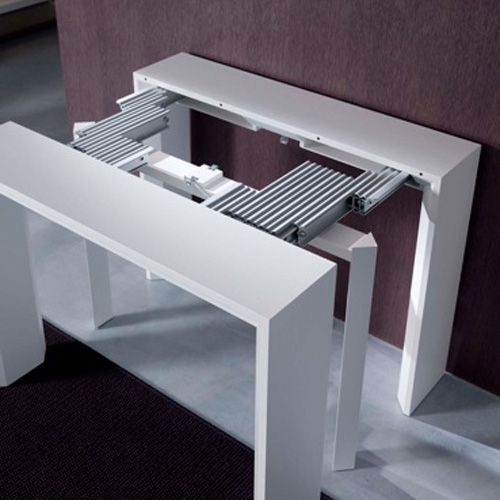
Small is also in with the furniture exhibitors.  We saw very few big pieces, and we saw two exhibitors with credenzas that made into full-size dining tables.  Like this:

Credenza1 Credenza2 Credenza3

Plus there were several booths showing beds that came out of cabinets or the more traditional Murphy-bed set-up for transforming spare spaces into guest rooms with the touch of a button. Plus closet systems that made use of every inch.

The furniture was also sleek and functional looking — nary a curve or a piece of extra ornamentation to be seen in upholstered or hard furnishings. And it really was about doing more with fewer pieces.

Window coverings were also more in the “blinds and shades” family than opulent draperies — and there were no prints except for a few geometrics. When I remember the meters and meters of cabbage roses we used on every upholstered surface in the 70s and 80s!  They are totally out of style now.

The finishes were the ones we’ve seen before — hardwood and engineered floors are still the most popular, there isn’t anything new there.  The counter tops were either quartz or what I came to think of as “novelty” stones, like marble with swaths of green running through; plus lighter granites than the blacks and dark greys we’ve seen in the past few shows.

There was a clean aesthetic when it came to all the decorating. The only place I saw texture was in the walls.  Bathroom and kitchen tiles often had designs incised into them — one booth had sheets of tempered glass with colours and textures embedded in it.  For myself, I would never put anything like that in my home.  How many homes have baths installed in the 1980s?  You can tell because of the florals in the tiles, something that is completely out of style now.  Tiling is something you only want to do once — don’t put anything up that is so very ….. dating.

Saving energy was a definite theme when it came to the doors and windows on display.  Plus there were lots of home security exhibitors, so it seems that putting in a security system is no longer an option but a necessity.

Taking it outside, I was surprised to see how much concrete was being used, often in interested ways.  And outdoor fire pits and fireplaces were everywhere.  “Outdoor rooms” are taking over from “yards and gardens”.

Of course, there were lots of booths selling things, mixers, knives, nozzles and ladders — I saw one man carrying a huge box containing a super-duper car seat cushion.  Luckily we were travelling by transit and had no way to get a lot of “things” home, and of course, no where to put them when we got there!  So we saved a fortune.

Knock, knock. Who’s there? And how many?

I ran across another great article on Life Edited, this time on household size.

All along I have touted laneway homes as a good method to increase the densification of neighbourhoods without changing their character.  These houses, by nature of their small size, will only house one or two people each.  What about the housing density of the rest of the neighbourhood?

Not this kind of housing density.

Not this kind of housing density.

We tend to frame the density issue in terms of housing size, because it’s easy to understand that big homes, as a rule, reduce overall density. But there is something else, just as important as housing size, that must be factored in to understand how density works, and that is household size.

The article quotes a paper in the online journal Population and Environment.  Looking at the population/housing ratio in the past 400 years,

the number of households grew faster than population size in every country and every time period. These findings suggest accommodating housing may continue to pose one of the greatest environmental challenges of the twenty-first century because the impacts of increased housing present a threat to sustainability even when population growth slows.

There are fewer people being born per capita, true, but

Progress made in curbing population growth, however, has not translated into reducing human
consumption of natural resources and impact on the environment.

Yikes!  Why?  Of course there are lots of reasons, and it’s not just because people are building larger homes (McMansions) for their smaller families.  People are also moving out of the family home at an earlier age.  The trend during the recent economic downturn for people to move back in with their parents after college is an anomaly, and probably will not be continued after the economy picks up again.  Also elderly people stay in their own homes longer rather than moving in with their families.  Plus they remain in their old family homes longer rather than moving to smaller ones.  There are other factors as well

The rising incidence of divorce also encourages increased household numbers. In the United
States, 15 % of all households had divorced heads in 2000 …. Although remarriage is common, the relatively high percentage of divorced households persists, and divorced households are 27–41 % smaller than married households

And that means?

From a more simplistic perspective, declining household sizes, from over 5 to approximately 2.5, will mean approximately twice as many houses will be needed per capita in any areas of the world yet to undergo the shift in household size.

Assuming that each of the additional households occupies a 210 m2 house (the average US
house size in 2002) (National Association of Home Builders 2004), then an additional
185,800 km2 of housing area would be required. This estimate may be conservative because land
area for household-related infrastructure (e.g., roads, yards, and retail) can require 2–4 times as
much land as the actual land used for the home …. Each of those houses would demand more household products and have lower efficiency of resource use per person because fewer people share goods and services in smaller households.

That’s why urban sprawl — taking more land to build more houses — will not solve all the problem.

One small caveat by Life Edited shows a glimmer of light in the tunnel of doom:

As a small space design blog, we’d be remiss if we didn’t mention that the amount of sprawl (i.e. the 72K sq miles) they calculate is based on a house size of 2509 sq ft–McMansions for all.

So smaller houses will help the problem well into the future.  And they give us a couple of options,

  1. Let things remain the same. Encroach on undeveloped lands and deplete all natural resources until the planet’s homeostatic environmental mechanisms are irrevocably destroyed.

  2. Reverse demographic shifts away from industrialization, the desire for privacy, divorce and so forth.

  3. Rethink housing. Adjust housing style to meet demographic shifts. Have smaller, more efficient houses with shared amenities. Creatively subdivide existing housing. Mitigate sprawl by keeping density high, even outside of major metropolises, permitting walk/bike/public transportation-friendly living.

That last choice seems the best to me.

New idea? Old idea! Micro-apartments

As cities throughout the globe find that micro-apartments are a great way to create housing for one-person households, we look back at ways teensy apartments fit into the housing mix decades, even centuries ago.

Often these smaller quarters were built that size, but sometimes they were made from larger ones, splitting one apartment into two.  Or in this case, making an apartment out of an old porter’s office and washroom.

But these are not new ideas.  People have been building apartments for centuries.  This complex in the Yemen desert looks quite modern.

DesertCity1

But a closer look reveals it is made of mud walls.

DesertCity2
Good protection from marauders as well as an efficient use of space.

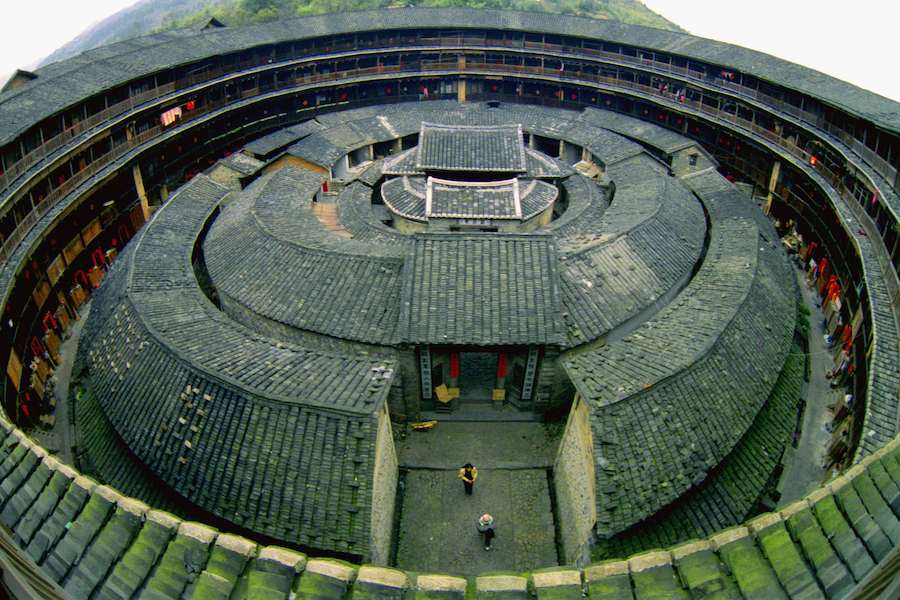
Or this micro-apartment from 12th century China:

ChinaApartment1

Quite a popular idea back then.

ChinaApartment2

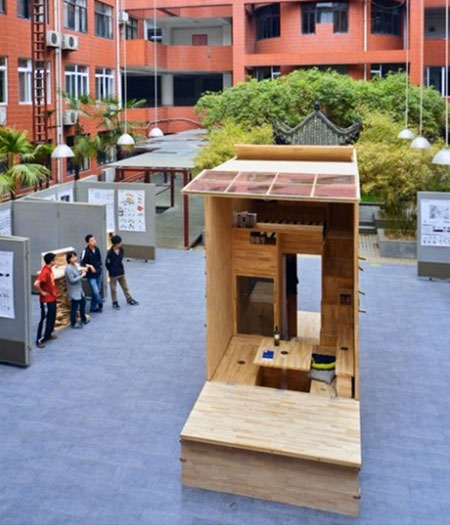
Maybe it’s these ancient micro-suites that inspired a modern-day architecture student in China to design this 75 square-foot home:

ChinaAprtment4

See more at this link.

The growing housing market? Or the housing growing market?

I’m sure you have a friend who quit smoking and then turned into the world’s biggest anti-smoking fanatic.  Sometimes I feel I’m turning into THAT PERSON about living in a smaller space — I love it and it’s such an improvement in our lives.  Let me proselytize a bit, I’ll probably calm down in 20 or 30 years.

Now that I’m a confirmed believer that small is the new black (should I get that on a T-shirt?  No, maybe not) I am on the lookout for stories that others are joining the movement, buying and building smaller houses.  There’s the Tiny House Movement and for a while it looked like housing in the US was getting smaller.

The median size of new homes built for sale peaked in 2007 at 2,295 square feet, then fell to 2,159 two years later, after the housing crisis hit.

But it looks like that trend is over — in fact

the appetite for ever-larger homes has returned: In 2012, new homes reached a new peak of 2,384 square feet and, according to the National Association of Home Builders, some 41 percent of new homes had four or more bedrooms, up from 34 percent in 2009.

Those quotes are from a story in the New York Times about how the recession-led reduction in the size of new homes was just a blip on the radar screen.

“The housing market is being driven by the move-up buyer, the luxury buyer,” said Brad Hunter, chief economist and director of consulting atMetrostudy. “And those who have strong incomes, secure jobs, their stock portfolio is doing well — they are able to buy whatever they want. And what they are buying is larger houses.”

The New York Times is also the paper that tells of the jobless recovery and the shrinking middle class, so I’m guessing these mega-houses are out of the question for most of the population.  But some people feel they are entitled to buy huge homes.

Maybe it’s sour grapes.  But this seems out of line to me.

This six-bedroom house, which has six full and three half bathrooms, measures about 9,000 square feet, including the basement. … added a wall of windows to the basement and furnished it with a pool table, a media room, a wet bar, a home office and a suite for their youngest daughter to use when she was home from college. …

That’s right, this 9K square foot home is for two people.  Sure it has everything they ever wanted in a home, but did it really take 9,000 square feet to indulge their every whim?

Media rooms, sunrooms and in-law suites can be added to standard models. Some customers are even opting for a so-called dirty kitchen, a separate galley off the main kitchen that is used to prep food. It keeps the dirty work of cooking hidden so it doesn’t sully the increasingly large kitchens that have morphed into granite-slathered family gathering spots.

It’s not just schadenfreude to think that these people will very soon become used to living in such, let me say it, excessive luxury.  It’s human nature to forget the joy of possessing something new and shiny, and to want something newer and shinier.  It’s called the Law of Wealth’s Diminishing Returns.  The reality of maintaining that huge house, vacuuming and dusting all those extra rooms, mowing those acres of lawn will take over and you’ll find that the property owns you, not the other way around.

And let me tell you something you probably already knew.  When you have more space your stuff expands to fill it.  There’s some kind of law of physics that explains it, but to put it in layman’s terms you have something, it wears out, but you keep it because you think you might use it sometime, it cost you something to buy, and YOU HAVE THE ROOM TO STORE IT.  So you do. And your stuff increases exponentially.

And lets not forget the cost of those homes.  There’s the larger mortgage which is easily absorbed when it’s 1 or 1.5% but could really get ugly if the rates go up even as high as 7%.  (I’ve seen rates as high as 12% but then I’m a little old lady).

And the enormous amount of power and resources it takes to build and run a home of that size.  It doesn’t help that your refrigerator runs on less p0wer if you have three of them.

This is not likely to become a big problem in our neck of the woods.  For one thing the costs of these homes is quite modest when compared to Vancouver prices.

Affluent buyers have been flocking to real estate, according to the Mortgage Bankers Association, with applications for home loans of $625,000 to $729,000 up 56.7 percent from August 2012 to August 2013. Mortgageapplications for more than $729,000 were up 41 percent.

As I say, this is still a relatively small market.  This “trend” won’t ever have the devastating effect on the subprime mortgage crisis did.  But it still makes me uncomfortable.

I don’t understand why people can’t be happy in less space – happier than they would be in a large house.  With more money to spend on travel and fun experiences.

Nostalgia is not what it used to be.

As one gets older (and that’s the plan, remember?) one finds oneself with what you might call “obsolete skills”.  For instance, while I am in charge of de-jamming and refilling the multi-use colour photocopier at work, I also carry in my brain knowledge on how to run a Gestetner machine.

Gestetner

If you are about my age you will recall the sound of the drum whooshing around, the smell of the duplicating fluid and the sight of purple-printed pages heralding a class hand-out or exam.

I don’t need the ability to run one of these machines, just as I don’t need to know how to send a Telex, or operate an old-fashioned switchboard.  But the knowledge remains, crammed into a little corner of my brain.

Technology has made a huge difference in the way we disseminate information–we have to constantly learn new skills to keep up with it.

But in the home these changes are not as apparent.  The vacuum of my childhood might have been an ancient Kirby bought from a door-to-door salesman, but it worked the same way my new built-in does.  The fridge defrosts itself, but it still cools stuff like our old round-shouldered Kelvinator.

The only domestic chore that has completely changed is the way we wash our clothes.  I was pondering this fact the other day, as I loaded sheets into a machine that will weigh the load, adjust the water level, and deliver clean items painlessly and surprisingly noiselessly.

I want to pay homage to the home makers of the past, and to this very important talent that was once such a difficult and time consuming task: to keep the family’s clothes clean.

How to use a wringer washer:

Because everyone changed their sheets on their beds on the weekends, Monday was wash day in our home.  Yes, all day Monday. Set aside at least 6 hours, because you are doing a whole week’s worth of laundry.

Separate the laundry into whites (sheets and towels), brights, darks, and dirty (Dad was a blue-collar guy, his clothes got dirty).

First the washing machine would be rolled to the sink.

VintageWashingMachine

We had a basement, and big double concrete sinks, so that’s where the washer would be placed.  A hose attached to the faucet fills the machine with straight hot water.

Put in the detergent and let the agitator mix it into the water, then start the wash.

First load:  sheets.  Set the timer for 20 minutes or more (depending on how dirty the clothes are) and go and do some baking or cleaning or God forbid write a letter or have a cup of tea.  When the timer goes off, go back downstairs, swing the wringer over one of the concrete sinks that you have filled with rinse water, and then feed the sheets into the wringer so that the soapy water runs back into the washer.  While the sheets sit in the first rinse, put in the second load.

After swishing the first load around in the first rinse water, swing the wringer so that it sits between the two concrete sinks.  Feed the sheets through the wringer into the second rinse so that the soapy water runs back into the first sink.  Empty that sink.  Rinse it and refill with fresh water while you wring out the items for a second time and load them into the basket to hang up outside (if it’s sunny, even if it’s freezing out there) or in the basement on the clothes lines especially installed for the purpose.

When it’s time to wring out the second load, put them through the wringer into the second sink — thus the second rinse from the first load becomes the first rinse of the second load.  That way you conserve water because this method uses a lot of water.  And you rinse in cold water because hot water costs money, kiddo!

As the saying goes, lather, rinse, repeat.  All day.  Put in more water if it gets low in the washer, but it will get progressively more grotty — that’s the way it is.  Put in more detergent if you add more water. Do the dirtiest clothes last.

As each load is finished and wrung out, carry the heavy basket of wet things to the back yard and reach into the basket and lift and pin the item onto the clothesline so that it will catch the slightest breeze and dry.  It sounds like hard work because it is. It’s a lot of stooping and standing and carrying heavy loads.  In the winter your hands will get very, very cold.

Eventually the last load is finished and it’s time to empty the washer (we used a kind of siphon that Dad had hooked up to the washer so it could empty into the sink).  That lady in the picture above?  She had to open a spigot in the bottom of the tub to drain the water into a bucket which she would then empty into her sink.

And that button on the top of the wringer?  That’s to release the rollers when your child tries to help and the rollers grab her hand and pull it through the wringer up to her elbow.  Ask me how I know about that.  The pressure on the rollers was adjustable, too, so you could fix it according to the weight of the fabrics being wrung.

Now remember — the laundry must be whisked inside off the line at the first drop of rain.  And you must bring everything in before the dews of the evening make it all damp again.

Fold and put away the items that don’t need ironing, underwear, towels, dish cloths.  Put the items that need ironing into the clothes basket.  That’s for tomorrow.

Affordability? It’s a relative thing.

The news this week is that Vancouver housing prices are the 2nd most unaffordable in the world.  The prices are not necessarily the 2nd most expensive in the world, just when compared to what you could earn if you move here from another large city.  We are hit with the double whammy of pricey real estate and lower wages.  Or, as Tsur Somerville of the Sauder School of Business at UBC says,

“Places that have a lot of amenities and are places that people really want to live, pushes up house prices, but also lowers wages, and employers are paying people less who are willing to take a lower paying job to be there. So you get a higher price-to-income ratio.”

I don’t ski on the local mountains in the winter, I don’t wake board in the local waters in summer.  I live in Vancouver because my family is here.  So I’m paying for those amenities that draw people to the area even if I don’t use them.  But we have found a way to live in a comfortable home — our laneway house.  It’s the smallest place we’ve ever lived in, but for us it’s a perfect solution to the dilemna.

I don’t expect you to wander the streets until you find a nice yard and ask the people if you can build a laneway house in their garden — laneway living is one solution, it’s not the only solution to the housing squeeze in the Metro Vancouver area.

The sad truth is that if you move to Vancouver you are going to be paying more — maybe a lot more — for housing than you would in another city, which means you will probably have to downsize (one bedroom to studio, etc.).  But there are still ways to make an attractive and comfortable home with less space.

Today we have a few ideas for living comfortably in a studio apartment.  They are sometimes called bachelor suites — another term for a separate dwelling with its own bathroom and kitchen facilities, but no separate bedroom.

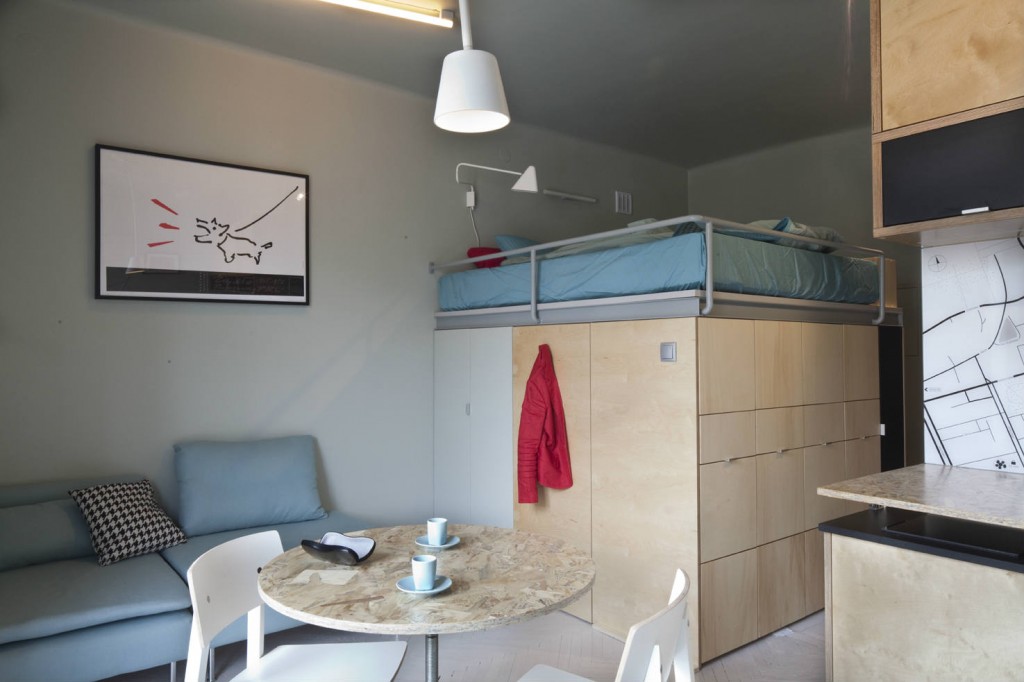
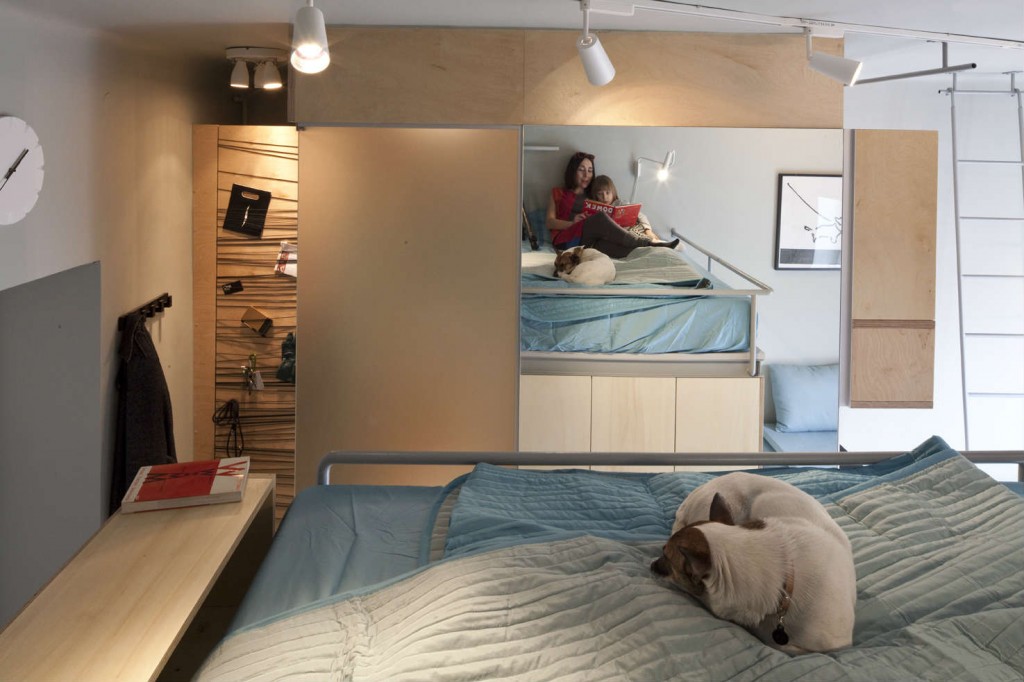
If you’ve some funds, you can get some swell built-ins to add to your space. From Life Edited, here’s a suite in Warsaw, Poland for a mother, her son, and a dog. It’s just 237 square feet.

Small-apartment-Warsaw-living_1

Small-apartment-Warsaw-closet

the suite has “normal” height walls, it’s great to see someone doing something up high in that limited space.

In Barcelona, this bachelor completely built-in his life into this 258 square foot suite:

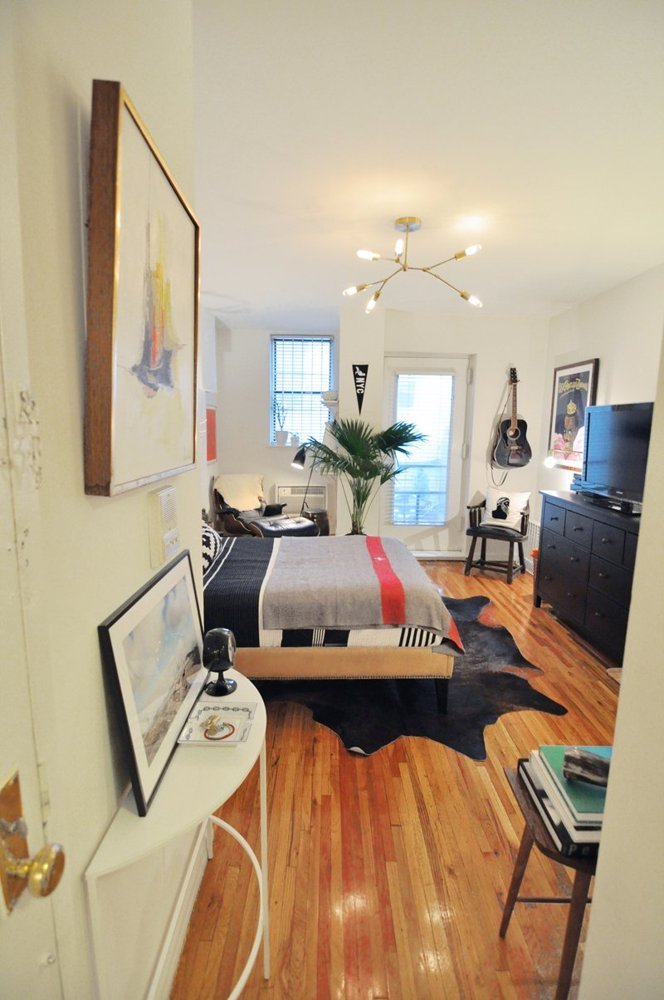
With bachelor suites you may not want to hide your bed away, but rather make it a focal point:

ManhattanBachelor

See the rest of this sweet suite at Apartment Therapy.

But Isabelle LaRue completely transformed her studio space with some clever hacks:

Isabelle is loaded with talent that way — check our her blog at Engineer Your Space.  But you could incorporate a lot of her ideas into your studio even if you are not as handy (maybe you have a few handy friends?).

Here’s another way people divided their space to get a private bedroom:

how-to-divide-living-room-into-bedroom-1

There’s more ideas on fitting a bedroom into a living room here.

The lesson I’m trying to jam down your throat here is that even if living smaller is not by choice (if, for example you have to live in a city with a tight housing market — I’m talking to you Hong Kong!) — you can still find a way to live comfortably in less space.

As I repeat — Small is the new Black.

Skip to my loo

I love our new bathroom.  Although it’s not really a bath-room, as we don’t have a tub, just a glorious, tiled shower with a rain head.

(Pictures?  Not yet.  Although the bathroom is nearly finished, we still have a couple of things that have to be fixed, and I won’t take pictures until it’s perfect.  Just take my word on this for now).

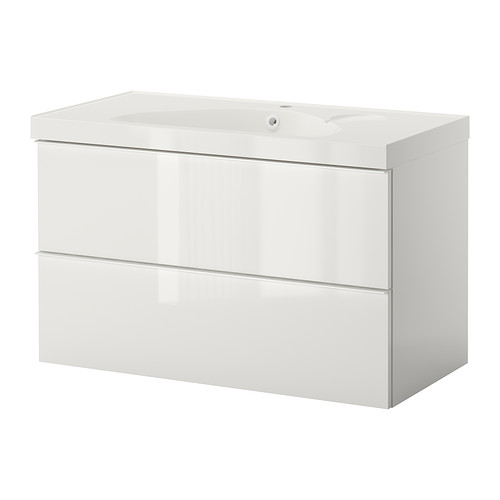
And we have surprising amounts of storage in the bathroom.  Our designer gave us, not only a Godmorgen sink and drawers

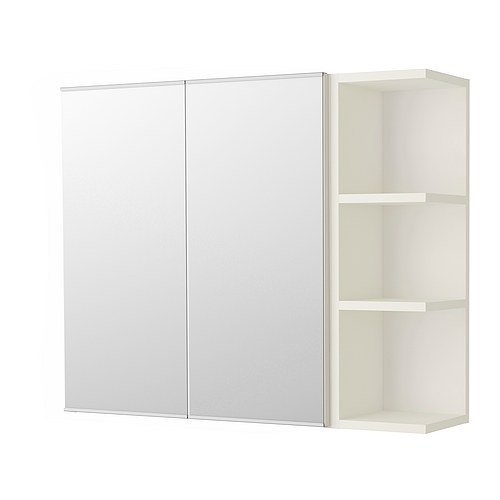
godmorgon-edeboviken-sink-cabinet-with--drawers__0172346_PE326412_S4which is super efficient, but she also carved a space for the Lilangen cabinet to sit inside a niche in the wall

lillangen-mirror-cabinet--doors--end-unit__0133086_PE288202_S4And she stacked two of them on one wall.  Giving us a full-length mirror and oodles of storage, with the mirrors flat against the rest of the wall.

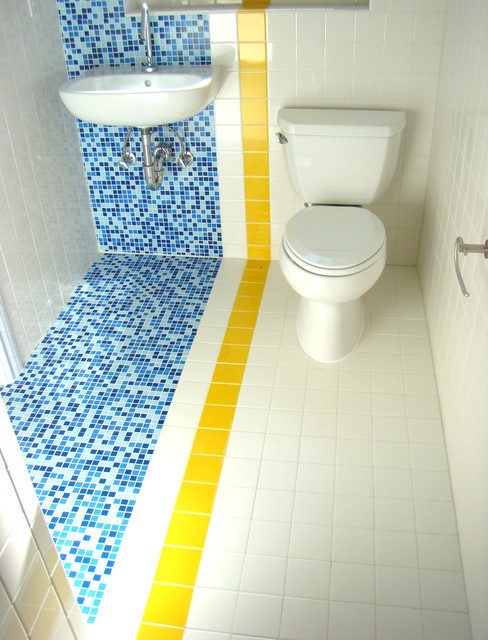
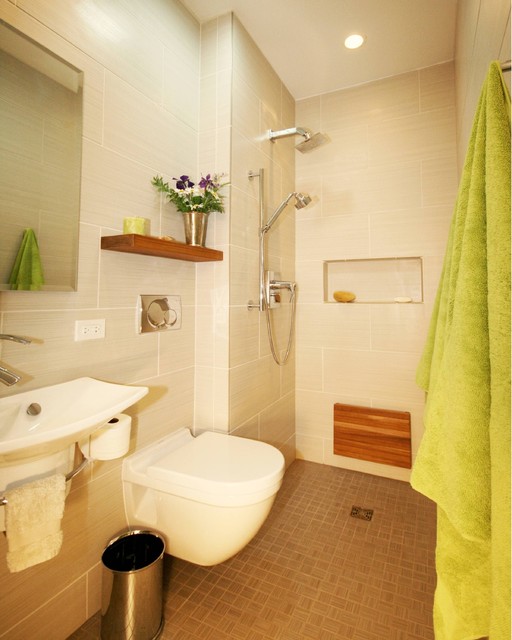
You don’t need to have a small house to have a need of a small bathroom.  Who amongst you has ever wondered if you could get a shower into the same footprint as a powder room?  Have you never thought “it would be so handy to have a full bath right there?”

Well, there are ways of doing this. Houzz has 9 tips for fitting more into less space in the bath/shower room.

My favourite is the European style Wet Room.  The whole room is the shower.  All the surfaces will need to be wiped down after your shower, but if it’s a teeny room that’s not a big deal.

When inches count a wall-mounted toilet can really save space.

We couldn’t do it because our toilet is set against an outside wall (full of insulation, etc.) And we have a regular sink, not this eensy weensy one.

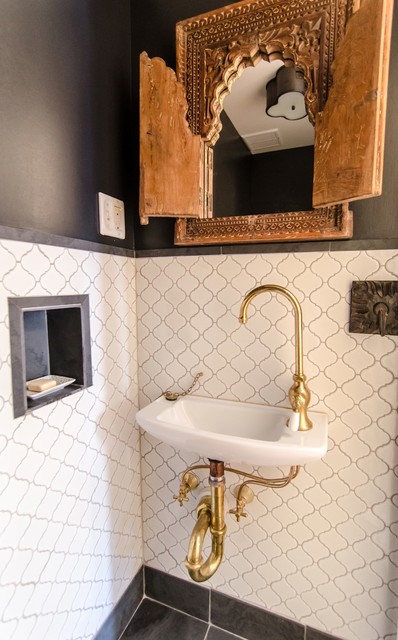
But that’s another way to save some space.  Apartment Therapy has some great little sinks — handsome, too!

ATBathroomSink1This one allows you to put a powder room under the stairs — great space saver.

ATBathroomSink2

No room for a toilet and a sink?  That’s what you think.

ATBathroomSink3Small space solutions.  Because small is the new black. (I just made that up but will be using it mercilessly in the future).

News from down the alley and around the town

DH and I took advantage of the unseasonably warm weather a couple of weekends ago to walk over to Commercial Drive and shop in some of the little stores that line that avenue.

We started off our stroll by walking down the alley for about five blocks — and we found a laneway home on every block.  All new, of course, all built under the former design rules with one-and-a-half stories and no outside parking pad, all looking very nice….and all looking very much the same.

I can’t blame people for wanting to avoid the extra cost of designing their own laneway homes.  And the Craftsman style that predominates is certainly handsome.  But I am glad that some of the local builders are including new and innovative designs in their catalogues.

Smallworks got lots of press this past week with their brand-new design for a glass-brick house.  The whole house is not built of glass brick, but the all four walls have a cheery glow:

GlassHouseThe design has got lots of attention.  I read about it in The Vancouver Sun, VanCity Buzz, Curbed, and Eater.  There was even a letter to the editor in the Sun that worried about the house contributing to light pollution. That’s more fuss about one laneway house than I’ve seen since the early days (oh, those pioneer days of laneway housing — two years ago).

I like the design, there are two versions of the plans, and I think it would be a welcome addition to any block.  And, as I said, I am happy to see a different and innovative look available without a custom design.

I don’t think I could live there (for one thing there is my proclivity to throw stones, and you know what they say….) it’s a little too bright — on a sunny day the light would pour in.  But it’s a handsome house, a good use of space, and a nice different design.

Congratulations, Smallworks.

On another note:

Laneway housing might be coming to the Queen City.  New Westminster Council is currently discussing

 the interest and feasibility of introducing laneway and coach houses similar to those allowed by the City of Vancouver.

Affordable housing is a problem throughout the entire Lower Mainland, not just in the city of Vancouver, so communities throughout the area are looking into a variety of solutions, and laneway housing is just one of them. New Westminster Council is discussing whether to go ahead with laneway housing or to wait and make it part of a much larger neighbourhood planning process currently planned for two years down the road.

The more the merrier, say I.  I believe fervently that laneway houses has a place in the mix of housing in any community.  It’s true that they don’t dramatically reduce the need for affordable housing but they do relieve the under-supply of homes in the area.

Fingers crossed the plan goes ahead.

More space for less stuff

The shelf guys were back this week to give us more space.  They put in shelves in places we had hardly thought of — great horizontal spaces for us to put our stuff.  And just moving boxes out of their way to install the shelves showed us once again — we have too much crap.  Er, things.

F’instance they installed a shelf under the kitchen sink so we can finally put our composting, recycling and garbage out of the way….and discovered we had stored bottles of carpet cleaner under the sink for the past 6 weeks.  We don’t have any carpets.  Ergo, we don’t need carpet cleaner.  Into the recycling they went.

Removing what we don’t need is part of our de-cluttering quest for this year.  And it’s a long, hard, constant job. Or, as LifeEdited puts it,

editing, i.e. getting to that essential, irreducible quality…is something that takes time and great effort.

They have a point, this life style demands a shift in thinking, a paradigm shift if you will.  One of the most important questions we have to ask ourselves is

What would my life look like in its most essential form?

So we’re changing our way of thinking in five essential ways, as suggested in this article:

1. Attention. Practice doing one thing at a time–whether it’s work, driving, reading or talking with a friend.

No more watching TV while writing, reading, doing the crossword.  Let’s concentrate on what we are doing.

2. Space. ask ourselves how we can make the most of the existing space and how we can remove any elements that don’t support how we live.

Like carpet cleaner.

3. Clothing.Create a wardrobe where every item is our favorite.

And that means no more shopping for shopping’s sake — even during the sales.

4. Food. eat less, but better–healthy, fresh food that supports longterm health, not immediate gratification.

Now the holidays are over and all the candy/snacks/desserts are gone, let’s keep it that way until next December.  The only food to grab and eat will be fruit.

5. Stuff. we might continually ask whether we need the stuff we have. Do we use it? Does our frequency and quality of use justify its residency in our lives?

As we move things from our rental storage space to our laneway home we have to keep getting rid of things we don’t use and don’t need.  Yes!  Everything we get rid of makes our lives simpler, more elegant, easier.  And cleaner.

Living a conscious, serene life.  Isn’t that what we all want?

My Pain, My Life, My Struggles, My Fight

Come walk with me, Down My Dark & Stormy Journey BUSINESS INQUIRIES & CONTACT EMAIL : GODSCHILD4048@GMAIL.COM

ANNOTATED AUDREY BLOG

Artist and Desert Dweller with Big City Style.

Im ashamed to die until i have won some victory for humanity.

Domenic Garisto / LIFE IS NOT A REHERSAL,SO LIVE IT..if you can't be the poet, be the poem..havau22.com

The Lady Who Lives Down the Lane

Lane Way Housing for the Nervous Novice

Apartment Therapy| Saving the world, one room at a time

Lane Way Housing for the Nervous Novice

Slightly Snug House

building a home that's not too big and not too small

Vancouverandy

Funny thoughts from a nut like me.

Small House Bliss

Small house designs with big impact

WeeHavyn

Lane Way Housing for the Nervous Novice