RSS Feed

Category Archives: Laneway House

More space for less stuff

The shelf guys were back this week to give us more space.  They put in shelves in places we had hardly thought of — great horizontal spaces for us to put our stuff.  And just moving boxes out of their way to install the shelves showed us once again — we have too much crap.  Er, things.

F’instance they installed a shelf under the kitchen sink so we can finally put our composting, recycling and garbage out of the way….and discovered we had stored bottles of carpet cleaner under the sink for the past 6 weeks.  We don’t have any carpets.  Ergo, we don’t need carpet cleaner.  Into the recycling they went.

Removing what we don’t need is part of our de-cluttering quest for this year.  And it’s a long, hard, constant job. Or, as LifeEdited puts it,

editing, i.e. getting to that essential, irreducible quality…is something that takes time and great effort.

They have a point, this life style demands a shift in thinking, a paradigm shift if you will.  One of the most important questions we have to ask ourselves is

What would my life look like in its most essential form?

So we’re changing our way of thinking in five essential ways, as suggested in this article:

1. Attention. Practice doing one thing at a time–whether it’s work, driving, reading or talking with a friend.

No more watching TV while writing, reading, doing the crossword.  Let’s concentrate on what we are doing.

2. Space. ask ourselves how we can make the most of the existing space and how we can remove any elements that don’t support how we live.

Like carpet cleaner.

3. Clothing.Create a wardrobe where every item is our favorite.

And that means no more shopping for shopping’s sake — even during the sales.

4. Food. eat less, but better–healthy, fresh food that supports longterm health, not immediate gratification.

Now the holidays are over and all the candy/snacks/desserts are gone, let’s keep it that way until next December.  The only food to grab and eat will be fruit.

5. Stuff. we might continually ask whether we need the stuff we have. Do we use it? Does our frequency and quality of use justify its residency in our lives?

As we move things from our rental storage space to our laneway home we have to keep getting rid of things we don’t use and don’t need.  Yes!  Everything we get rid of makes our lives simpler, more elegant, easier.  And cleaner.

Living a conscious, serene life.  Isn’t that what we all want?

Decorating for the ages?

Back a year ago or so when we saw the design that would eventually become our laneway home, we decided to get rid of our furniture (which would not have fit into it anyway) and go with a mid-century modern decorating scheme. Choosing one theme means that all your decorating goes together and you eliminate a lot of other choices when selecting furniture and accessories.  No to that French provincial pouffe!  Ixnay on the cottage-cute curtains! We consulted our designer, and came up with the interiors that we really wanted.

We like the calm, sleek look of the mid-century vibe, plus we know that it is a look for the ages.  The last thing we want is for people to step into our place and estimate to the month exactly when we chose each piece.  We want a timeless look, if you will, avoiding the pieces that were right “in style”, so our interiors would never go “out of style”.

Dated trends like overstuffed shabby-chic upholstery from the 80s, shag carpeting and the orange-and-brown colours from the 70s, the items that would immediately mark our place as “2013”.

If you know what I mean.

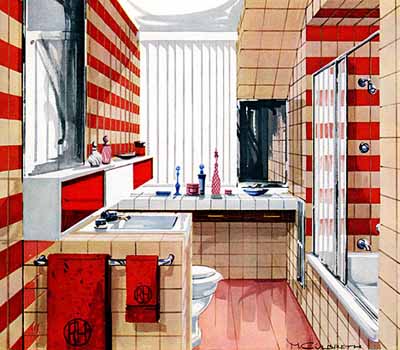
BHG0556

This room will be trapped in 1956 forEVER!

But of course, we failed.  Not entirely, because some of the items we picked were chosen to evoke the 1950s — turquoise headboard and fabric in the bedroom, sputnik lamp above the bed — that are specific to that time.  But we failed in the sense that some of the newest trends of 2014 (according to Style at Home) were incorporated into our decor almost by osmosis.

In the bathroom we stuck with classic glossy white subway tiles and hexagonal tiles for the shower surround.  But we chose matte tiles in a neutral grey for the floor.  And that is a trend for 2014, according to S@H:

Trend-bath1


As is the floating vanity, which was chosen because it’s easy to clean underneath (and it shows off our floor tiles).

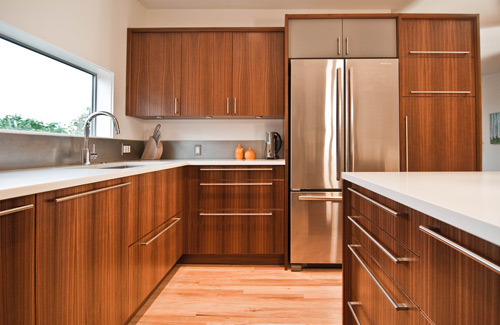
In the kitchen, which is the room that you really want to get right because it’s so difficult and expensive to change it, we ended up with two features that are trends,

Built-in cabinetry that looks like furniture.

Very much like this, but with horizontal grain.

Very much like this, but with horizontal grain.

As it is described in the article

Far from the unfitted kitchens we’ve seen in the past, the new trend in kitchen design for 2014 is built-in accent cabinets that act as framework for the rest of the cabinetry. “We often design these cabinets tall and narrow to sit right on the counters, flanking the stove or on either ends of the run of cabinetry,” says Erin. “They’re usually quite contrasting in both colour and style, introducing more detail than the simple door profiles throughout.”

Because our kitchen and our sitting area are the same small space we want the cabinetry to look like built-in shelves you would find in a den or library.

Another “trend” we went with (honestly, we had no idea it was a trend) is carrying on the kitchen counters up the wall as a slab backsplash.  The article recommends veined materials like marble or limestone, but in our tiny space we wanted to keep the patterns to a minimum and went with the white quartz of the peninsula and counter to be used as a backsplash behind the stove and around our little counter-height window. It looks great, the lights above catch the glints of the stone embedded in the slab, and it is a dream to keep clean.

Another trend we didn’t realize we went with was the neutral-taupey-grey colour we used throughout the space.  We thought we were being as classic and timeless as we could, but according to S@H, it’s a trend.

 “Trends are moving from cool to warm greys and towards beautiful taupes, explains Bev Bell, creative director for Beauti-Tone Paint.

We had to keep the paint colour neutral, we wanted a grey undertone, but we knew if we went with a bluey cool grey the rooms would look cold when the weather was gloomy and rainy.  Instead, the warmth of the taupe keeps the feeling cozy.

IMHO, I think people go with decorating trends because new things become available — attractive new products that make a lot of sense at the time.  Shag carpet in comfy warm oranges had never been on the market before and people liked the intimate feel it gave the room.  Some people even upholstered their walls in it — remember?

And there’s a kind of zeitgeist that is reflected in our decor.  Back in the 1950s, new products incorporating the plastics that had been developed during the war were available in colours people had never seen or used.  And it was the “atomic age” when the A-bomb was going to guarantee our future security, as atomic power was going to fuel it.  The futuristic shapes of moldable plastic influenced art and decor.

"Dreams of Eames"

“Dreams of Eames”

So it’s not such a bad thing that we have some trends that are reflected in our decor.  We can’t really avoid it, we are part of our times, we live in this era and that will inform our choices when it comes to decorating as it does our choices in wardrobes, entertainment, technology.

And our home will always reflect this time — as long as we are living in it.
Keeping it cool – decluttering the fridge.

While showing off our ootsy-cutesy home over the holidays, someone mentioned that their small fridge was driving them a bit crazy, as it was just too small to adequately hold their needed victuals between trips to the market.

I didn’t see how it was an issue for us as we have three markets within easy walking distance, and we can replenish our little Blomberg quite easily and frequently — every day if we want.

Fridge

But guess what — now it’s an issue.

Mostly because none of the local markets supplies small amounts of foodstuffs for couples with small fridges — they are used to stocking huge freezers with family-sized boxes and bags of food.  Plus I just go a little nuts when I see some produce I like, so our eensy crisper gets filled up and spills over into the limited number of shelves.

It’s a habit I must break myself of — right now I am wondering how I am going to get rid of a large bunch of kale and 3/4 of a head of cabbage since I’ve discovered that my cabbage/kale soup has a deleterious effect on DH’s  digestive tract. I bought a lot because a) I like cabbage/kale soup, and b) it’s cheap (like borscht!  only cheaper!), and c) no one in the neighbourhood sells half a head of cabbage. Plus I find myself with a leek (they only came in bunches of 3) and half a sweet potato.

I have learned my lesson, and will only get what we need from now on, and I am sure I will be able to clear out the fridge if I plan a few meals of leek/kale/sweet potato soup (it is a real thing) with cole slaw on the side.

I’m usually quite good at planning meals — I customarily make a month’s plan of meals so we’re not repeating the old stand-bys and we’re trying new recipes.  I just went off the rails with the move.

But it turns out that wasting food is not just a fault of mine…

  • It’s estimated that 40% of America’s food supply ends up in the trash.

  • 10% of greenhouse emissions from developed countries is generated by the production of food that is never eaten.

Yikes!  This article from Life Edited came along just at the right time.  It offers six tips for editing down your supplies, and preventing waste. As it suggests in the article, I buy food from the perimeter of the grocery store, the produce, meat, dairy, and bakery, and try to stay away from the processed food in the middle.  And we save our scraps for the city’s compost scheme. Leftovers get taken to work for lunch.

But I am guilty of saving cans and jars of food “for special”

Avoid “precious” food. How many times have you bought special cheese, meat, heirloom tomatoes–whatever–and waited to use it for a special occasion, only for that food to end up rotting? Have a plan for your food–either eat it at an appointed time or immediately. Food spoils. Make every day a special occasion.

And henceforth, I swear I will live by this rule:

Buy only what you need. This is a pretty obvious one, but try to buy the food and the quantities you know you’ll consume from one shopping trip to another. It’s okay to have an empty fridge before you go shopping. If feasible in your area, make more frequent, smaller shopping trips.

I’ll take that challenge!

You may know that I am a decorating junkie (and if you didn’t know before…..that statement was a dead giveaway).  Every Christmas my husband “surprises” me with a year’s subscription to Style At Home.  I follow decorating blogs and get updates from Houzz and Apartment Therapy.  It was a bit silly when I was living in an 1100 square-foot-condo that I couldn’t afford to renovate, but it’s ludicrous when we’re living in a teensy laneway house with all-new furnishings and finishes.

Or is it?

Although we are going to concentrate on de-cluttering and minimalising our lives this year, we will also have to finish off the little things that will make our house our home.  And Apartment Therapy has a great way to do it, with lots of help and tips.  It’s called The January Cure — a month-long step-by-step way to give yourself a

 “new” cleaner and more organized home.

What’s the sense of moving into a perfect home if I keep up all the bad habits that got me into clutter-strewn life I lived when I had more space?  I’m sure it will take me many iterations of the cure to rid me of all my bad habits but I will start small.

Step One (I should have started this on Thursday, but won’t have to spend a lot of time on it):  Make a List of Projects.

ApartmentTherapyCure

Hmmmm. Starting in the front foyer area, we need to put a picture over our electrical panel.  It’s well-recessed into the wall, so a picture on a good solid hinge can also hide lots of “front door clutter” behind it.  We also want to hang some more art.

We have to wait until all the deficiencies are addressed to get some of these projects finished BUT making a list will give us a good start. I’ll go through the place room by room to make the list.

Step Two:  Weekend Chores, Flowers and Floors.  Hah!  That’s a snap.  Our built-in vacuum will de-fuzz the floors followed by a swipe with the damp mop. Quick work.  Plus a visit to the market for some flowers.

Step Two also includes finding Earth-friendly cleaners.  We have been relying on tried-and-true cleaners, but this is a good time to check out some of the more ecological choices we have. Luckily Apartment Therapy has some suggestions.

We’ll also see if we can’t complete one task from our project list: hanging the bedroom blind.

Well, I feel I’ve accomplished something already.

Fresh starts!

I don’t really make resolutions.  I find that they just add more pressure to my life, and I like making goals and working towards them rather than just saying “I will eat more healthily”.

So instead of just saying “I will live more minimally in 2014” I have set ourselves the task of getting rid of our rented storage space.  I am giving myself the wiggle room that we may move the rest of our stuff into a smaller storage space, and then continue our process and our progress into 2015.  But we will definitely be ridding ourself of stuff.

So far so good with keeping to the more minimal lifestyle on the retail front.  We ventured out on Boxing Day and managed to come back with just what we needed — a tray for the sitting area to make an ottoman into a coffee table, plus an HTMI cord so we could connect my laptop with the TV and watch videos (went through the whole Harry Potter canon during the holidays). I even bought some new bras, and came home and tossed my old ones.  There just isn’t space to save old AnyThing, if we get acquire  new, we have to shed something.

Today I got another little kick in the pants reminder to keep downsizing.  My twice-weekly email from Houzz included some handy tips for editing belongings.

The author mentioned one of my bugbears.  I am not looking forward to editing family pictures.  We used to have so many walls we could just toss pictures of grandparents and ancestors, so many surfaces to hold stiffly-posed portraits and spontaneous snap shots.

She wisely suggests editing:

 I took all of my family pictures out of albums and off the walls, and then organized them by year, starting in 1972 when Mike and I were married, and moving through our 40th wedding anniversary. Then I picked my absolute favorites and built a new single album, simply entitled “The First 40 Years.” I placed the rest of the pictures in clearly marked envelopes that went into a single large plastic bin. (Plastic bins are a downsizer’s best friend.)

This is a big project.  I am not looking forward to taking it on, but will make a start by sorting through our pictures for family shots and putting them aside.  Hopefully someone will find a quick and inexpensive way to digitize the photo library by the time I get around to it.

Unfortunately, the pictures don’t take up a great deal of room.  Fortunately the stuff that does take up a lot of room is easier to get rid of.  And we have a goal to work towards — no more expensive rental storage.  As this other excellent guide to de-cluttering says,

Begin with the end in mind. Think about how you want your home to be. Browse through the ideabooks you’ve already created and look for themes. Only after you’re clear what you’re shooting for should you begin to purge

Time to look backwards — and forward

As I like to remind people (yes, I can be annoying that way), January is named for the Roman god Janus, who could look forward and backwards at the same time.

I think that’s important, and this is about the right time of year to do it.  The hustle and excess of Christmas is over, and we have a few days respite before the hustle and excess of New Year’s Eve.

2013 was a real year of transitions for me and for mine.  As the year began we had to get ready to sell our condo, while we were getting ready to build our laneway, and I was getting over the blow of my mother’s sudden and unexpected death.  Tough times.  But we got through them.

Spring came. We sold our condo.  My father passed away (another emotional blow).

And we broke ground for our house.  Day1.1Everything seemed to take so long!  Waiting for the inspectors, waiting for the suppliers, waiting for utilities connections.  But bit by bit the house went up and we moved in right on schedule. When the footings went in we kept saying “How can we live in such a small space?”

Foot1And we said that again when the foundation walls went in:

Day35Large


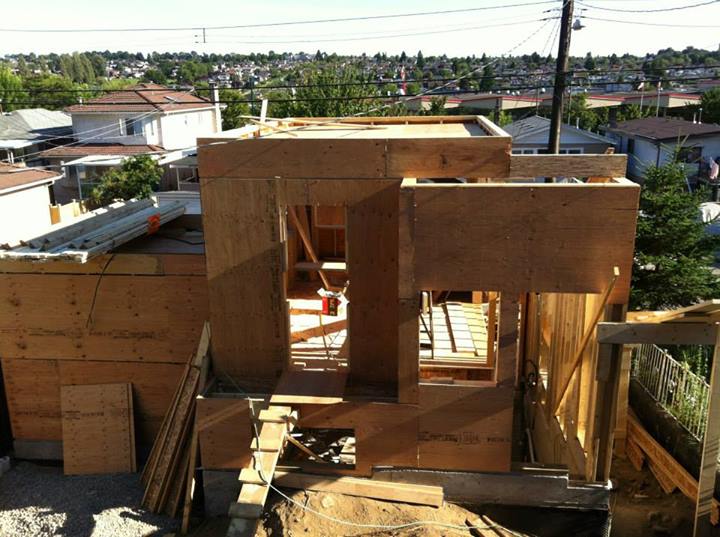
And when the wooden structure was built:

20130711.4


We just couldn’t see ourselves and our stuff in such a small space.  But when we moved in it was clear that the place is exactly the right amount of space and roominess that we need, and anything that does not fit in here is just extra stuff that we don’t need.

We love our little home so much.  We are so comfortable.  And we are so happy when friends and family come by and we can show them around.  Everyone says they love the design and the feeling of cosiness, and we have to agree.  It’s also nice that it takes us about 10 minutes to tidy up the place for visitors.

There are still a few deficiencies to be addressed.  But we are super comfortable and find our neighbourhood to be perfect for us.

So what is ahead?  This blog was built to chronicle the building of the laneway home.  And now that is done.

But I still find things to write about.  Our life and our move to a more minimalist lifestyle.  Other small houses, the tiny house movement.  So the blog will go on. (yes, that is Celine Dion you hear in the background).

Besides, laneway housing is still news, as was shown in this recent story in the Toronto Star shows. The Dunn-Roy family finds

“This has been such a fun experience. I absolutely love my little house,” says Dunn-Roy. “It’s functional, it’s forced us to totally declutter and we’re no longer rattling around in that big house.”

And other people are still interested in living the small life.  This architect built a 200-square-foot home.  In Idaho.  By herself! After a divorce and losing her home to foreclosure (sounds like she had kind of an up-and-down year herself —  she broke her back falling off the roof.)

So you’ll be hearing from me.  And I hope I hear from you, too.

Christmas at the laneway house

Back when we had a natural gas fireplace in our condo, I loved to light it when I first got up on a winter morning.  No matter how grey the day it always made me feel better to see the glow. I thought I would miss it, but of course, we adapted to get what we needed.

XmasFire2013

The cable company runs a continuous Yule log that we’ve got going all day.  It looks toasty but it doesn’t make the room uncomfortably warm (as a real fire would).  I’ve even recorded it so we can have it even when the Christmas season is over and we need that little glow in the evenings. Thank you, electric hearth.

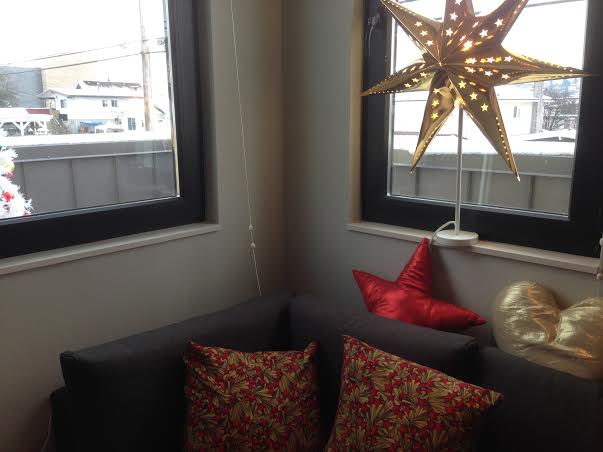
Over in the corner with the sectional we’ve put up an IKEA star and I’ve made some covers for our cushions that were a little more festive.

XmasCorner2013

And our Christmas tree?  Well we don’t have room inside for a tree — so we’ve put it out on the deck.

XmasTree2013

We’ve put outdoor lights on a white tree, set on our patio table.  We can see it from our sitting area, and it just adds the right touch of Christmas.  We’ve had some snow and that adds to the seasonal feeling, too. It looks especially nice in the evenings, when the lights glow through the “needles”.

XmasNightTree

We’ve definitely had to cut back on the decorations from when we were living in a larger place, but that’s OK.  We still get a Christmassy feeling, and we are so looking forward to Christmas day, and carrying our casserole (world-famous broccoli cauliflower souffle, recipe a la Susan Mendelson) across the yard to the big celebration, and being able to imbibe without worrying about getting on the road to get back home.  The whole family will be there, including my sister, niece, old friends, and even an ex-spouse.

We have so much to be thankful for this year.  We have this beautiful home that we love so much, and we are so close to the people we love so much.  There have been some tough times, too, and I am missing my parents a lot, but somehow being in this new house with new traditions makes it easier.

And we hope everyone is having the best holiday season ever!

Tests, trials, and inspections

Even though we had moved into our (tiny, perfect) home at the beginning of the month, the house having passed its Safety Inspection, we actually hadn’t had our FINAL final inspection.  The inspector arrived a couple of weeks ago, and (spoiler alert) we passed!  So now we are very happy and secure that our house is all legal and everything.  **whew**

But that wasn’t the only test we had to pass.  To be deemed energy efficient, we had to have an Energy Efficiency Evaluation.  A qualified energy advisor has assessed the energy efficiency of our house by using Natural Resources Canada’s EnerGuide Rating System procedures. That involves some test, including a Blower Door Test.

energuide-label

The rating goes like this:

New House build to building code standards 65-72
New house with some energy-efficiency improvements 73-79
Energy-efficient new house 80-90
House requiring little or no purchased energy 91-100

Our house got an Energy Efficiency Evaluation of 83!

The evaluation also included a report on how much we can expect to pay to heat the house — combined electrical and natural gas costs of $942.19 — a year!  Along with telling us how much we can expect to pay each month that also gives us a base amount of what we should be spending, so we can see how much our electrical devises/gas stove and barbecue/do-dads and gee-gaws are costing us to run.

And that great score means we can apply for some PowerSmart Rebates.  DD is working on that.  She and DSIL have to apply, as the home owners.

To help us keep track of power usage we might get a Neurio device next year.  A local invention,

Neurio is a home intelligence™ technology that makes your ordinary appliances smart and your home more efficient. Using a WiFi power sensor and a cloud service with some smart pattern detection algorithms, Neurio monitors your home’s electricity to figure out what your appliances are up to – without the need to install sensors on every device.

It’s pretty space age-y, and a great idea to help conserve. If everyone cuts back on the power they use we can all save in the long run.  Here in BC we expect cheap electricity, just like we expect cheap, clean water.  But with more homes being built, more people moving here, we will need more power.  And that means more dams because we just haven’t caught on to the idea of wind farms (even though there’s a big honking windmill visible from Downtown Vancouver).

windmill

Dams are way out in the mountains, far, far away.  But they are super expensive to build.  And the people who own the land way out in the mountains may not be crazy about the idea of, you know, flooding it.  And they were here first.

How much can we stuff into our laneway house?

Stuff is a noun.  And stuff is a verb.  It’s either the things you own, or it’s how you fit them into a small space.

So how much do we need to make us happy? Comfortable? Content?

It’s a long trail of discovery.  With many things discarded along the way.

Last night I watched a movie called “Happy“.  It was a fascinating study of people around the world and what makes them happy.  And guess what doesn’t make them happy?  Stuff. Scientist types explained that wanting stuff makes us happy.  And the anticipation of owning something makes us happy.  We’re even happy when we’re acquiring the stuff. But owning it does not make us happy.  Because once it’s ours, after a very short time it just becomes part of “the stuff we own”.  And apart from it losing that new-car smell and getting a little worn, it also needs to be taken care of.  Polished. Ironed. Painted. Dusted.  More work for you.

Oh, sure, I know you love that guitar/vintage Chanel purse/motorcycle.  But how much of our stuff do we really love, and how much of our stuff is just…..stuff?

We’re lucky in that our two moves this year have brought us face to face with everything we own.  And we own too much.  During the first move I was astonished by the stuff I found in the back of cupboards or the top of closets.  Things I had not even looked at in the 13 years we had lived in that condo.  I said good-bye to it quite happily. Now, as we sift through our Christmas decorations for the ones we can use, the ones that will go to family or to decorate my workplace office, and the ones that will be used to decorate our laneway home, we will be freeing ourselves a little bit more from the tyranny of owning too much stuff.

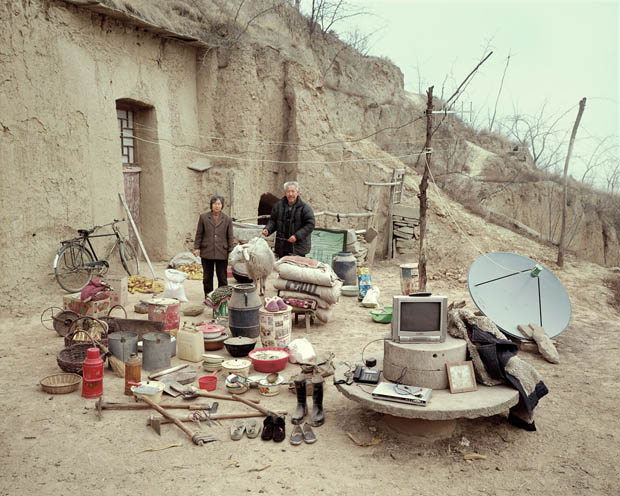
Huang Qingjun is a Chinese photographer who photographed families with all their belongings posing in front of their homes.  These people own very little.  What they have is precious to them.  You can read more about the story here, here, and here, and read an interview with the photographer here.

My favourite shots are these:

200-7

200-6

Even in a yurt or a mud house built into the side of the hill, these people have their TVs and their satellite dishes.  They are connected with the world outside their small homes.

And I suspect they are happy.

Pushback on small apartments in Portlandia

It’s no secret that the rental market in big cities is crazy.  Crazy as in bad.

This article in the New York Times explains how the people who are being badly squeezed by the rental shortage are those on the bottom of the economic pyramid.  New rental buildings are going up — but only for renters who can afford at least $1500 a month.

Many of the worst shortages are in major cities with healthy local economies, like Seattle, San Francisco, New York and Washington. “We’ve seen a huge loss of affordable housing stock,” said Jenny Reed, the policy director at the D.C. Fiscal Policy Institute. “We have lost 50 percent of our low-cost units over the past 10 years, and at the same time, the number of high-cost apartments, the ones going for more than $1,500 a month, more than tripled.”

Everyone is suffering from the rental crunch.  As accommodations get scarce they get more expensive.  It’s bad for everyone, but for the people who don’t make much money it’s far worse. The people who make our lattes, who deliver our papers, who serve us our lunches are all hurting for accommodation they can afford.  So are students, and retirees who don’t own their own home.

And it’s just going to get worse.

Seattle has followed other American cities in allowing (even encouraging) the construction of Micro-suites.  AKA aPodMents.  I’ve spoken of them before.  And other cities in the States are also allowing tiny apartments to go up.

For the adAPT NYC competition, micro-apartments meant an apartment that was between 275-300 sq ft, but these included kitchens and ADA bathrooms. In San Francisco, legislation last year granted an allowance for building dwelling units as small as 220 sq ft, with 70 sq ft for bathroom and kitchen. In Boston, they nervously authorized the construction of 450 sq ft “Innovation Units.” In Providence, RI, they’re making apartments as small as 225 in the Arcade Providence.

But not everyone loves them.  In Portland right now the city government is in the midst of a controversy over a plan to allow these mini-homes to be constructed.

reusable-protest-sign

 The issue, once again, is parking. …The apartments, enjoy a “group living” designation–the same as dormitories, monasteries and convents. As such, they are not required to provide a set amount of parking spaces.

IMHO this opposition is taking is a very, very, very short-sighted view.  Even the most myopic of us can see that having more cars and finding space to put them is not the answer.  Every city planner since Robert Moses has worked to keep cars out of civic cores.  We need them, true, but improved transit and walkable neighbourhoods will serve the entire city (not to mention the planet) much better in the long run.

And let’s look at the market for these micro suites — not every one who rents one will own a car.  Since affordability is the chief attraction of renting one, it’s quite likely that the potential clientèle will use transit or some form of co-op car ownership like Zip Cars or Car2Go rather than tying up money in an automobile.

But even if most of the people in the building have cars, why are the people currently living in the neighbourhood worried about street parking?  Don’t they have garages and parking pads in their yards? And even if they put up “average” sized apartments rather than the micro-suites, isn’t it likely that the tenants will be sharing them, so you end up with the same number of people (and cars).

I’m very much interested in what others feel about micro-suites.  I think there’s definitely a place for them in the housing mix of every large city.

My Pain, My Life, My Struggles, My Fight

Come walk with me, Down My Dark & Stormy Journey BUSINESS INQUIRIES & CONTACT EMAIL : GODSCHILD4048@GMAIL.COM

ANNOTATED AUDREY BLOG

Artist and Desert Dweller with Big City Style.

Im ashamed to die until i have won some victory for humanity.

Domenic Garisto / LIFE IS NOT A REHERSAL,SO LIVE IT..if you can't be the poet, be the poem..havau22.com

The Lady Who Lives Down the Lane

Lane Way Housing for the Nervous Novice

Apartment Therapy| Saving the world, one room at a time

Lane Way Housing for the Nervous Novice

Slightly Snug House

building a home that's not too big and not too small

Vancouverandy

Funny thoughts from a nut like me.

Small House Bliss

Small house designs with big impact

WeeHavyn

Lane Way Housing for the Nervous Novice