RSS Feed

Category Archives: Life

Where — and how — do you want to live

When DH and I began planning our laneway we started by looking around at what was familiar to us.   We had a pretty conventionally designed condo, two beds and two baths,  and we couldn’t get around the idea that we were going to be living in less than half the space we had.  We thought about what we would lose, not what we would gain.

We looked at how other people were downsizing and building laneways, we saw what we liked and what we didn’t like.  And gradually it dawned on us that we shouldn’t just look at how other people live, or how we USED to live, we should look forward, to how we WANTED to live.  We let our imaginations go a little.  We didn’t just want an average house that had been shrunk, we wanted a new plan for us that would lead to a whole new life.  We knew there would be sacrifices (Like “space”.  And “things”.) But in the end we had exactly what we wanted.

There was no way to imagine at the beginning of the journey how it would end. And how it would change our lives.

thumb

Among many other advantages our new life has given us is that we drive less and take transit more often. And we like it. When the car was available down a flight of stairs we used it all the time — whenever we went down town or out for dinner or over to the kids.  Even though transit was right there we didn’t even think about it, we had a car!  Why not use it?

But now we take transit all the time.  I take the 99 Express to work.  It takes a little more time than driving, but I read or knit, and there’s no problem getting a seat because I’m at the end of the line (both ends of the line).  We take transit down town, it’s less than half an hour and we don’t have to worry about parking.  We get down to Granville Island without going through the Hell that is finding parking on a sunny Saturday. If we want to take in a Night Market we can zip out to Richmond or take the Sea Bus to North Vancouver.  All in all Translink is a pretty good system.

So when Translink wanted to expand we were enthusiastically supportive.  Even when the Provincial Government said that the local governments would have to raise their share through a sales tax hike (.5%) we said yes.  But the Provincial Government wanted it put to a referendum; we said yes — but 62% of the region said no.

thumb2

I was pretty steamed. Although I could also understand it.  It’s the old problem of trying to see the end of the journey from where you are now (comfortably behind the wheel of your car).

Others were also frustrated.  Peter Ladner in Business in Vancouver pointed out it was a pretty dumb idea in the first place (or as he put it more elegantly “Determining complex funding and planning issues with a single yes-no vote is an abysmal surrender of political leadership.”) Follow the link, he points out other lessons learned through the referendum process. Hard, nasty lessons, but lessons all the same.

But it was a column by Peter McMartin that put all my inchoate rage into a coherent verbal form. Read the whole thing, please, but for me this is the key issue:

The questions pile up. But the most perceptive question was one I heard in a conversation with Gordon Price, director of Simon Fraser University’s City program. To him, the plebiscite asked a question much more philosophical than yea or nay to a transit tax.

“To me,” Price said, “it was an existential question.

“It asked Metro Vancouverites, ‘Who are we?’ ”

Read more: http://www.vancouversun.com/news/Pete+McMartin+real+Vancouver+emerges+from+ruins+plebiscite/11187386/story.html#ixzz3fF1TYKXt

I have to agree with Peter McMartin that Vancouver is currently nothing special.  We’re in a lovely natural setting.  But we’re not living up to our reputation as innovative and free-thinking nature-lovers.  We just can’t imagine our lives without cars.

I want you to do it — to imagine your life with a dependable transit system that can take you all over the Lower Mainland.  Cheaply.  Easily. No congestion. Freeways with smoothly-running traffic from Horseshoe Bay to Hope.   Doing your shopping by hopping on and off the Broadway Skytrain.  Taking the family to the beach or the park on the bus.  No parking problems.  Less pollution.

Or how about this?  Using a service like ZipCar or Car 2 Go in combination with Transit.  Giving up the ownership of a vehicle that sits parked 90% of the time for greater freedom of mobility. Answering the question of Who are we? with “we’re the people with vision, we ARE the future, we embrace change for the better and accept the inevitability of the end of the automotive age. We are part of that change.”

Otherwise those of us who use transit will be forced to use a less reliable form of transportation:

thumb1

(Less) Power to the people!

I chatted with Ian and Steve at the Home Discovery Show  on CKNW about the difference in the amount of energy we use here at the laneway house.  It really hit me this week when I signed up for BC Hydro’s Equal Billing.  We are paying $35 a month for our electricity now, back at the condo we paid $64 a month.  That’s a huge difference because even though our new home is about half the size of our old one, our condo was on the second floor of a three-storey building, so we only had two exterior walls.  Now we have four exterior walls over 1.5 floors, plus a roof and deck over the entire footprint.

But we don’t have to depend on lower energy bills to know our laneway is energy-efficient. Our house received an EnerGuide rating of 83 from BC Hydro.

Developed by Natural Resources Canada, an EnerGuide rating is a standard measure of a home’s energy performance. A rating of 0 represents a home with major air leakage, no insulation and extremely high energy consumption. A rating of 100 represents an airtight, well insulated, sufficiently-ventilated home that requires no purchased energy.

Power Smart new homes are required to achieve at least ENERGUIDE 80, higher than what’s required by the B.C. Building Code.

That rating put us in the “highly energy-efficient new house” category in their rating system.

This is “Offtober” at BC Hydro.  Visit their site to see how you can save on special deals from retailers; PowerSmart Programs; and play contests.

EnergyStar

If you want to make some changes to your home you can take advantage of rebates and other incentives from the City of Vancouver, BC Hydro, and Fortis.   Find out more about that here.

If you are a low-income household you can take advantage of BC Hydro’s Energy Conservation Assistance Program.  Find out more about this here.

And if you just want to get started living a more sustainable life, pick up some hints here .

What does all this energy efficiency mean to us?  It means lower Fortis bills for a start.  We pay about $25 a month for natural gas for our heating and cooking (including our barbecue).  But it also means getting out of bed on a winter morning and feeling that radiant heat.  It means no cold corners, no nasty drafts.  It means comfort, as much as sustainability.


A long, hard slog, another moving experience

The good news is that our parents’ condo in Nelson has been sold.  The subjects have been removed and in mid-October a new owner will be moving in.

The bad news, of course, is that they want to move into an empty condo.  Everything had to be removed, all the furniture, all the boxes, all the pictures, everything.

Happily my sister had gone through the place in the Spring, tossing and re-packing, and had handled most of the heavy lifting.  But there was still a lot to do, so last weekend she and I climbed into a big, honking rented SUV filled with empty boxes and drove up to Nelson from Vancouver and we started sorting.  Everything that we put into our hands had to be either given away, thrown away, or packed to be brought back to our place. All I wanted were the photos, a quilt, an afghan, and the cutlery.  My son and his wife wanted a chair and ottoman.  A local charity was taking the rest of the furniture.

I don’t have to tell you how horrible it is to move.  Tossing away boxes and boxes of opened food, half-full bottles of cleaning supplies.  Added to that there was the mental strain of decision fatigue.  The emotional wrench every time we ran across a piece of paper with our mother’s writing, a card signed by our father.  We fell into our beds, exhausted, every night.  And rose to face it all again, chaos and mess and piles of things.

To save our sanity we took time for walks around town and even had facials.  To prevent the foolish choices that come from decision fatigue we quit at supper time, and spent the evenings relaxing as much as we could before early bed-times (we were pretty pooped after shifting boxes and bags all day, neither of us is in our first bloom of youth).

When we left after a last farewell tour of the now-empty condo we were relieved, but not comforted.  We were so fortunate that we could do it together, my sister lives on the other side of the country and it was just luck that she was on the West Coast to attend a course and could take some holidays, because it would be exponentially more difficult for one person (hauling a huge old TV to the recyclers was definitely a two-person job). And we could help each other winnow through the collections of chotchkes.

One job I will be undertaking right now! is the labelling of the photos and slides I brought home.  I have to identify all the faces I recognise and scan and email the ones I don’t to relatives (while they are still around) so we can catalogue them all.  Note:  pencilling “Dad” on the back of a photo with no date is not going to help someone trying to identify it 70 years later.

So it’s good-bye to Nelson, a beautiful city but one that we have seen frequently over the past 40 years.  Now we will take trips to other equally-lovely corners of this fantastic province.

A new addition

How have I been occupying myself the last couple of weeks?  Not by writing blog posts.  No, I have been waiting.  We slipped away for a week to our usual holiday spot, but the rest of the time I was waiting.  Brooding.  Sitting in my empty nest and waiting on the arrival of our newest BFF — our grandson. This long weekend I watched a Dr. Who-athon on Netflix and knit a little blue sweater as my daughter patiently waited for her son to be born.

And now he is here!

Andrew

He arrived on September 1, and is a bonny lad. We are all madly in love with him, especially his sister.  How like her he is!

The best thing about this wonderful experience is that we now live right next door to these wonderful people, and can visit them whenever we want!  There are not many grandparents who have that chance, and I realize how lucky we are.

Soon I will be back to the regular content of the blog, but for now I will be gazing into that beautiful face. Darling Douglas.


Clutter – what is it?

I’ve been thinking more about the mechanics of keeping our place tidy and clean, so I was shocked when I saw the headline on Lifehacker:

Keeping Some Clutter May Be More Valuable For Lower-Income Households

Wait, what???? How can clutter be valuable?

The idea seems a bit counterintuitive (particularly if you account for storage space), but it actually makes sense. “Clutter” is typically seen as junk. Crap you don’t need. However, the less money you have, the less you can afford to replace that old stuff you might-but-probably-don’t need.

This idea can manifest itself in a number of ways, including hanging on to old furniture, clothes that don’t fit anymore, or a pile of chargers and cables.(emphasis mine)

I consider ourselves to be upper-lower-income.  And we do hold on to stuff — but only to stuff we will probably need. And that certainly includes a pile of chargers and cables.

For instance, we each just got brand-new Kindles.  My old one is cacked — that’s been tossed.  But what about the charging cord?  It fits my new Kindle.  I can still use it.  So the new ones could get put away and we could just use the old one, but why not take it to work and leave it there?  Or put it into my purse with my spare cell phone charger so I’ll always be able to charge it?

But I won’t throw it out.

Or how about head-phones?  When I got my new phone it came with ear-buds.  So I took my old set and put them away.  Sure enough, when my new ear-buds gave out I could pull out the old set and use them.

Broken stuff gets turfed.  But I cannot call a baggy full of chargers and cables “clutter”.

What’s “clutter” to you?

Keeping it clean — old school

Yes, the laneway house is kept tidy.  Two adults, two indoor cats, all working together to keep it clean and habitable.  Who couldn’t manage that?

TidySign

OK, we don’t get any medals.  And I have to admit a couple of corners (in the storage space beneath the stairs for example) that are not as well-organized as I would like.  But let’s get into the WABAK machine and see how I learned how to keep a house tidy, back in the days before the internet.

Back in a time I like to call….the 60s.

My mother worked hard to keep our home clean and tidy.  And my sister and myself had chores to do every week to help her.  We had to dust and vacuum the living room, do dishes, iron our clothes, the usual things our friends did.  But the worst was the Saturday morning bedroom cleaning routine.  DS and I would retire to our bedrooms, and after an hour she would emerge, her bed made, her desk organized, her dresser dusted, her floor mopped.  I could hear her leaving for an afternoon with her buds while I closed the book I had been reading and did a quick zip around the room to pass inspection.  I didn’t mean to procrastinate.  I just got side-tracked.

That habit followed me.  I knew I had to do the minimum amount of housework to keep the place looking habitable, and I wasn’t dirty, I just kept putting off the stuff that was “too much bother”.

You can get away with stuff like that when you are part of a two-job couple.  But when you are a stay-at-home Mom, it’s part of your job to keep the house clean.  And I just found it overwhelming. I thought that you were or you weren’t a tidy person, that was it.  There was no way out of the mess.

Then one day, I think I was watching Mike Douglas while I ironed, I saw two sisters, Pam and Peggy.  They called themselves the SLOB Sisters.  And they were just like me! Sidetracked Home Executives.

Their book gave me a system.  And it worked.  I didn’t have to be “naturally tidy”, I just followed the system. Big tasks were carried out once a month, with smaller ones done daily or weekly.  There were even jobs that you only needed to do once a year.  Everything was scheduled.  So simple.

I used their system religiously while the children were small.  It fell apart (a bit) when I went back to work.  But there are still things I do that I learned under the SLOB Sisters’ tutelage.

There are other books, other systems.  But if you are feeling completely overwhelmed by housework, I am here to tell you that there is a way out.  And you can do it.

5 ways the laneway life is changing us for the better

We’ve been living in our laneway for over three months now, time for the first inventory of how living here has changed our lives.  The differences are subtle, but telling.

Hmmmmmmmmm.......

Hmmmmmmmmm…….

I feel more in control of the changes in my life these days.  I’ve always been aware that I couldn’t complain about my job or my home because as an adult I had made every decision that had landed me where I am.  Of course those were always restricted by the available options, but it was my choices that had determined where and how I lived.

So I like to keep track of how these decisions have steered my life in slightly different directions. Since moving into our laneway,

1.  I know more about what’s going on. I never used to watch the news.  In the morning I was busy in the kitchen and bathroom getting ready for work.  In the evening I was busy making dinner in the kitchen.  Then I was in bed before the late night news.  But now I watch the news while I prepare breakfast and dinner — I’m paying more attention to it. Whether that’s better for my peace of mind or not, it’s probably much better for me.

2.  I like shopping again. I don’t buy as much stuff.  That was going to be a given.  Our cupboards and closets are full.  But I am pleasantly surprised how much more fun it is to go shopping.  For one thing I will not buy anything that is not exactly what I want and need.  You must have been poking around a store and thought “I could probably use one of those” or “I need something like that” then you get it home and put it away and forget about it because it’s not exactly what you needed, it’s just sort of what you needed.  No more of that.  If it’s not exactly what I need right now, I won’t buy it.

3. I enjoy mornings more.  In our condo the clothes closets and dressers were in our bedroom.  I get up earlier than DH, so I had to get everything ready the night before so I wouldn’t disturb him rooting around for the clothes I needed.  The door to the ensuite where I performed my morning toilette opened so that any light would shine right on his sleeping face.  Small things, I know, but now when I get ready in the mornings I can shut off the closet and bathroom with a sliding door, creating a little dressing area for myself (this isn’t a lucky fluke, BTW, our designer created this for us). That gives me a lot more options when I dress.

Plus the light pours into our upstairs even when the day is grey.  It makes it much easier to get up and go. That means the whole day gets off to a good start.

4. We are eating better.  I used to make up meal plans at the beginning of each month.  It meant we were not duplicating meals but it also meant we were getting into a rut.  We would do a big shop on the weekend because we had a big fridge and lots of cupboard space.  But now we have a tiny fridge we can’t fill it up with food we are not going to eat right away.  So we shop every day, luckily we are right down the street from three major grocery markets, and we are trying out new foods.  Polenta.  Kale.  Quinoa. Radiccio. Plus we don’t throw food out because there is no room for leftovers to become science experiments, they are used up within a few days. DH is anticipating grilling season (and his brand new natural gas barbecue).

5. I worry less.  Because there’s less for me to worry about.  It’s very odd.  The less I have, the happier I am or at least the greater my sense of satisfaction. Of course I don’t worry about our laneway home because everything is brand new, so I am not concerned about things breaking down. And since it was built specifically for our needs everything is right where we want it all the time. But experts at Baylor University have found that materialists — people who have to have things to be “happy” are less happy than other people because they have no gratitude. I am grateful every day for our home and our new life and that gives me a sense of satisfaction and, yes, happiness.

Nostalgia is not what it used to be.

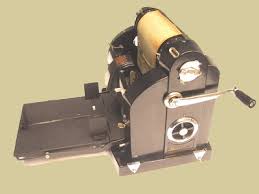
As one gets older (and that’s the plan, remember?) one finds oneself with what you might call “obsolete skills”.  For instance, while I am in charge of de-jamming and refilling the multi-use colour photocopier at work, I also carry in my brain knowledge on how to run a Gestetner machine.

Gestetner

If you are about my age you will recall the sound of the drum whooshing around, the smell of the duplicating fluid and the sight of purple-printed pages heralding a class hand-out or exam.

I don’t need the ability to run one of these machines, just as I don’t need to know how to send a Telex, or operate an old-fashioned switchboard.  But the knowledge remains, crammed into a little corner of my brain.

Technology has made a huge difference in the way we disseminate information–we have to constantly learn new skills to keep up with it.

But in the home these changes are not as apparent.  The vacuum of my childhood might have been an ancient Kirby bought from a door-to-door salesman, but it worked the same way my new built-in does.  The fridge defrosts itself, but it still cools stuff like our old round-shouldered Kelvinator.

The only domestic chore that has completely changed is the way we wash our clothes.  I was pondering this fact the other day, as I loaded sheets into a machine that will weigh the load, adjust the water level, and deliver clean items painlessly and surprisingly noiselessly.

I want to pay homage to the home makers of the past, and to this very important talent that was once such a difficult and time consuming task: to keep the family’s clothes clean.

How to use a wringer washer:

Because everyone changed their sheets on their beds on the weekends, Monday was wash day in our home.  Yes, all day Monday. Set aside at least 6 hours, because you are doing a whole week’s worth of laundry.

Separate the laundry into whites (sheets and towels), brights, darks, and dirty (Dad was a blue-collar guy, his clothes got dirty).

First the washing machine would be rolled to the sink.

VintageWashingMachine

We had a basement, and big double concrete sinks, so that’s where the washer would be placed.  A hose attached to the faucet fills the machine with straight hot water.

Put in the detergent and let the agitator mix it into the water, then start the wash.

First load:  sheets.  Set the timer for 20 minutes or more (depending on how dirty the clothes are) and go and do some baking or cleaning or God forbid write a letter or have a cup of tea.  When the timer goes off, go back downstairs, swing the wringer over one of the concrete sinks that you have filled with rinse water, and then feed the sheets into the wringer so that the soapy water runs back into the washer.  While the sheets sit in the first rinse, put in the second load.

After swishing the first load around in the first rinse water, swing the wringer so that it sits between the two concrete sinks.  Feed the sheets through the wringer into the second rinse so that the soapy water runs back into the first sink.  Empty that sink.  Rinse it and refill with fresh water while you wring out the items for a second time and load them into the basket to hang up outside (if it’s sunny, even if it’s freezing out there) or in the basement on the clothes lines especially installed for the purpose.

When it’s time to wring out the second load, put them through the wringer into the second sink — thus the second rinse from the first load becomes the first rinse of the second load.  That way you conserve water because this method uses a lot of water.  And you rinse in cold water because hot water costs money, kiddo!

As the saying goes, lather, rinse, repeat.  All day.  Put in more water if it gets low in the washer, but it will get progressively more grotty — that’s the way it is.  Put in more detergent if you add more water. Do the dirtiest clothes last.

As each load is finished and wrung out, carry the heavy basket of wet things to the back yard and reach into the basket and lift and pin the item onto the clothesline so that it will catch the slightest breeze and dry.  It sounds like hard work because it is. It’s a lot of stooping and standing and carrying heavy loads.  In the winter your hands will get very, very cold.

Eventually the last load is finished and it’s time to empty the washer (we used a kind of siphon that Dad had hooked up to the washer so it could empty into the sink).  That lady in the picture above?  She had to open a spigot in the bottom of the tub to drain the water into a bucket which she would then empty into her sink.

And that button on the top of the wringer?  That’s to release the rollers when your child tries to help and the rollers grab her hand and pull it through the wringer up to her elbow.  Ask me how I know about that.  The pressure on the rollers was adjustable, too, so you could fix it according to the weight of the fabrics being wrung.

Now remember — the laundry must be whisked inside off the line at the first drop of rain.  And you must bring everything in before the dews of the evening make it all damp again.

Fold and put away the items that don’t need ironing, underwear, towels, dish cloths.  Put the items that need ironing into the clothes basket.  That’s for tomorrow.

Time to look backwards — and forward

As I like to remind people (yes, I can be annoying that way), January is named for the Roman god Janus, who could look forward and backwards at the same time.

I think that’s important, and this is about the right time of year to do it.  The hustle and excess of Christmas is over, and we have a few days respite before the hustle and excess of New Year’s Eve.

2013 was a real year of transitions for me and for mine.  As the year began we had to get ready to sell our condo, while we were getting ready to build our laneway, and I was getting over the blow of my mother’s sudden and unexpected death.  Tough times.  But we got through them.

Spring came. We sold our condo.  My father passed away (another emotional blow).

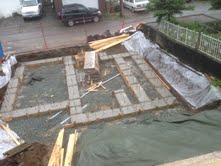
And we broke ground for our house.  Day1.1Everything seemed to take so long!  Waiting for the inspectors, waiting for the suppliers, waiting for utilities connections.  But bit by bit the house went up and we moved in right on schedule. When the footings went in we kept saying “How can we live in such a small space?”

Foot1And we said that again when the foundation walls went in:

Day35Large


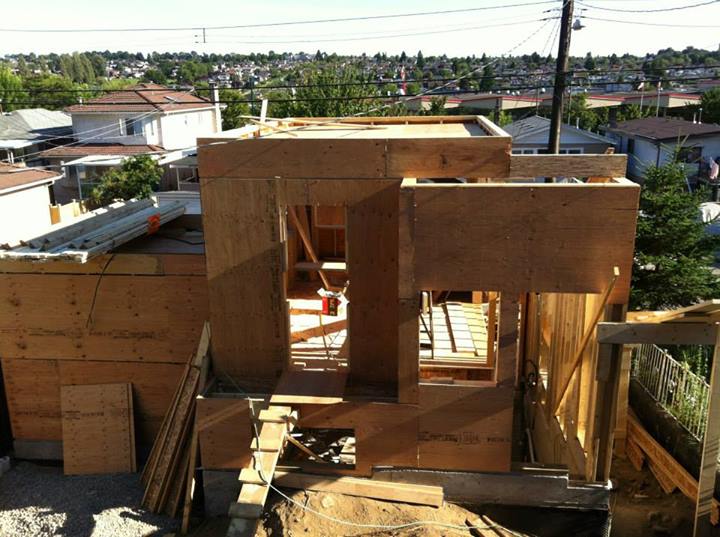
And when the wooden structure was built:

20130711.4


We just couldn’t see ourselves and our stuff in such a small space.  But when we moved in it was clear that the place is exactly the right amount of space and roominess that we need, and anything that does not fit in here is just extra stuff that we don’t need.

We love our little home so much.  We are so comfortable.  And we are so happy when friends and family come by and we can show them around.  Everyone says they love the design and the feeling of cosiness, and we have to agree.  It’s also nice that it takes us about 10 minutes to tidy up the place for visitors.

There are still a few deficiencies to be addressed.  But we are super comfortable and find our neighbourhood to be perfect for us.

So what is ahead?  This blog was built to chronicle the building of the laneway home.  And now that is done.

But I still find things to write about.  Our life and our move to a more minimalist lifestyle.  Other small houses, the tiny house movement.  So the blog will go on. (yes, that is Celine Dion you hear in the background).

Besides, laneway housing is still news, as was shown in this recent story in the Toronto Star shows. The Dunn-Roy family finds

“This has been such a fun experience. I absolutely love my little house,” says Dunn-Roy. “It’s functional, it’s forced us to totally declutter and we’re no longer rattling around in that big house.”

And other people are still interested in living the small life.  This architect built a 200-square-foot home.  In Idaho.  By herself! After a divorce and losing her home to foreclosure (sounds like she had kind of an up-and-down year herself —  she broke her back falling off the roof.)

So you’ll be hearing from me.  And I hope I hear from you, too.

We’re home!

This is just a quick note to say that we have successfully moved into our new home. It’s still a bit of a work in progress, with a few touches to be completed, but it is coming together nicely and is so adorable!
Things that surprised us about our new home:

  • how quickly we adapted to the smaller space, and how completely comfortable we are in it.  The rooms seem exactly the right dimensions
  • how much storage we are finding in every nook and cranny.  We are still downsizing, and there will not be room for everything we currently own, but we are still putting things together and there is room for what we need

Things that pleased us about our new home:

  • the appliances!  The Blomberg washer has been going nearly non-stop.  Got some bright red tea towels you need to wash for the first time?  Do them by themselves!  The washer weighs the load and automatically adjusts the amount of water it uses!
  • BlombergWasher
  • the under-fridge freezer has drawers for better storage options.
  • and the natural-gas stove!  What’s not to love!

What completely blew us away about the new house?  That is a toughie, as we have been thrilled with just about everything about the place.  But for face-dropping dramatic day vs night transformation, we have to go with the enormous difference the landscapers, Vantage Landscaping performed.  Amro and his team took a back yard that had been ripped apart and chewed up until it looked like the set for a WWI trench warfare movie of the week, and turned it into a lush oasis complete with plum tree, artfully arranged boulders, and even our “dry river bed” up the west side of the home.  Plus plantings outside the laneway entrance that look so lovely! In two days! From Verdun to Versailles!

My Pain, My Life, My Struggles, My Fight

Come walk with me, Down My Dark & Stormy Journey BUSINESS INQUIRIES & CONTACT EMAIL : GODSCHILD4048@GMAIL.COM

ANNOTATED AUDREY BLOG

Artist and Desert Dweller with Big City Style.

Im ashamed to die until i have won some victory for humanity.

Domenic Garisto / LIFE IS NOT A REHERSAL,SO LIVE IT..if you can't be the poet, be the poem..havau22.com

The Lady Who Lives Down the Lane

Lane Way Housing for the Nervous Novice

Apartment Therapy| Saving the world, one room at a time

Lane Way Housing for the Nervous Novice

Slightly Snug House

building a home that's not too big and not too small

Vancouverandy

Funny thoughts from a nut like me.

Small House Bliss

Small house designs with big impact

WeeHavyn

Lane Way Housing for the Nervous Novice