RSS Feed

Tag Archives: Laneway House

5 ways the laneway life is changing us for the better

We’ve been living in our laneway for over three months now, time for the first inventory of how living here has changed our lives.  The differences are subtle, but telling.

Hmmmmmmmmm.......

Hmmmmmmmmm…….

I feel more in control of the changes in my life these days.  I’ve always been aware that I couldn’t complain about my job or my home because as an adult I had made every decision that had landed me where I am.  Of course those were always restricted by the available options, but it was my choices that had determined where and how I lived.

So I like to keep track of how these decisions have steered my life in slightly different directions. Since moving into our laneway,

1.  I know more about what’s going on. I never used to watch the news.  In the morning I was busy in the kitchen and bathroom getting ready for work.  In the evening I was busy making dinner in the kitchen.  Then I was in bed before the late night news.  But now I watch the news while I prepare breakfast and dinner — I’m paying more attention to it. Whether that’s better for my peace of mind or not, it’s probably much better for me.

2.  I like shopping again. I don’t buy as much stuff.  That was going to be a given.  Our cupboards and closets are full.  But I am pleasantly surprised how much more fun it is to go shopping.  For one thing I will not buy anything that is not exactly what I want and need.  You must have been poking around a store and thought “I could probably use one of those” or “I need something like that” then you get it home and put it away and forget about it because it’s not exactly what you needed, it’s just sort of what you needed.  No more of that.  If it’s not exactly what I need right now, I won’t buy it.

3. I enjoy mornings more.  In our condo the clothes closets and dressers were in our bedroom.  I get up earlier than DH, so I had to get everything ready the night before so I wouldn’t disturb him rooting around for the clothes I needed.  The door to the ensuite where I performed my morning toilette opened so that any light would shine right on his sleeping face.  Small things, I know, but now when I get ready in the mornings I can shut off the closet and bathroom with a sliding door, creating a little dressing area for myself (this isn’t a lucky fluke, BTW, our designer created this for us). That gives me a lot more options when I dress.

Plus the light pours into our upstairs even when the day is grey.  It makes it much easier to get up and go. That means the whole day gets off to a good start.

4. We are eating better.  I used to make up meal plans at the beginning of each month.  It meant we were not duplicating meals but it also meant we were getting into a rut.  We would do a big shop on the weekend because we had a big fridge and lots of cupboard space.  But now we have a tiny fridge we can’t fill it up with food we are not going to eat right away.  So we shop every day, luckily we are right down the street from three major grocery markets, and we are trying out new foods.  Polenta.  Kale.  Quinoa. Radiccio. Plus we don’t throw food out because there is no room for leftovers to become science experiments, they are used up within a few days. DH is anticipating grilling season (and his brand new natural gas barbecue).

5. I worry less.  Because there’s less for me to worry about.  It’s very odd.  The less I have, the happier I am or at least the greater my sense of satisfaction. Of course I don’t worry about our laneway home because everything is brand new, so I am not concerned about things breaking down. And since it was built specifically for our needs everything is right where we want it all the time. But experts at Baylor University have found that materialists — people who have to have things to be “happy” are less happy than other people because they have no gratitude. I am grateful every day for our home and our new life and that gives me a sense of satisfaction and, yes, happiness.

Who gets to live here?

It’s no secret that I’m a real fan of any housing that lets people live in the city of Vancouver.  Houses, duplexes, condos, rental suites, basement suites, laneway houses.  Bring them on, in greater numbers.  I think that anyone who wants to should live where they want, in the city that has won the Best City in the World award and offers everyone the joys of living in a big, cosmopolitan, multicultural metropolis such as this.

Vancouver hasn’t always been such a “cosmopolitan” place.  We’ve always been a railway terminus and a seaport, a place of sawmills, stevedores and gandydancers, hard-working blue-collar workers.  And for many, many, many years, these people have ended up in the Downtown East Side (DTES) when they couldn’t work any more because of age or injury.  That neighbourhood has been the skid road — a term that started in this town when the corduroy log-paved roads would be greased to allow logs to slide down them to the sawmills — of Vancouver.  It’s a district of Single Room Occupancy hotels, where the sad and the broken live.  There are drugs, drug users, drug sellers (they don’t have to be pushers down there, just vendors). There are people struggling — and losing — with substance abuse of every kind.  There is prostitution.  There are the mentally ill. And there are also the agencies and organizations who help these people through their struggles. It’s a tough neighbourhood — but caring.

So in the middle of this vibrant town, full of life and activity and fun, there’s a place of shadows and sorrow.

Right next to this area is Vancouver’s Chinatown, a cultural treasurehouse. But it is also feeling the pressure of urban development. 

The property these areas sit on is becoming more and more valuable; development is pushing into it, squeezing the “have-nots” into a smaller and smaller area.

 Now maybe the city has found a solution to the squeeze.

From the Vancouver Sun comes this story of a new revitalization of the downtown east side and its centre, Hastings Street.

Today, Hastings is the heart of the Downtown Eastside, Vancouver’s most troubled neighbourhood. Hastings has become synonymous with drugs and poverty, an internationally-known eyesore.

But change may be around the corner. The city of Vancouver has spent the last couple of years going through a new Downtown Eastside local area planning process (LAPP), in tandem with many of the neighbourhood’s most vocal anti-poverty activists.

And therein lies the secret to this plan’s success.  Lots of times experts and pundits and caring folk from all around the city will try their best to solve the problems of civic blight.  But it’s only because they have pulled in people who live and work and advocate here that I think that they might have a chance to make this work.

If the Downtown Eastside plan succeeds — and that’s a big if — much of Hastings between Clark Drive in Strathcona and Abbott Street in Gastown is likely to be replaced with new developments. Taller buildings filled with single room occupancy hotel rooms, known as SROs, around Hastings and Main will probably survive, but most everything else is up for grabs, unless it is a designated heritage building or existing social housing.

There will be condos allowed in the five blocks between Clark and Heatley, as well as in the two blocks from Carrall to Cambie. Any new development will have to include 20-per-cent social housing.

The condo-free zone between Heatley and Carrall is called “Hastings Central.” Maximum heights range up to 12 storeys, although pure social housing projects can apply to go higher. All new projects in this zone have to be at least 60-per-cent social housing.

Overall, the plan calls for 4,400 social housing units to be built in the Downtown Eastside. Most people think this is the rough patch around Hastings and Main, but the city plan defines it as a much larger area that includes surrounding neighbourhoods like Victory Square, Gastown, Chinatown, Strathcona and Thornton Park.

Is it going to work?  Who knows?  It’s a noble effort, there are lots of people who are fighting it — well-meaning people with good arguments against it.

I’ve had some spirited discussions with them.   Why should developers buy into this plan?  Why should we, the lucky ones, bother with these people, drug addicts and the like?

Because, that could be us.  One or two mis-steps.  Age.  Illness.  Injury.  We could be there. According to counsellor Andrea Reimer:

She figures fewer than a hundred of the Downtown Eastside’s 18,000 residents are involved in the street disorder that goes on. Most of them just “fell through one crack, and then another.”

“How many times did I meet guys who lost their job, got divorced, had gambling addictions, were injured at work and were on pain medications they couldn’t get off of. People with brutal childhoods. It’s amazing that some of them are still walking around, right? And some of them aren’t.”

I want it to work.  I want the people who live in the DTES to have clean, safe, pleasant homes to live in.  And I think it could work if those homes were a mixture of those who have and those who have not.

I want it to work because I think the true measure of a society is how they care for those who cannot take care of themselves.

Learn more about building Laneway Houses from the experts!

If you are interested in building a laneway house on your property, or if you are just curious about the process, then you owe it to yourself to attend a presentation on Laneway Houses on Wednesday, March 12.

A panel of experts will be there to answer your questions and provide information:

Ralph Case, President of the Real Estate Action Group – Investment benefits of laneway housing
Jake Fry, President/Owner of Smallworks Laneway Housing Inc. – Designing and building small
Colin Lawrence, VanCity – Financing made easy
Richard Bell, LLC – How to share title

Date: Wednesday, March 12, 2014

Where: University Golf Course
5185 University Blvd (10th ave. west of Blanca)

Time: 7:00pm – 8:30 pm

BTW, that address is quite accessible by bus, if you would like to go but don’t have an automobile.  But there’s lots of parking there if you want to take the car.
If this is something you think would be of value to you, please attend.  It’s the best way to get expert advise I’ve seen so far (other than reading this blog, of course!)

Who wants to live the small life?

Have I convinced you to live in a small house yet?  Lots of people love living the small life — and bring great gusto to it. And not just on mountain tops and deep in forests.  These people found smaller is better even in the biggest cities.

Designer and architect Rohan Walters built an 1100 square foot “Driveway House” in Toronto in a space that was just 12 by 40 feet.  Read more about it here where Humble Homes drew our attention to it.

The use of glass walls and frosted panels allow lots of light to penetrate into the interior of the home.

SmallHumbleHomes

I particularly like how the electrical outlets are placed high on the walls along a silver-coloured strip.

SmallHumbleLiving

And it’s super efficient, too, using as small an environmental footprint as it does a physical one.

In the heart of Paris, clever use of design by Julie Nabucet and Marc Baillargeon allow comfort and style in just 130 square feet. Thanks to Tiny House Talk for the heads up.

SmallParis1

The bed pulls out from underneath the raised kitchen area.

SmallParisbed

And I love the bold touch of the red kitchen cabinets. This angle allows you to see how they’ve brought light into the kitchen through the clouded glass of the bathroom door.

SmallParisBath

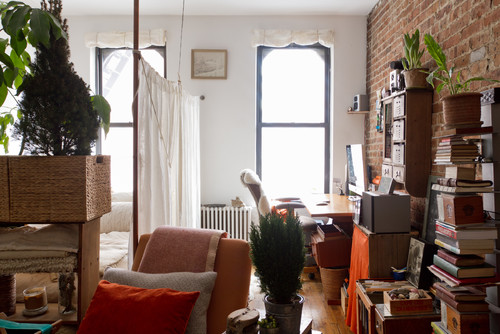
Of course, there are lots of opportunities to create a great small space in New York City.  This Houzz story shows a 300 square-foot studio in Manhattan.  Are you expecting more sleek finishes and mid-century modern lines?  Nope, this space has gone all Boho in Soho. (Actually in the Upper East Side, but who could resist…?)

Eclectic Bedroom by Brooklyn Photographers Rikki Snyder
In decorating her studio, she was inspired by both New York City and rural Chilean Patagonia. She wanted to create an urban refuge but was also drawn to rough woods, thick wools and warm colors, which were naturally suited to the apartment’s existing brick wall.
Even this tiny NYC apartment shows us warm wood and rich textures.
SmallNYCMain
This story from Life Edited shows how they’ve fit so much into the tiny area without looking cluttered or “stuffed”.
SmallNYCUpper
From Apartment Therapy we learn about another tiny home, right across the bridge in Brooklyn and just 460 square feet.  They have used light wood tones as well to make their house look warm and yet clean and elegant.
SmallBrooklynMain
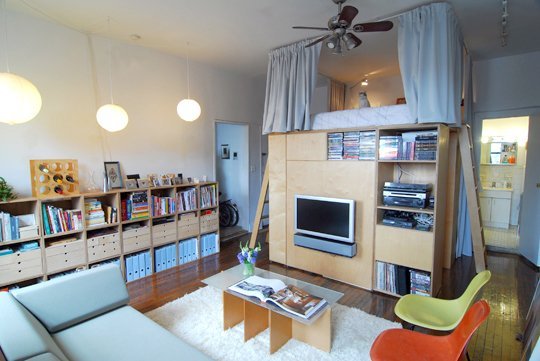
But the secret to living in such a small place is in building up.  Looking the other way in the suite we see how they have created a second story in their sleeping loft.
SmallBrooklynLoft
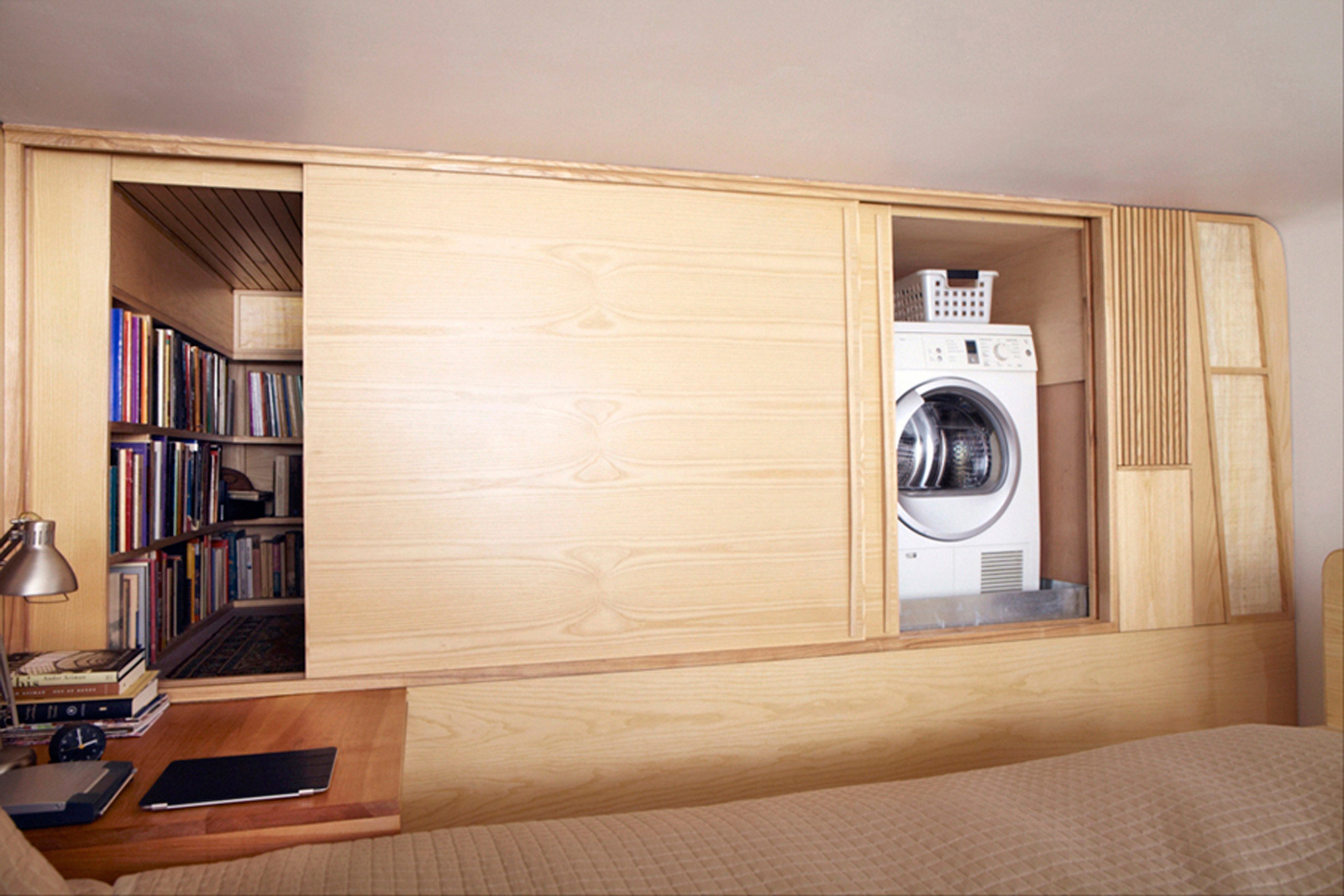
Lots of clever use of built-in storage, plus an office area tucked under the bed.
SmallBrooklynDesk
Big cities and small homes.  The perfect combination.

13 Reasons Why Smaller Is Better

Many years ago I was walking down a residential street here in Vancouver with a much younger friend of mine.  We were both looking at the houses, stating our preferences.  I was rather surprised to learn that she wanted a big house.  Not just big, not just huge, a monster house. The kind of house that takes up most of the lot, that overwhelms the space.

MonsterHouse

Know what I mean?

She said she wasn’t planning a large family, or to live in a multi-generation situation.  She just liked big houses.

I thought she was out of her mind.  I still do.  Smaller houses are best.

There, I’ve said it.  And I am prepared to back it up.

Northern Homesteader got me started with 12 Reasons to Live in a Smaller House – other than money.  Here’s her list, with my comments.

1. A small house is cozy

In a big house you have to find your cozy spots, create them with an overstuffed chair or a window seat.  But a small house is all cozy corners and intimate spaces.

2. A small house is warmer in the winter

It takes less than 10 minutes for our house to get warm on a cold morning.  The radiant heat works beautifully, and there are no cold corners.  In fact the laneway house is so energy-efficient that we turn down the heat to 16(C) in the afternoon so it doesn’t get uncomfortably hot.

3. A small house is easier to decorate

Even if you are going for a bohemian style with every flat surface covered in pictures and knick-knacks, decorating a small house takes less time and energy.  Even painting a room takes less time.  And you’ll need fewer cushions, fewer paintings, and fewer area rugs.  So if you want to completely change the look you can do it over a weekend.

4. A small house is faster to clean

Our former condo was only 1100 square feet, but it had two full baths and miles of carpeting.  To clean it up used to take us most of Saturday.  Now we can be out of here in less than an hour, with every surface sparkling and every floor damp-mopped.

5. A small house builds relationships

It’s funny, when you have a big home, how little time you spend in the same room as another person.  You might drift through the kitchen while your husband makes dinner to grab a glass of wine before you go back to watching the news in the front room, but you don’t actually have that much face time.  But in our laneway, I can be in the “sitting room” doing the crossword while DH is making dinner, and we are sharing and chatting, and sometimes watching the news together.  Yet when we want some private time there is always a little corner where we can be alone.

6. A small house inspires ideas and creativity

In our condo we had storage space galore.  Closets stuffed with clothes we didn’t need any more, an entire storage room just for stuff, 50% of which we didn’t use.  But now we have to find storage in every nook and cranny.  The space under the stairs.  the space in the stairs. And since more of our stuff is on display we have to find ways to make it attractive.  There’s a reason I keep watching those decorating shows.

7. A small house prevents clutter

We used to have a pile of papers in the kitchen.  Also one in the front hall.  And one in each bedroom.  No more!  I keep a (lovely) basket where I put all the papers that come into the house.  Once a week I go through it and toss what we don’t need and file what we do.  Bills and bank statements I get online so there’s less paper coming in. Clutter makes a small house look very messy.  It also makes a large house look very messy, but there’s more places to hide it.

8. A small house feels securer

When DH is out I know I just have to lock the two doors and this place is a fortress.  No dark corners or iffy locks.

9. A small house helps to live simple

Maybe that’s not your goal.  Maybe you look for ways to complicate your life.  But buying less, cleaning less, fussing less is what I want.

10. A small house is freeing

I thought it was funny when I read this — because that is exactly how I feel!  Less stuff makes you feel freer.  It’s part of 9., but it’s more than that, too.

11. A small house encourages more time outdoors

Last week I was feeling a bit closed-in.  You can feel that in a large space, too, but I knew what I needed, a brisk walk to the store.  Our small fridge means we buy less, and shop more often.  So we get out every day.

12. A small house takes up less space

The blogger at Northern Homestead loves her garden space.  And she’s not going to sacrifice it to gain more housing square footage.  We like the garden space we share with the main house — their back yard is actually bigger than it was before we built the laneway here because there was a big concrete slab where the house sits.

Twelve good reasons to have a small house, but I’ve thought of a 13th.

13. Smaller ecological footprint

Building the house took fewer resources than building a large house.  That’s a good enough reason to build small.  But running it takes fewer resources, too.  Heating, cooking, running the washer and dryer all take less energy than a larger house with large appliances uses.  If we want to be responsible energy consumers that is one more reason to live in a small house.

Our visit to the BC Home and Garden Show

DH and I braved the snow yesterday to take in the BC Home and Garden Show. Thanks to Ian at the Home Discovery Show for the admission!

There were masses of people, lots to see, lots to do, in short, the usual Home and Garden Show.

And there were lots of individual items — and a few over arching trends.

Smaller is definitely in.  We saw a couple of laneway builders — one, My Lane Home, builds the structure off-site and then assembles it on the foundation they put on your property.  We had a nice chat with them. A lot of the regular design/build/renovate exhibitors were also displaying info on building laneways.

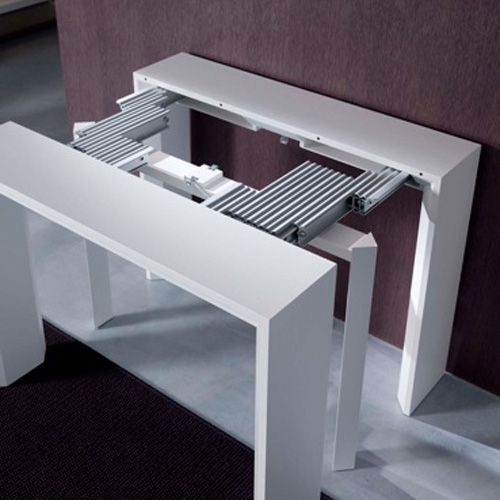
Small is also in with the furniture exhibitors.  We saw very few big pieces, and we saw two exhibitors with credenzas that made into full-size dining tables.  Like this:

Credenza1 Credenza2 Credenza3

Plus there were several booths showing beds that came out of cabinets or the more traditional Murphy-bed set-up for transforming spare spaces into guest rooms with the touch of a button. Plus closet systems that made use of every inch.

The furniture was also sleek and functional looking — nary a curve or a piece of extra ornamentation to be seen in upholstered or hard furnishings. And it really was about doing more with fewer pieces.

Window coverings were also more in the “blinds and shades” family than opulent draperies — and there were no prints except for a few geometrics. When I remember the meters and meters of cabbage roses we used on every upholstered surface in the 70s and 80s!  They are totally out of style now.

The finishes were the ones we’ve seen before — hardwood and engineered floors are still the most popular, there isn’t anything new there.  The counter tops were either quartz or what I came to think of as “novelty” stones, like marble with swaths of green running through; plus lighter granites than the blacks and dark greys we’ve seen in the past few shows.

There was a clean aesthetic when it came to all the decorating. The only place I saw texture was in the walls.  Bathroom and kitchen tiles often had designs incised into them — one booth had sheets of tempered glass with colours and textures embedded in it.  For myself, I would never put anything like that in my home.  How many homes have baths installed in the 1980s?  You can tell because of the florals in the tiles, something that is completely out of style now.  Tiling is something you only want to do once — don’t put anything up that is so very ….. dating.

Saving energy was a definite theme when it came to the doors and windows on display.  Plus there were lots of home security exhibitors, so it seems that putting in a security system is no longer an option but a necessity.

Taking it outside, I was surprised to see how much concrete was being used, often in interested ways.  And outdoor fire pits and fireplaces were everywhere.  “Outdoor rooms” are taking over from “yards and gardens”.

Of course, there were lots of booths selling things, mixers, knives, nozzles and ladders — I saw one man carrying a huge box containing a super-duper car seat cushion.  Luckily we were travelling by transit and had no way to get a lot of “things” home, and of course, no where to put them when we got there!  So we saved a fortune.

Knock, knock. Who’s there? And how many?

I ran across another great article on Life Edited, this time on household size.

All along I have touted laneway homes as a good method to increase the densification of neighbourhoods without changing their character.  These houses, by nature of their small size, will only house one or two people each.  What about the housing density of the rest of the neighbourhood?

Not this kind of housing density.

Not this kind of housing density.

We tend to frame the density issue in terms of housing size, because it’s easy to understand that big homes, as a rule, reduce overall density. But there is something else, just as important as housing size, that must be factored in to understand how density works, and that is household size.

The article quotes a paper in the online journal Population and Environment.  Looking at the population/housing ratio in the past 400 years,

the number of households grew faster than population size in every country and every time period. These findings suggest accommodating housing may continue to pose one of the greatest environmental challenges of the twenty-first century because the impacts of increased housing present a threat to sustainability even when population growth slows.

There are fewer people being born per capita, true, but

Progress made in curbing population growth, however, has not translated into reducing human
consumption of natural resources and impact on the environment.

Yikes!  Why?  Of course there are lots of reasons, and it’s not just because people are building larger homes (McMansions) for their smaller families.  People are also moving out of the family home at an earlier age.  The trend during the recent economic downturn for people to move back in with their parents after college is an anomaly, and probably will not be continued after the economy picks up again.  Also elderly people stay in their own homes longer rather than moving in with their families.  Plus they remain in their old family homes longer rather than moving to smaller ones.  There are other factors as well

The rising incidence of divorce also encourages increased household numbers. In the United
States, 15 % of all households had divorced heads in 2000 …. Although remarriage is common, the relatively high percentage of divorced households persists, and divorced households are 27–41 % smaller than married households

And that means?

From a more simplistic perspective, declining household sizes, from over 5 to approximately 2.5, will mean approximately twice as many houses will be needed per capita in any areas of the world yet to undergo the shift in household size.

Assuming that each of the additional households occupies a 210 m2 house (the average US
house size in 2002) (National Association of Home Builders 2004), then an additional
185,800 km2 of housing area would be required. This estimate may be conservative because land
area for household-related infrastructure (e.g., roads, yards, and retail) can require 2–4 times as
much land as the actual land used for the home …. Each of those houses would demand more household products and have lower efficiency of resource use per person because fewer people share goods and services in smaller households.

That’s why urban sprawl — taking more land to build more houses — will not solve all the problem.

One small caveat by Life Edited shows a glimmer of light in the tunnel of doom:

As a small space design blog, we’d be remiss if we didn’t mention that the amount of sprawl (i.e. the 72K sq miles) they calculate is based on a house size of 2509 sq ft–McMansions for all.

So smaller houses will help the problem well into the future.  And they give us a couple of options,

  1. Let things remain the same. Encroach on undeveloped lands and deplete all natural resources until the planet’s homeostatic environmental mechanisms are irrevocably destroyed.

  2. Reverse demographic shifts away from industrialization, the desire for privacy, divorce and so forth.

  3. Rethink housing. Adjust housing style to meet demographic shifts. Have smaller, more efficient houses with shared amenities. Creatively subdivide existing housing. Mitigate sprawl by keeping density high, even outside of major metropolises, permitting walk/bike/public transportation-friendly living.

That last choice seems the best to me.

Itty bitty bedrooms

Our builder is back today, finishing up (we hope) the last bit of work before the room is absolutely complete (no pix till it’s perfect).  The bedroom is definitely the smallest one I’ve ever had in a home — just wide enough for our queen size bed plus one small chair.  But I think it’s the perfect size for us — we love it. And we’ve even included some kitschy 50s-style touches to make it completely our own.

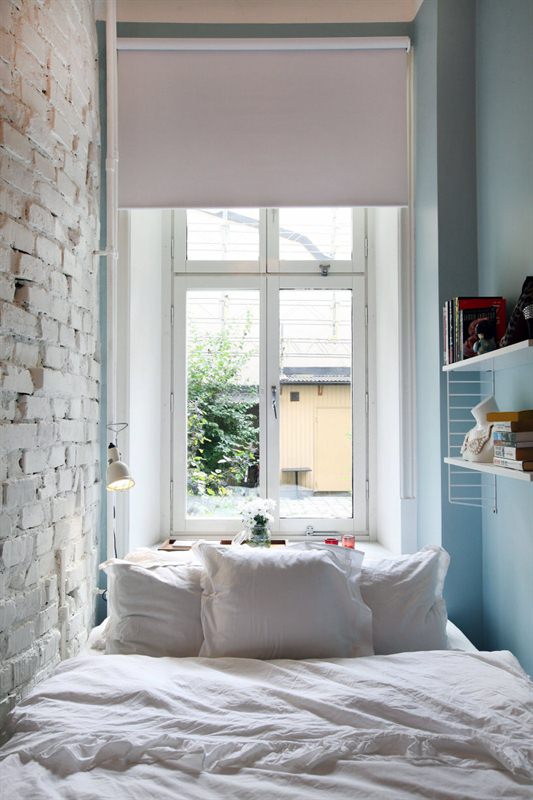
I’ve always known that other people have small bedrooms, and I’ve wondered how they managed.  So off to Apartment Therapy to look at what others have done with their tiny sleeping rooms.

First, some parameters, I was interested in areas that could sleep two adults — I know you can tuck a child’s crib into any corner, but that wasn’t going to help me.  Plus, it had to be set off from the main living space in some way, not just part of a studio apartment.  And I found some real winners — and inspiration.

Bedroom-Swedish


This all-white room still manages to get that punch of colour with the wall-papered back wall.  And the kitchen cupboards set high bring in more storage while not intruding.

Bedroom-European


This all-white room grounds itself with the darker bedskirt — and brings texture in with that lovely heirloom coverlet.

Bedroom-French


This room is really tiny, but the high ceiling could make you think you’re sleeping in the bottom of a box!  It’s the light walls and minimal textures (just the brick wall) that make it a comfortable space.


Bedroom-tiny


By keeping the accessories in this room light and bright it manages to look cute but not cluttered.  And the shelf beside the bed means no need for a nightstand (spoiler alert–that’s what we did in our room).

But just because a bedroom is eensy doesn’t mean it can’t be dark and dramatic.

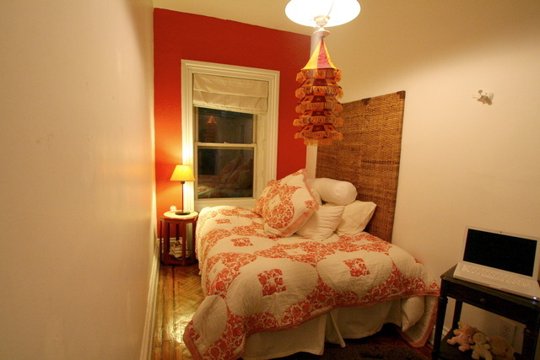
Bedroom-bright


This narrow room has the bed pushed against one wall as we’ve seen in some of the other rooms, and thus has gained space for an unobtrusive night table.  But it’s that bright pop of wall colour repeated in the coverlet and that dramatic light fixture that makes it special.

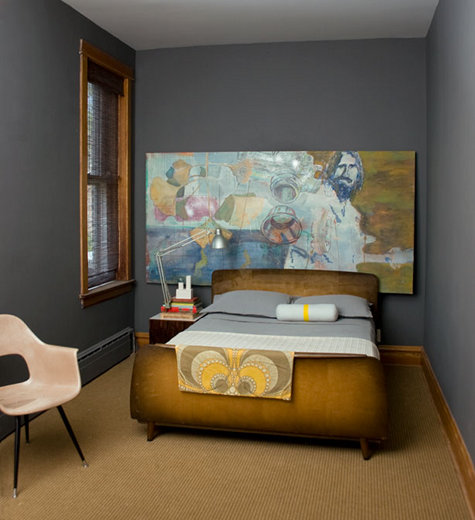
Bedroom-dark


The dark colours in the wall really bring the drama to this small bedroom.  Very clever use of colour, see how the ombre wood of the bed is picked up in the mustard tones of the wall-sized painting?  Plus the little punch around the white pillow also picked up in the quilt hanging over the foot of the bed.  Even the window trim is that same tone.  Very clever.

And as we have seen, even the smallest spaces can be dramatic.

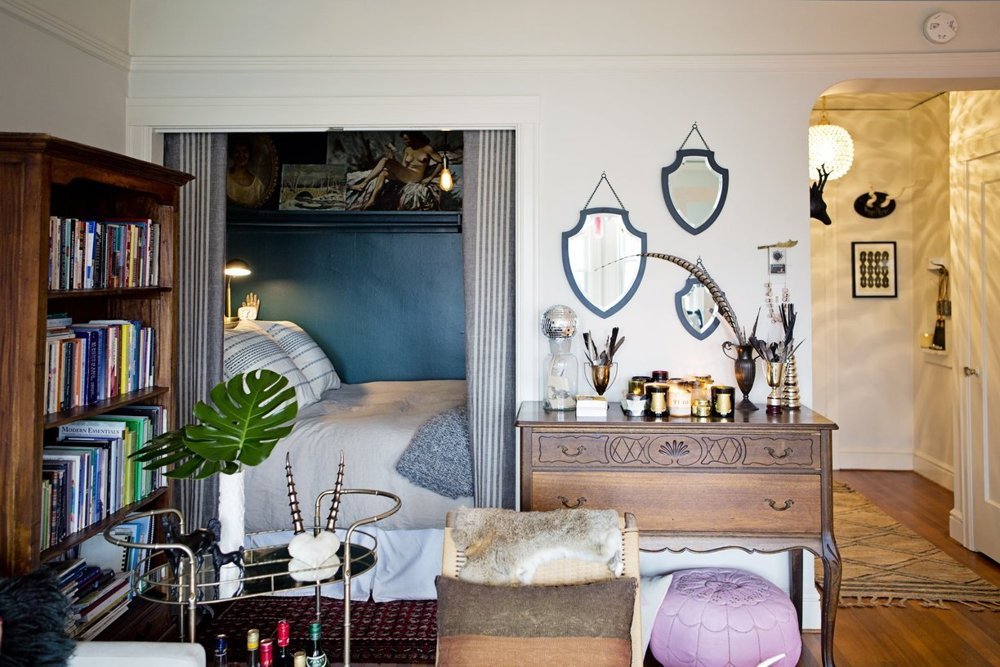
Bedroom-Niche1


This home is basically a studio apartment, but the owner has taken what might have been left as storage space and managed to fit a bed into it.  what makes it a bed ROOM is the dark blue wall colour, so different from the light tones of the rest of the space.  Here’s another look at it:

BedroomNiche2


Glossy wall paint reflects the overhead bulb and the wall-mounted bed lamp.

Lots of ideas that show that clever always trumps large when it comes to decorating — and small is beautiful.

Five Reasons Why Family Day Really Was “Family” Day

Monday, February 10, 2014 was the very first Family Day here in British Columbia.  I really wanted this day to be something I could plan and everyone could enjoy. With everyone so busy I didn’t want to add to their plates by saying “Entertain Me!”  I wanted everyone to just show up and have a good time. You may think that has nothing to do with laneway living, but actually it fit in perfectly with our new way of life.

1. It’s all about “Experience”

We won’t be buying much new stuff.  And for everything we bring into the laneway, we have to take something out .  Instead of stuff, we want to spend our time and energy on having new experiences.  And that means

2. Getting Out of the House

In the past I may have been tempted to just make a nice dinner and have our family (two kids, two kids-in-law, one grandchild) over and then we would sit around and eat and then everyone would get up and go.  But we don’t have room for that anymore, and though we will certainly be sharing lots of communal meals, the small size of our place means that if we are planning an event we will need to be outside of the laneway.  That could mean out in the back yard at a barbecue, but in the winter it usually means inside somewhere else (the weather is so iffy, it was supposed to snow but instead it rained buckets).

3. Finding Family Things to Do

The fact that it was Family Day gave me a bit of a kick in the pants.  I haven’t thought much about entertaining children (well, child) for a while.  Plus I wanted something everyone would enjoy, so it had to be more than visiting McDonald’s or dragging the little darling around Science World (she’s a bit young to take it all in).  I just poked around the internet and found Family Day activities at Burnaby Village Museum.  The museum would be closed, but the Carousel would still be open, and they would have fun things for little kids. It’s close to everyone, and not too expensive.  We started off with brunch at a restaurant, then went straight to the museum, and “Carousel, Carousel!” (Only not in that Logan’s Run way).

4. Unplugging

I admit that I like sitting and watching Disney movies with the little girl on the TV or computer.  But for this I wanted a more….analog experience.  Going out and doing real things in the real “meat world”.  Touching and holding hands and walking and playing with plastic frogs.  Riding a real carousel horse (twice).

Whee

5. Building memories

It doesn’t take too many family dinners until the memories all melt together.  Especially since we usually do the same dishes for special occasions.  And that’s good.  It’s so nice to look back on all those Christmas dinners at Grandma’s and the Angel Food cake your Mom always made for your birthdays.

For this Family Day I thought I would be building memories for the little girl — her first ride on a real carousel.  But of course, I was really building memories for myself.

This memory especially

Whee2

Organizing? Or ?

We are still in the process of a) getting rid of stuff, and b) finding places for the stuff that we need.  We want to downsize our rented storage space this month with the goal firmly in place of getting to the point where we don’t need any exterior storage space at all.

So I am doing my part by sitting down with a cup of coffee and my laptop and perusing stories on organizing.  Thanks to Apartment Therapy for giving me “101 Organizational Helpers” with “stylish storage options”  and tips like

Even when your contents are stored and labeled, it means nothing if they’re not accessible. Stacking a group of boxes and storing them on wheels is a great way to utilize the back corner of a closet. When you need a particular box, out rolls your storage cart for easy access.

That is a good idea.  Also

consider repurposing a few things from the kitchen to help you straighten up your sleeping space. Silverware and ice cube trays can be used to sort jewelry and dresser drawers,

But then I ran across another article that reminded me of what it is all about.

Life Edited asked the musical question “Is Organization A Sham?

The article quotes The Minimalists Joshua Fields Millburn and Ryan Nicodemus from their book “Everything That Remains” 

Discussing how to get rid of our stuff answers only the what side of the equation, but not the why; the action, but not the purpose; the how-to, but not the significantly more important why-to. In other words, the what is relatively easy. We all know instinctually how to declutter–how to get “organized.” But that’s just one part of the larger issue. Instead of “get organized,” I’ve decided I need to start thinking of organizing as a dirty word, a sneaky little profanity who keeps us from really simplifying our lives.

You see, our televisions would have us believe there’s a battle being fought on the consumption continuum, a battle between messy hoarders on one side and spruce organizers on the other. And from our couches it’s hard to see who’s winning. I’d like to posit, however, that these two sides are actually working together, colluding to achieve the same thing: the accumulation of more stuff. One side–the hoarders–does so overtly, leaving everything out in the open, making them easy targets to sneer at. Face it, we all laugh and point and say “I’m sure glad my house doesn’t look like that,” every time we see them on TV. But the other side–the sneaky organizers–are the more covert, more systematic, when it comes to the accumulation of stuff. Truthfully, most organizing is nothing more than well-planned hoarding.

Who among us has not glanced at one of those hoarding shows, shocked and yet fascinated, like staring into the abyss that our lives could spiral into if we weren’t ever vigilant.  Those hoarders, those poor, pathetic people, don’t think they are hoarding.  They know that they might need that thing, that old magazine with that article, that pair of shoes that just needs new soles, that pot that might come in handy.

All around us we see constant reminders that we NEED MORE STUFF.  The answer is not to find more places, more attractive containers and more efficient ways to hang onto it.

It’s important to see that the final goal is not to find places for everything we own, it’s to get rid of everything that doesn’t fit into our lives any more.  That will give us more time and energy to concentrate on what is really important.

My Pain, My Life, My Struggles, My Fight

Come walk with me, Down My Dark & Stormy Journey BUSINESS INQUIRIES & CONTACT EMAIL : GODSCHILD4048@GMAIL.COM

ANNOTATED AUDREY BLOG

Artist and Desert Dweller with Big City Style.

Im ashamed to die until i have won some victory for humanity.

Domenic Garisto / LIFE IS NOT A REHERSAL,SO LIVE IT..if you can't be the poet, be the poem..havau22.com

The Lady Who Lives Down the Lane

Lane Way Housing for the Nervous Novice

Apartment Therapy| Saving the world, one room at a time

Lane Way Housing for the Nervous Novice

Slightly Snug House

building a home that's not too big and not too small

Vancouverandy

Funny thoughts from a nut like me.

Small House Bliss

Small house designs with big impact

WeeHavyn

Lane Way Housing for the Nervous Novice