RSS Feed

Tag Archives: Neighbourhoods

What I’m loving about our new neighbourhood

We were incredibly lucky to be able to move into the neighbourhood where the laneway is being built.  Thank goodness for basement suites, as there are very, very few apartment buildings available around here.  The ones that we could find are subsidized housing, and those are nearly impossible to get into, especially for short-term rentals.
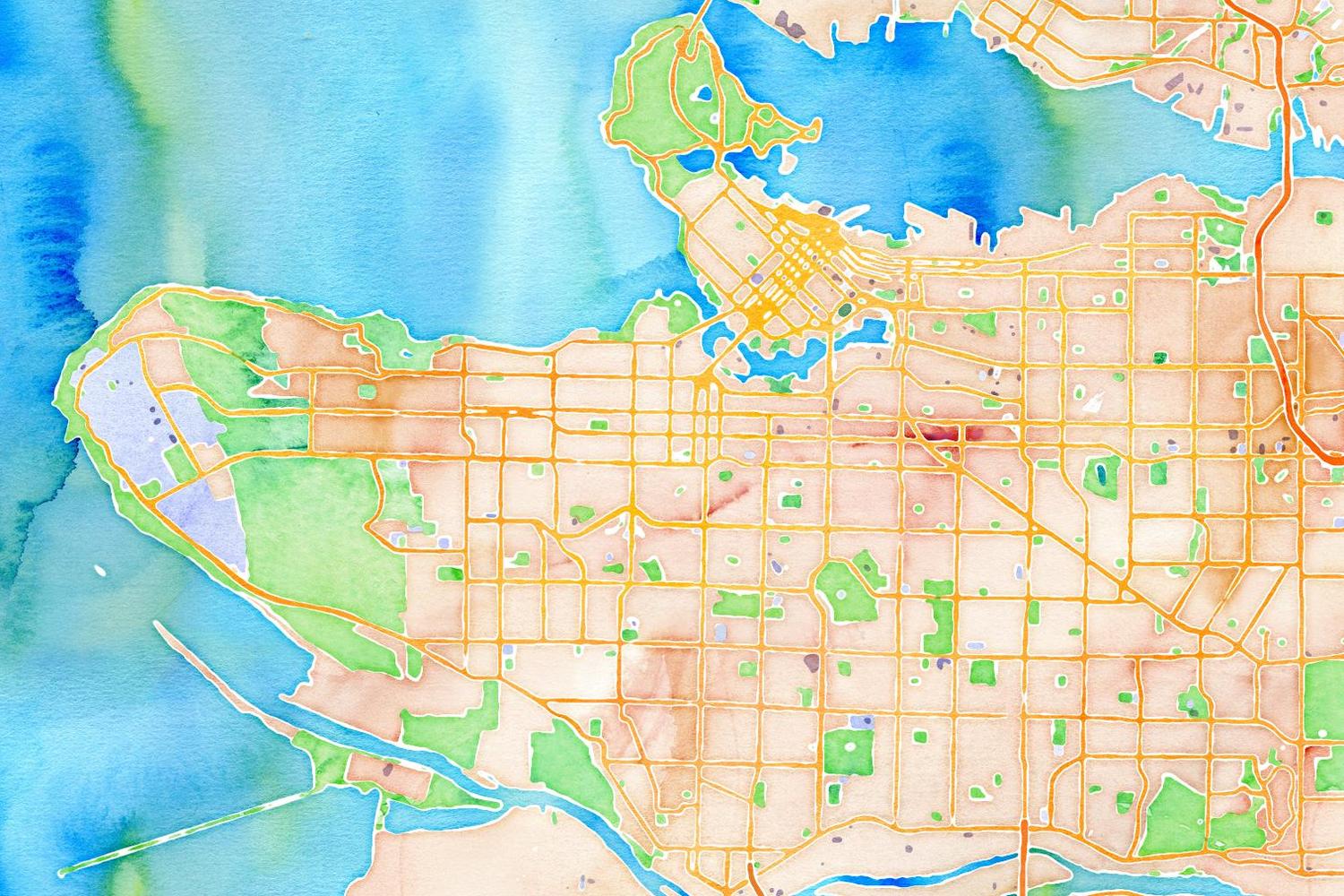
watercolor_iCXHbhfkY7w

Our Town

But here we are and we are very happy with the area.  For one thing, transit is a breeze.  We are very close to the Skytrain, and will be even closer when we move to the laneway. We can get downtown, to our gym, to shopping in Burnaby, and to parks and recreation quickly and easily.  The Broadway corridor is right there, with the express buses running during rush hours to whisk me to and from work.  We use the car even less here than we did at our old residence.

Shopping is also great.  I miss my London Drugs right down the street, but there are plenty available a short  Skytrain ride away.  We have a Superstore within easy walking distance, as well as a small shopping centre with a Price Smart, a Pet Smart, Canadian Tire, Mark’s Work Wearhouse, and a Starbucks (*whew*).  There’s a WalMart right down the street, too.

On an exploratory walk around the neighbourhood last weekend, we found several small parks close by.  Plus a possible pizza place.  We also have walked over the Commercial Drive on the Central Valley Greenway, which DH has explored on his bike.

But all this was something we expected, because we thought quite a bit about the neighbourhood before we agreed to move here, checked out the Walk Score, etc. and so we knew what to expect…..or so we thought.

What were we not expecting?  Garbage collection.  I lived in a condo for about 30 years, the years of Garbage Collection Reformation.  In a condo, garbage was something you took out, put in the giant bin, and it magically disappeared. We had visited friends’ homes and seen coloured maps of Vancouver on the sides of their fridges, but we’d never really considered what they were for.  I don’t know if we suspected that all our friends had identical taste in fridge decor, but we just never thought about it.

But now we do!  Because my friend, you LIVE AND DIE by the date of your garbage collection.  Every two weeks that truck trundles down that lane and if you don’t have your garbage out where they can grab it, it’s like Santa, that truck is not going to come back until its appointed time.

Luckily every single week a truck comes by for recycling.  And if you don’t think that’s a motivation to recycle everything you possibly can, you have never tried to fit four week’s garbage into a two-week bin. Now there is something even newer than regular recycling, which is composting.  Vancouver now takes your table scraps and coffee grinds and composts them.  It’s a great idea!  And it makes that every-other-week garbage collection quite doable.

In fact it’s such a good idea that Mayor Bloomberg is doing it in New York City.

Another advantage that I never expected started out as an inconvenience.  I know I’ve mentioned that the laneway is being built into a slope.  I don’t think I’ve told you that the slope is actually a big, honking hill that runs from a couple of streets above ours right down to the Grandview Highway where all the stores are.  Just to get to the Skytrain from the laneway means climbing down, and of course back up, a significant grade.  I thought this would be a pain, but it has turned into a blessing.  The first few times I charged up that hill to catch the 7:38 99 bus, I swear I thought I would pass out.  There were little red dots dancing in front of my eyes.  But just a couple of weeks has given me much more stamina — it’s great exercise!  Who knew!

Oh, the people at Life Edited knew.  They point out in this article that cities where exercise is built right in have healthier citizens.

And I’m good with that.

NIMNBY*

*Not In My Neighbour’s Back Yard

This week’s public meeting at City Hall really opened my eyes to some of the problems the city has in getting anything done. Every time the City wants to move forward there’s always push-back.  Not from everyone, no, but from some of the people who have property here.

Sitting and listening to the speakers at the meeting clued me in to how those people really want things to be. And this is how people want things to be:

The same.

They want their neighbourhood to stay the same — the houses the same size they are now.  They want places to park their cars and roads to drive on them.  They don’t want “developers” and “Translink” to ruin everything. They don’t want laneway houses in their neighbour’s back yards.

castles

There goes the neighbourhood!

But at the same time, they want their property values to go up (but not their civic taxes), they want their kids to be able to buy in the same neighbourhood they live in now, to take safe and convenient public transit to schools that are well-maintained and full of happy kids.

It seems like they want a small-town life in a big city. And they don’t see how that just won’t work.

We live in a big city — with big city problems.  We have homeless.  We have poverty.  We have drugs and crime and traffic.  And we can’t solve those problems if everything remains the same.

Everyone who spoke agreed that we have a housing problem in Vancouver.  We have limited rental space, which makes it very expensive.  We have no more room to build more houses, which means the houses that are here go up in value — a limited supply for an increasing demand. And people want to live here because the jobs and the economy.

Of course some people had solutions.  Don’t densify within Vancouver city limits, let the suburbs absorb the people who will be moving here.  Or densify by building large apartment buildings.  Or densify, but don’t build apartment towers, build low-rise rental buildings, only don’t re-zone any single-family homes to do it. Or (my personal favourite) slow down the economy in Vancouver so people won’t want to move here any more.

There seemed to be a quasi-elitist sentiment behind many of the speakers’ comments — I’ve got mine and now I will protect it by making sure that you don’t get yours. I got the feeling some of them wanted Vancouver to become a gated community, where the professionals and the wealthy get to live here, and the people who flip our burgers and clean our hospitals and type our letters and sell us clothes get to take transit in from the suburbs.

But, as Mark Sakai from the Greater Vancouver Home Builder’s Association pointed out, the city is changing, it has to change and we want it to change.  The only important thing is that it changes in ways that mean a better life for its citizens.

So I am happy that the City has allowed laneways to add to the densification of Vancouver, and I am glad that it’s become more inclusive.  There was some talk about limiting the number of laneway homes allowed to be built on any one block, but everyone could see how unfair — and elitist — that was.

By the way, if anyone is thinking that small town life is stress-and-wierdness-free, remember that Mt. Airy, North Carolina, hometown of Andy Griffith and model for Mayberry, was also where Chang and Eng Bunker, the original Siamese Twins, had their home, and their descendants still live there.

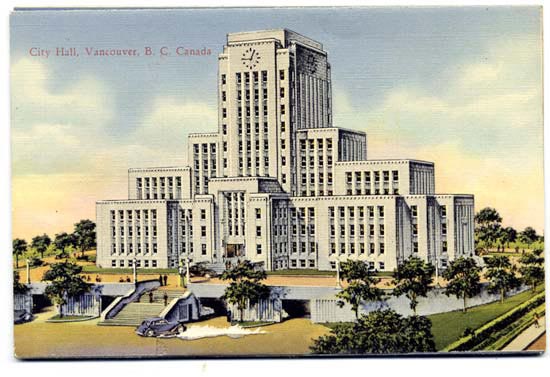
City Hall confidential

This isn’t confidential at all, of course.  I just wanted a really dramatic headline for this post.

I’d never been to Vancouver City Hall before DH and I attended the public hearing on June 11. But I wanted to have my say about laneway homes, I wanted to be sure there was at least one voice who didn’t have a dog in the fight.  It’s one thing to have the developers there — and I was sure they would do a good job.  But I just wanted to be a “Jane Citizen” showing support for laneways knowing that we would not be affected either way.

vancouver-city-hall-1930s

There were two items on the agenda.  First there was a discussion of the Regional Context Statement, our contribution to the Regional Growth Strategy that will be shaping our communities in the next few years.  Since this was my first public hearing, there were two things that really stood out for me

  1. The Vancouver City Council is made up of people who are really on the ball, and
  2. Most people do not listen

Although it was explained that there was no new information in the council’s contribution to the Metro Vancouver report, that is was all about giving the baseline information so people could move forward, speaker after speaker insisted that this was all new information, and their neighbourhood/community/back yard would be adversely affected by the report, and HOW DARE THEY submit this report without their input.

I guess I must expect that average people with a full head of steam about something are going to be sitting rehearsing their five minutes at the podium, and won’t be listening to the replies that all the previous speakers were getting.  But I, a neutral by-stander at the beginning of the process, was 147% in favour of council’s acceptance of the amendment by the end.

Thanks, fellow citizens!  You made council look very good!

Also — what is with the hate-on that people have with Translink?  I’m saving a post about the NIMBYism we encountered throughout the evening for later, but wow.

We got to the part of the evening where we were discussing the amendments affecting laneway homes. The city gave their presentation, which you can see here.  SPOILER ALERT!  These amendments were accepted. (Yay Us!)

I was 8th in the line-up to speak.  First was Jake Fry of Smallworks, who did a very good job presenting the “pro” argument, as did the representative of LaneFab.  A couple of people spoke about their lane homes.  I spoke about how building our laneway is helping keep our family truly together.

There were some arguments against the laneways (see what people opposed wrote to City Hall here).  They were basically:

  1. I don’t like laneways
  2. No one should have them.

Most of the problems people were speaking about were with parking (laneway dwellers using their in-home garages as living or storage rooms so they have to park on the street) and the heights of the 1.5 storey laneways causing loss of sunlight and privacy in their yards.

Since both of these problems are addressed (and hopefully solved) with the new amendments, those arguments didn’t seem to be helpful to the process.

All in all this was a very valuable experience for me.  I actually walked away from the meeting (taking Translink home with DH) feeling much more confident in the transparency of the processes the City uses to decide issues, and in the City Council itself.

And now there will be more laneways!  Huzzah!

From the Wall Street Journal – laneway homes as urban development trend

The Wall Street Journal has been paying attention to the small home trend.  And, clever capitalists as they are, they have put the article behind a paywall.  Scamps.
Video interview with article author, Conor Dougherty.

But writer Conor Dougherty seems to be quite impressed with our laneway homes.

Ajay Kumar built a $300,000, Moroccan-themed cottage that sits in his backyard and will soon be occupied by his parents.

Mr. Kumar’s “laneway house” is part of a broader plan that encourages Vancouver homeowners to add rental units in their basements, attics and backyards. The hope is to reduce sky-high housing costs and increase population density throughout the city—including the single-family-home neighborhoods like Mr. Kumar’s that surround the city’s towering downtown.

…….

During the past two decades, Vancouver’s main approach to add housing has been to go up, constructing scores of downtown condo towers. Recently the city has started rezoning arterial streets to allow more compact row houses.

The city took a step toward increasing density in single-family neighborhoods in the 1980s, when it first allowed basement suites. Since 2009, it has reduced the amount of time it takes to get a permit for basement apartments and permitted laneway homes like Mr. Kumar’s throughout the city.

The article also acknowledges that not everyone is crazy about the idea.

A dozen blocks away, Ronald Hatch also lives next to a laneway home, and he hates it. Mr. Hatch, 73, a retired literature professor, says the two-story home shades his backyard, reducing his raspberry crop.

I can see his point.  I know I would hate it if I had someone build a home that overlooked a formerly open back yard.  But you don’t have to build a laneway to get that effect.  Who has not seen huge, behemoth homes taking up more space vertically and horizontally in these older neighbourhoods?  The zoning is in place.

Getting more people into the city can be done in a number of ways.  You can build more smaller homes or fewer large ones, or some kind of combination of the two.

I’m prejudiced of course, but I prefer the charm of the laneway homes to the giant houses that can take over a neighbourhood.

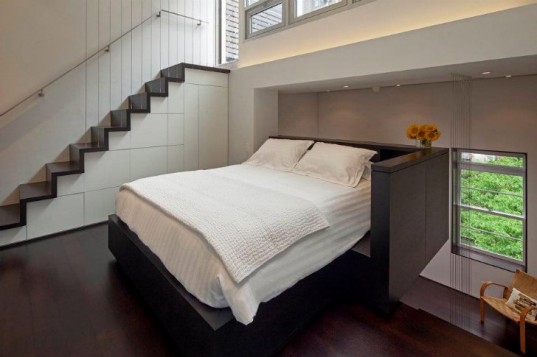
Another super cool super small NYC apartment

Thius 425 square foot Manahttan apartment comes to us via the Inhabit website.

Manhattan-Micro-Loft-Specht-Harpman-5-537x357It’s another sleek, cool looking micro-apartment, built into a loft and over 3 floors.  Of course it is loaded with built-in storage — the space beneath the stairs is non-stop closet.  And it manages to maintain a comfortable feel while keeping clutter to a minimum.

The owners are using it as a pied-a-terre, not planning to live there full time, but I think it would be perfect for a single person (or a very compatible couple). I hope they hang a few paintings to take advantage of all that light.

BTW, you may want to subscribe to Inhabit’s newsletter.  It’s NYC-centric, but full of articles of interest to all sustainability and small-living fans.

Support laneway houses in Vancouver!

We knew that the City of Vancouver was discussing laneway houses.

But now they are asking for our input.

Want to show some support?

 Council referred proposed amendments to the laneway housing regulations and guidelines, and expansion of the program to Public Hearing on June 11th, 2013

interested in what they have to say?  Here’s the proposed amendments. I have to admit I flagged about page 32, but then, my evenings are full of placing items in cardboard boxes prior to the big move.  I will read it, and I will be at that meeting if it is at all possible.

Gotta walk the walk, know what I mean?

Thanks to the guys at Lanefab for the heads-up.

Laneway homes in the news

Two stories in the Vancouver Sun today about laneway homes:

West Vancouver is considering allowing laneway homes.  Or, as they say in the carriage trade, “coach houses”.

As a community planner put it all into perspective,

“We have a community that is aging, that needs different housing options. We have younger families who are having difficulty establishing themselves or remaining in West Vancouver because of the cost of housing,” Mikicich said. “At the same time, it’s a community that highly values the established character of its neighbourhoods.”

It’s a way to increase density in this charming suburb of Vancouver without incurring the “monster house” syndrome. As Jake Fry of Smallworks remarked,

“You may have more roofs per acre, but they’re going to be smaller roofs. They’ll probably even have less square footage per city lot, but there’s going to be more families and you’ll see the … communities become much more dynamic”

In this story, homeowners who have build laneway homes and applied for HST (now GST) rebates were instead charged bills by the CRA.  The Canada Revenue Agency rules are not just confusing, they can be contradictory.

It LOOKS straightforward, you build a house and apply for a tax rebate.

But where the rules may get sticky — especially in high-priced Vancouver — is when it comes to determining the value of a laneway home built as a rental.

“The GST/HST new residential rental property rebate is limited to rental units that are less than $450,000 at the time of substantial completion of construction,” CRA said.”

Most laneways can be built for less than $450K, but if you take the value of the property into account the value would be much greater.

To me, this is ridiculous.  You cannot find a property in Vancouver that is worth less than $450K.  As the writer, Don Cayo, says, determining the added cost of the property is difficult and moot:

But simple division may, in fact, overestimate the land value — it hasn’t been subdivided and it can’t ever be, so there’s no market reference to determine its value. Land assessments are usually based on “highest and best use,” but there’s no other use — or only unlikely or very limited use — for pieces of property that small. So their “worth” is highly hypothetical.

I’m taking more than a casual interest in how this plays out, so stay tuned for updates.

We have a cunning plan

We went over to see Laurel at  Novell and signed the contract and looked at the final plans and picked up our copies of the plans and the permits and signed a whopping great cheque.  And all is well. Better than well, really.

Would you like to see what the place will look like?

Like this:

Plans3.1


(click on the images to embiggen)

That’s the main floor — nice, dark bedroom with a lovely bright bath with the walk-in shower we wanted. Plus the washer/dryer, the clothes closet outside the sleeping space, and the storage for our shoes int the bottom two stairs.  Then upstairs

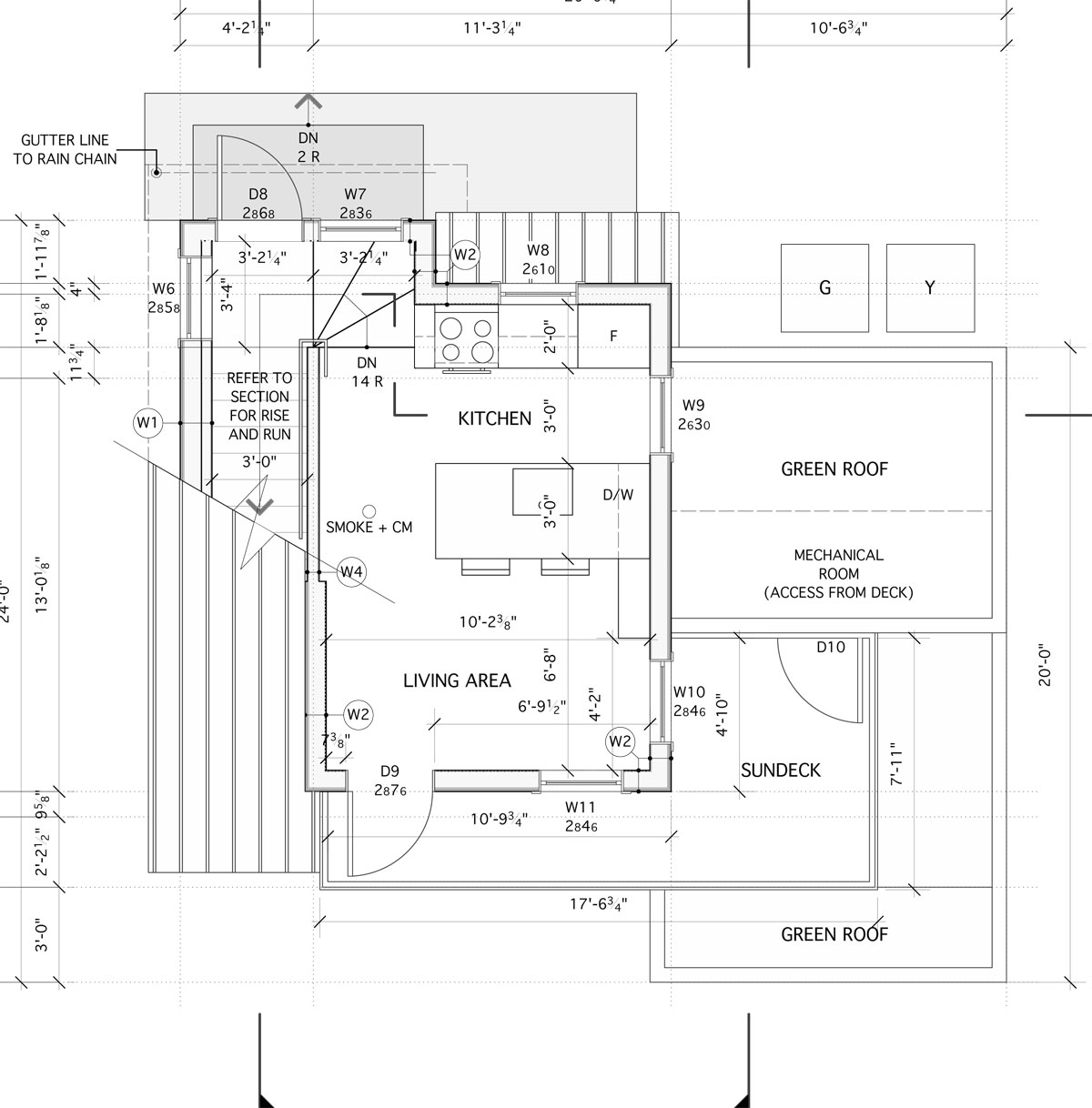
Plans3.2

the adorably small sitting room with the kitchen of our dreams — compact but just what we want. Plus the walk-out to the deck with green, living roof  all around it. A little deck off the north side stepping into our garden.

By the way, we were wondering the outside dimensions of the sectional we will be getting for our sitting area, so Novell kindly marked out the measurements — 4’2″ by 6’91/2″.

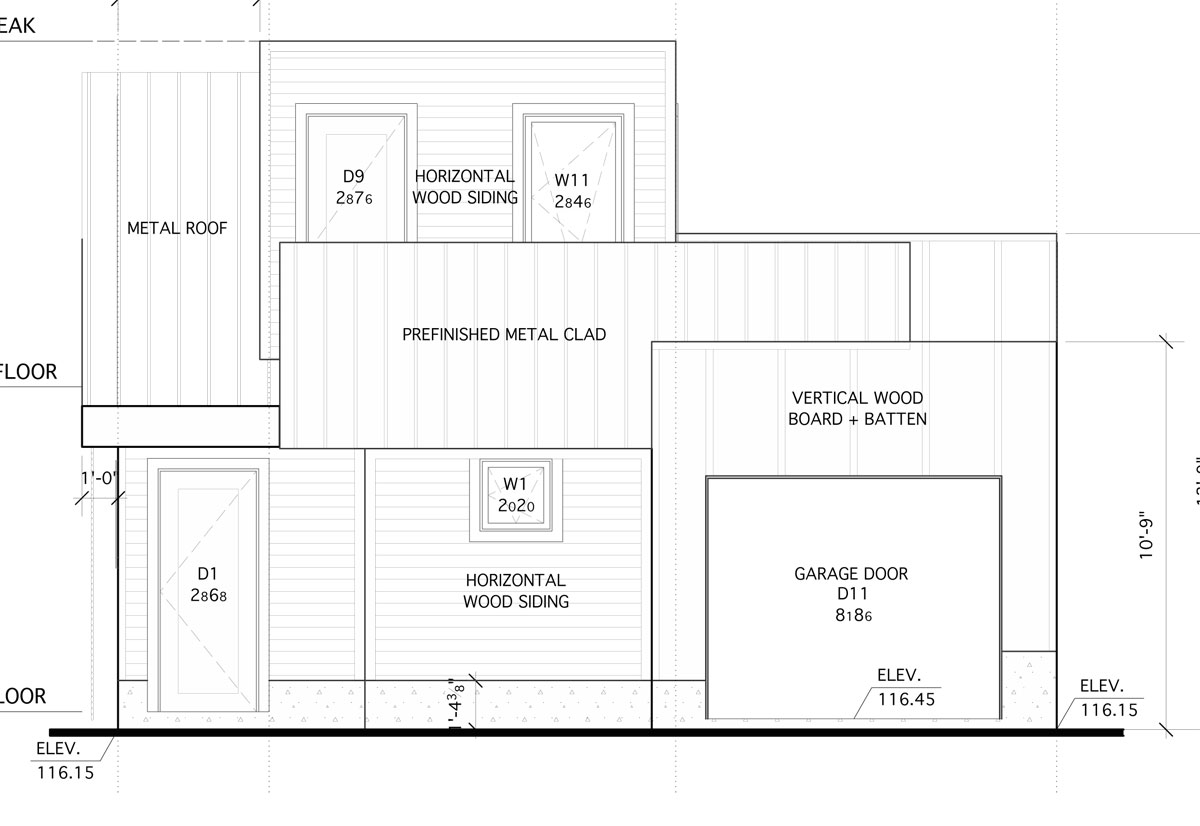
That is not the whole plan, of course, there is also a look at what the outside will be:

Plans5.1

That’s what you’ll see walking up the lane — except with lovely plants around the front door on the lower left. The pitched  metal roof is rolled steel, continuing onto the cladding on the front of the deck. the siding and the board and batten will be painted to match the main house.

Going clockwise, if you can sneak between the fence and the house, on the west side:

Plans5.2

See how you walk in on the lane level of the house and walk out on the yard level, with all the light coming through the windows. We have great plans for a green space between the home and the fence.

If you walk out the basement of the main house, you’ll see this:

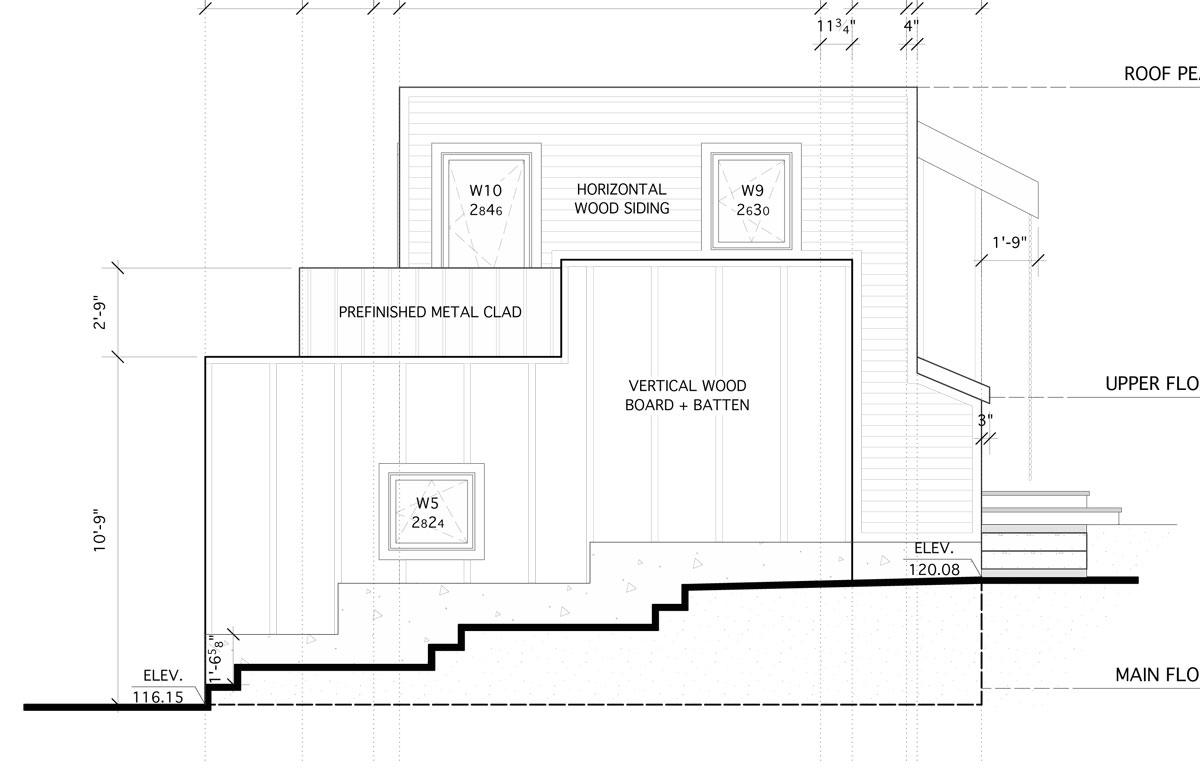
Plans5.3

The metal roof is rolled steel, and you see how the foundation continues below grade — that’s our bedroom.  You see the bedroom window, with the little window between the counter and the upper cabinets of the kitchen on that side of the house.

And of course, the east side of the building:

Plans5.4

The bump up on the garage roof will be covered in living roof — with bulbs planted for a beautiful spring garden just outside our kitchen window.

S’pretty swell, isn’t it? You see how we couldn’t just buy a plan off the rack– the slope of the lot, plus our need for the special engineering the living roof requires meant that we needed something a little more…custom

Start of build will be May 13, and should last 30 weeks.

Bon yoyage, our little home!


High land costs down under mean the end of cottages

I believe you know I am a supporter of living small.  I was just in a neighbourhood a few weeks ago that had undergone a change in the other direction.

I remembered a neighbourhood close to our new house that had been primarily small bungalows that had been constructed in the late forties.  The entire area had been built for returning soldiers after World War II, and had been street after street of similarly designed homes of 1000 to 1500 square foot size.

BungalowI’m a boomer, and when I was small we lived in a house much like this — maybe you remember homes like this — two bedrooms on top (your Dad probably put another in the basement when you and your siblings outgrew the one bedroom). One bathroom for the whole family.  An eat-in kitchen or a tiny dining room.

But when I saw the neighbourhood again recently, I had to look for these old bungalows — they had been replaced by McMansions.  I felt a real sense of loss. But I understood why.  If you visit the site Crack Shack or Mansion, play the game to see if modest bungalows like the one above are dilapidated shacks or worth the price of a mansion in another city.  Who am I kidding — a dilapidated shack in Vancouver IS worth the price of a mansion almost anywhere else.  Because it’s all about the price of the property.

I can understand why someone who buys one of these homes would tear it down, and for another $300K or $400K, build a huge home that dominates the lot and leaves no yard to speak of (or play in).

And Vancouver is certainly not the only city to “suffer” from this.  Even Down Under,  the land crunch is being felt.  In this article we learn that Sydney, Australia is seeing their bungalows (or “cottages” disappearing).   And the reason is

Bob Schwartz, chief economist of Pitney Bowes Software, which did the analysis, said two- and three-bedroom houses were becoming ”too small” for the Sydney housing market.

”Those types of houses are in decline because they are simply not the best use of space,” he said. ”The small cottage just can’t cut it with high land prices.”

I am hoping that the option of increasing the living space in the home by building laneway homes will slow or stop this trend.  As nice as these large houses look, it doesn’t increase the densification of the neighbourhoods, and it completely changes their character.


What’s new, you ask?

I am back in Nelson, lovely Queen City of the Kootenays.  It’s impossible to describe how lovely this place is, so:

Nelson


My sister and I are up here to visit our father, who celebrated our arrival by slipping on a wet bathroom floor and ending up in the hospital with a bruised foot and back.  Being 89 years old presents its own problems in the healing process, so it’s not likely he’ll be home before Sis and I have to head back to our other obligations. We visit him in the hospital and chat with the doctors and nurses and generally try to be good daughters.

But there is good news this week, and that is that DH and I have found a place to live during the build.  DH took on the task of combing Craigslist and Kajiji looking for suites in the area to rent.  We really wanted to move into our new neighbourhood so we could watch over the build process and also get used to our new stores and local amenities.  There aren’t any apartment buildings in the area for rent, just basement suites. Luckily. after a couple of false starts,  he found one just 10 blocks from our new home, in the basement of a large home.  It’s close to transit and shopping, and most importantly, close to the action as the build goes on.  The landlord didn’t ask us to sign a lease, so we will be renting month to month, ideal for us. It has 8 foot ceilings and is quite bright.  And it’s small, so we’ll get used to just keeping what we need.

Because I will be up at the hospital and away from the computer, I may not be posting at my usual manic rate.  But I’m still here.


My Pain, My Life, My Struggles, My Fight

Come walk with me, Down My Dark & Stormy Journey BUSINESS INQUIRIES & CONTACT EMAIL : GODSCHILD4048@GMAIL.COM

ANNOTATED AUDREY BLOG

Artist and Desert Dweller with Big City Style.

Im ashamed to die until i have won some victory for humanity.

Domenic Garisto / LIFE IS NOT A REHERSAL,SO LIVE IT..if you can't be the poet, be the poem..havau22.com

The Lady Who Lives Down the Lane

Lane Way Housing for the Nervous Novice

Apartment Therapy| Saving the world, one room at a time

Lane Way Housing for the Nervous Novice

Slightly Snug House

building a home that's not too big and not too small

Vancouverandy

Funny thoughts from a nut like me.

Small House Bliss

Small house designs with big impact

WeeHavyn

Lane Way Housing for the Nervous Novice