By now you may have noted my interest in other people’s small spaces — and more importantly, what they’ve done with them.
This story on Apartment Therapy is about a small apartment in Brooklyn, New York, that still manages to feel (in the words of the article) “comfortable and roomy”.
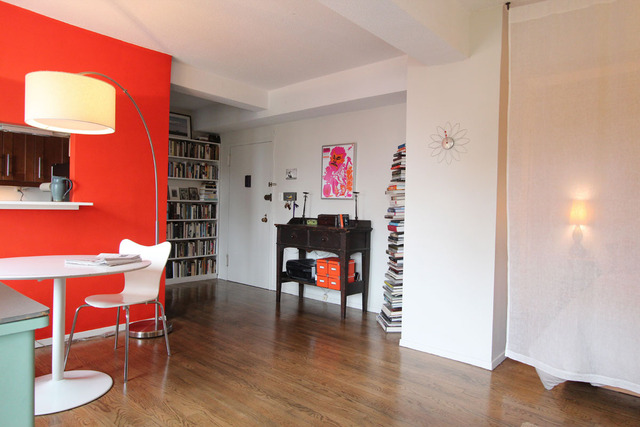
That bold shot of colour emphasizes the other white walls. If they’d tried to put it elsewhere it would have made the “choppiness” of the other walls very obvious. But now, everything flows. And keeping the curtain that blocks off the bedroom area of this studio the same colour as the walls adds to that flow.
In this shot, you see that the main room only has two smallish windows,
But it still feels light and airy.
Read the article and see all the rooms in this home. It’s a good lesson in living with less.
Micro-apartments are finally coming into their own.
Of course, the idea is not just to move into a tiny space–we’ve all done that at one time or another. Futon sleeping in a studio apartment–been there! Along with the milk-bottle-case bookshelves and the wine-bottle candle holders. But we’re grown-ups now and we want some style. Small style.
But let’s just say that you want to live in a very expensive part of town (this is Vancouver–every part is expensive). Or you spend a lot of time out and about and you just can’t see why you need to pay top dollar for space that sits empty for most of the day. Then get the smallest apartment in the nicest neighbourhood and create your very own micro-apartment.
The idea is to get the very most out of the least amount of space. And according to Life Edited, it’s doable.
This is a no-brainer. But it doesn’t necessarily mean moving to the pricier areas like Kitsilano, Kerrisdale, Gastown or Yaletown. Cambie Street has lots of great shops and restaurants. And Commercial Drive has always been a pretty happening place. A few years ago, Main Street was not a particularly great area — but now it’s very hot.
Pick a good size:
about 250-400 sq ft for singles; 300-600 for couples; 500 + for families
And shape:
In general, square and rectangular spaces are ideal.
Then furnish it — thoughtfully. As in tip 4:
Get a Murphy Bed. It’s the single easiest way of creating space without sacrificing function. A queen size bed is about 35 sq ft.–i.e. 10% of a 350 sq ft space; a 10% used exclusively while unconscious.
They advise that while opting for a really gorgeous unit like the Swing Bed is a great solution.
Man oh madman, I love mid-century modern decor. Uncluttered, sleek, lots of natural light and wood.
I don’t have to tell you that’s what I want in our new place.
Over at Small House Bliss, Frank and Mili have a great story on the historic Hailey Residence in the Hollywood Hills. Go to their blog for the full story (BTW, are you following their blog? because it is a never-ending cornucopia of great small-house ideas). But here is a shot that is truly inspiring:
Look at the light, the style — the space they’ve put into a small area, without sacrificing that clean aesthetic
I dream of sipping my pre-prandial martini in a room with that much style packed into a tiny space.
Judy Ross lives in Manhattan with two young sons. And her place looks great. Just 600 square feet she has managed to fit in so much storage that her home looks tidy and spacious even while filling the place with lovely artwork and objets.
Graham Hill, the founder of TreeHugger.com was one of those very bright people who made a great deal of money starting up and selling an internet company. For more money than most of us will ever make in our lifetimes.
What does a young man with virtually unlimited funds do? Go on a shopping spree, of course! In fact, he hired his own shopper to do all the boring stuff — he just pointed to polaroids and nodded to bring more stuff into his life. A big apartment in New York AND a large house in Seattle. Plus everything you need to live in those places.
But then he needed to hire people to look after his stuff. Because looking after his stuff was a job. And he didn’t have time to do it.
My house and my things were my new employers for a job I had never applied for.
It took some time, but Graham stopped worrying about owning things and concentrated on doing things. Now he lives in 420 square feet in New York.
I’m still a serial entrepreneur, and my latest venture is to design thoughtfully constructed small homes that support our lives, not the other way around….My space is small. My life is big.
His newest venture is LifeEdited — a way to help other people live smaller and better.
In the end, I don’t think it’s a case of not having enough time to learn to live with less. I think a change like that — like we are making — calls for a shift in priorities. And that is probably a very good thing.
Keeping in mind our new lifestyle — less is best — I am continuing to toss stuff right, left and centre. But it’s not without pain.
I look at things and think “I can’t throw this out — it has too much value.” But then I wonder if it only has value because I’m imbuing it with the value I think it should have. Sounds complicated (Oh. I. Am. Complicated.) but what I’m saying is this, “I don’t own crap, I own valuable objects. I own it, therefore it has value.”
But then I say “Don’t be an idiot. Toss it.”
Now I have found support in this article at Houzz.
It’s okay to feel pain, and worry, and concern and anxiousness. That’s normal. But it’s IMPORTANT to move beyond that.
The truth is, as you declutter, you will probably make mistakes. You will almost certainly get rid of things you’ll later regret, but I’m here to tell you it’s going to be all right. Don’t let the fear of potential regrets get in the way of a new lightness and freedom.


 The Lady Who Lives Down the Lane